

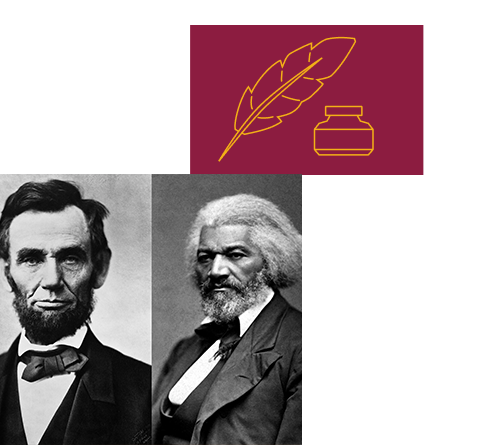

Frederick Douglass’s journey from enslavement to freedom was an act of profound self-reliance and courage. His escape was not only a personal triumph but also a powerful statement about the right to liberty and justice for all.
Justice as a Civic Virtue
Grounded in History
As you watch, pay attention to how Frederick Douglass and Abraham Lincoln link justice to disciplined self-reliance, education, and responsibility under law. Notice how each turns to the Declaration and the Constitution as enduring standards, urging the nation to replace passion and prejudice with reasoned judgment and to extend liberty in practice as well as principle.
Concept, Illustration, Moral Tension
Focus on how Frederick Douglass’ determination to learn to read reveals the deep link between justice, education, and self-reliance. Consider the moral tension at the heart of slavery, which sought not only to control the body but to suppress the mind, and reflect on how literacy became an act of resistance grounded in reason and human dignity.
Frederick Douglass realized that slavery was not only about physical bondage but also about controlling minds. Justice, for Douglass, meant the freedom to learn and think independently, which he viewed as essential for self-reliance and moral responsibility.
He believed that intellectual freedom was a cornerstone of justice, allowing individuals to make informed decisions and contribute meaningfully to society. This understanding shaped his lifelong fight against oppression and inequality.
Despite orders from his enslaver forbidding further instruction, Frederick Douglass pursued literacy with determination and resourcefulness. He bartered bread for lessons from neighborhood boys and seized every opportunity to strengthen his reading and reasoning, recognizing that education was the pathway out of bondage.
Around 1831, Douglass purchased The Columbian Orator, a widely used reader filled with speeches on liberty, moral courage, and natural rights. Through its dialogues and arguments, he encountered the language of reason and justice that would shape his lifelong critique of slavery. His struggle to read became more than personal advancement; it was an act of disciplined self-reliance that exposed slavery as a system built on ignorance and injustice.
For Frederick Douglass, the injustice of slavery lay not only in forced labor but in the deliberate suppression of literacy and reason. To forbid education was to deny self-rule, to cripple the mind in order to secure control over the body. Douglass recognized that ignorance was not incidental to slavery; it was one of its chief tools.
This denial exposed a sharp contradiction between America’s founding claim that all are created equal and the lived reality of human bondage. Douglass argued that education was essential to self-reliance, moral judgment, and participation in civic life. Justice, therefore, required more than emancipation from chains; it required equal opportunity to cultivate the mind and exercise the rights promised in the nation’s founding principles.
Beliefs, Behavior, Consequences
Consider how Abraham Lincoln and Frederick Douglass’ beliefs about justice shaped their actions and the consequences for the nation. Reflect on the tension between ideals and political realities.
Beliefs
Both Frederick Douglass and Abraham Lincoln grounded justice in the principles of natural equality, consent, and the disciplined use of reason. Each, largely self-educated, believed that access to learning and the cultivation of judgment were essential to self-reliance and to meaningful participation in self-government.
For Douglass and Lincoln, justice required both personal and civic responsibility. Individuals had to exercise reason over passion and develop habits of work, study, and integrity; at the same time, the nation had to align its laws with the Declaration’s promise that all are created equal. A just society, in their view, depended on citizens and leaders who combined moral courage with fidelity to constitutional principle.
Behavior
Frederick Douglass and Abraham Lincoln embodied justice through disciplined public action shaped by education, reason, and law. Douglass’s speeches, from his Fourth of July address to “Self-Made Men,” insisted that literacy, self-reliance, and equal rights were essential to liberty. He argued that slavery was sustained by ignorance and that justice required removing barriers to learning, work, and political participation.
Lincoln, in turn, appealed consistently to the Declaration of Independence as a moral standard. In speeches from Peoria to Cooper Union, he argued that slavery violated the principles of consent and natural equality, and that the nation must restrain passion through constitutional reason. His leadership during the Civil War, culminating in emancipation and support for constitutional amendments, reflected his conviction that justice required both fidelity to law and steady expansion of liberty.
Consequences
The efforts of Douglass and Lincoln had profound consequences for the nation. Their work exposed the hypocrisy of a country that claimed to value liberty while denying it to many of its citizens.
By challenging these injustices, they fueled the abolitionist movement and influenced policies aimed at extending liberty and justice to all. Their legacy continues to inspire efforts toward equality and social progress.
Check Your Understanding
How did Frederick Douglass and Abraham Lincoln view the pursuit of justice?
Concluding Module 12
Rethinking the Pursuit of Happiness
In this module, we saw how Frederick Douglass and Abraham Lincoln embodied justice as a civic virtue rooted in disciplined self-reliance, educated reason, and fidelity to law. Each called the nation back to the Declaration’s promise of equality, insisting that liberty required both moral responsibility and equal opportunity, especially access to learning and participation in self-government.
Their work led to emancipation, constitutional amendment, and expanded civil rights. Yet resistance, prejudice, and violence revealed how fragile justice could be when passion displaced reason. Justice thus emerges not as an abstract ideal but as a practiced habit of aligning law, character, and national purpose with the enduring standard that all are created equal.
Key Takeaways
- Justice demands disciplined courage and commitment to equality, requiring individuals and leaders to subordinate passion and prejudice to reason and law.
- Frederick Douglass and Abraham Lincoln linked justice to self-reliance, education, and the cultivation of judgment as foundations for responsible citizenship.
- Both Douglass and Lincoln appealed to the Declaration of Independence and the Constitution as enduring touchstones, challenging the nation to align its laws and practices with the principle that all are created equal.
- Progress toward justice proved gradual and contested, as prejudice, violence, and political resistance tested constitutional commitments.
- The pursuit of happiness, understood as moral alignment with natural rights and equal liberty, requires ongoing civic effort and the steady practice of virtue.
Food For Thought
- How can we practice justice as a civic virtue in today’s society?
- What obstacles to justice persist, and how might they be addressed?
- In what ways does education continue to play a role in achieving equality?
Optional Reading
- Jeffrey Rosen, The Pursuit of Happiness, Chapter 11
- Frederick Douglass, What to the Slave Is the Fourth of July? (opens in a new tab)
- Frederick Douglass, The Constitution: Is It Pro-Slavery or Anti-Slavery? (opens in a new tab)
- Frederick Douglass, A Plea for Free Speech in Boston (opens in a new tab)
- Frederick Douglass, The Self-Made Men (opens in a new tab)
- Abraham Lincoln, Speech to the Young Men’s Lyceum of Springfield (opens in a new tab)
- Abraham Lincon, The Cooper Union Speech (opens in a new tab)
- Abraham Lincoln, The Emancipation Proclamation (opens in a new tab)
- Abraham Lincoln, The Gettysburg Address (opens in a new tab)
Created in partnership with Arizona State University.