



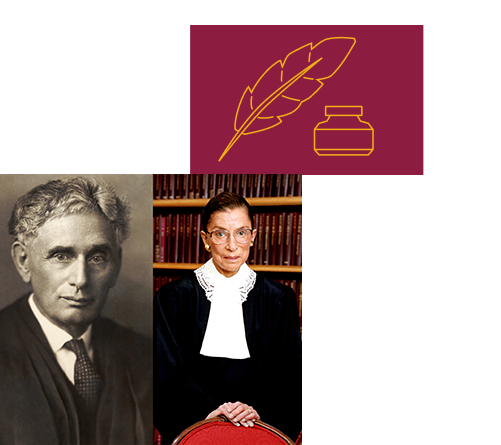

Justice Louis Brandeis emphasized silence as essential for intellectual growth, allowing space for reflection and thoughtful deliberation. Silence, for Brandeis, created the conditions favorable to developing one’s faculties, protecting the inner freedom necessary for reflection, learning, and the thoughtful exercise of liberty central to the pursuit of happiness.
Thoughtful Restraint in the Pursuit of Happiness
Grounded in History
This video examines the virtue of silence through the jurisprudence of Louis Brandeis and the disciplined practice of Ruth Bader Ginsburg. As you watch, notice how silence functions as a deliberate pause that cools passion, sharpens judgment, and prepares speech grounded in reason. Consider how silence and public discussion work together, with restraint serving not as withdrawal but as preparation for responsible civic engagement.
Silence as Intellectual, Moral, and Spiritual Discipline
Let's explore the multifaceted concept of silence as understood by the Founders and Justices Brandeis and Ginsburg. As you open each accordion below, focus on how silence relates to intellectual, moral, and spiritual development, and consider the tensions it holds within public and private life.
Thomas Jefferson’s practical rule to count to ten when angry, and to one hundred when very angry, embodies this discipline. Silence in this sense is active self-government, a habit that tempers emotion and clarifies judgment.
Silence protects the inner life by creating space for reflection and the development of the faculties. Echoing classical disciplines admired by the Founders, including Pythagorean habits of order and restraint, silence allows reason to examine thought, moderate passion, and cultivate reverence for the work of self-government. It is less withdrawal than preparation, a deliberate stillness that strengthens the moral and intellectual capacities on which liberty depends.
Silence, rightly understood, does not eliminate the duty of public discussion; it prepares it. The moral challenge lies in discerning when to pause and refine judgment and when to speak with clarity and courage. Louis Brandeis and Ruth Bader Ginsburg modeled this balance, pairing deliberate restraint with principled speech so that reason, not impulse, guided their public service.
Silence as a Discipline of Self-Control
Explore these cards on silence as a practical discipline for managing emotions and impulses. Pay attention to how Founders like Jefferson and Franklin recommended specific habits to cultivate self-restraint and thoughtful speec
The Tension Between Speech and Silence
Look at the two tabs below to examine the moral tension between when to speak out and when to practice silence. Consider how silence can be both a virtue and a challenge in public and private life, as reflected in the examples of Justices Brandeis and Ginsburg.
Speaking out, when disciplined by reflection, can be an act of courage and justice. Ruth Bader Ginsburg exemplified this balance, pairing careful deliberation with clear, principled opinions that advanced equality under law. Her willingness to dissent when necessary, and to speak with precision rather than heat, demonstrated that responsible speech grows out of thoughtful silence and fidelity to constitutional principle.
Speaking out, when disciplined by reflection, can be an act of courage and justice. Ruth Bader Ginsburg exemplified this balance, pairing careful deliberation with clear, principled opinions that advanced equality under law. Her willingness to dissent when necessary, and to speak with precision rather than heat, demonstrated that responsible speech grows out of thoughtful silence and fidelity to constitutional principle.
Check Your Understanding
Which of the following best describes the Founders’ understanding of the virtue of silence?
Concluding Module 13
Rethinking the Pursuit of Happiness
In this module, you examined silence as a civic discipline that places deliberation over impulse and protects the development of the faculties of reason, judgment, and self-control. Through the examples of Louis Brandeis and Ruth Bader Ginsburg, you saw how deliberate pause, careful drafting, and measured speech strengthened clarity of thought and principled decision-making in public life.
You also considered how silence and public discussion work together, with restraint preparing responsible expression. Applied to contemporary challenges of speed and distraction, this virtue reminds us that self-government begins with governing our own minds and words.
Key Takeaways
- Silence is a deliberate habit that gives space for reflection and steadies the mind before action.
- The virtue of silence involves discernment, recognizing when pause strengthens judgment and when clear, courageous speech serves the public good.
- For the Founders and jurists such as Louis Brandeis and Ruth Bader Ginsburg, silence safeguarded reason and conscience, enabling thoughtful participation in civic life.
- Practicing restraint tempers emotion and elevates public discussion from reaction to deliberation.
- Applied today, intentional pause and careful communication reinforce habits of character essential to sustaining a self-governing people.
Food For Thought
- How might cultivating deliberate pause before speaking, posting, or deciding improve your clarity of judgment and strengthen your relationships?
- When does restraint allow reason to cool passion, and when does principled speech become a civic duty that silence would fail to meet?
- How can the Founders’ emphasis on deliberation over impulse guide your habits in digital spaces, encouraging slower thought, careful reading, and more responsible public discussion?
Optional Reading
- Jeffrey Rosen, The Pursuit of Happiness, Chapter 12
- Justice Brandeis's concurrence in Whitney v. California
Created in partnership with Arizona State University.