
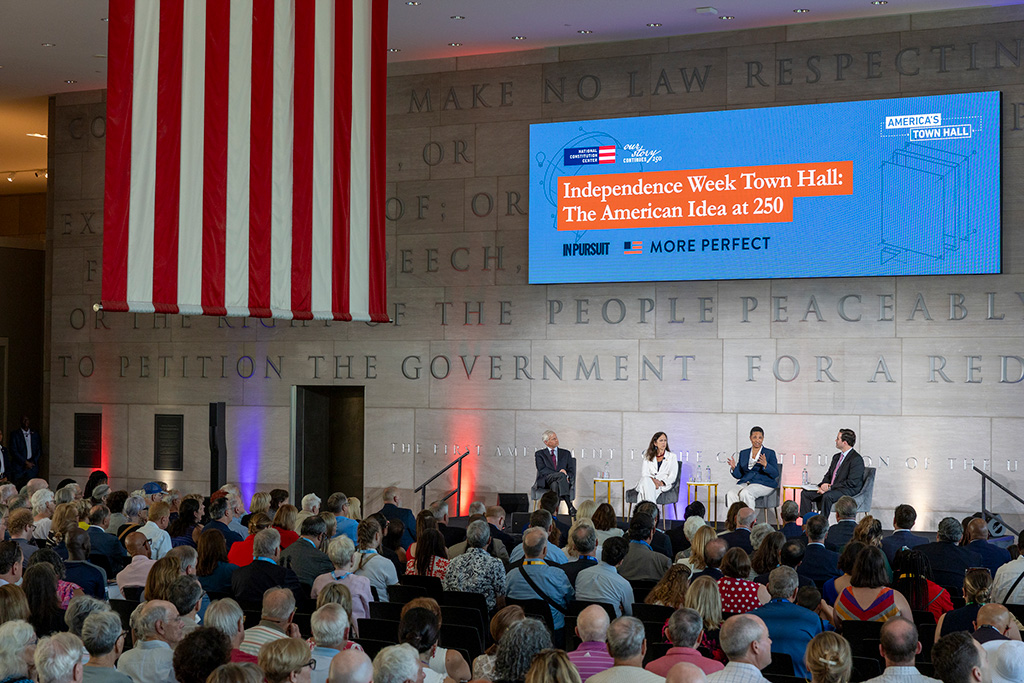



At the National Constitution Center, we value civil dialogue, which empowers students to speak about constitutional and historical topics in ways that remain civil, respectful, and reflective. As you prepare to discuss these topics in your classroom, we encourage you to establish norms such as:
- Stay calm
- Listen patiently
- Listen actively
- Don’t speak twice until everybody has spoken once
You can find more support for establishing norms and civil dialogue practices in our Civil Dialogue Toolkit.
Media Asset
National Constitution Center’s Constitution Daily Blog – The Supreme Court’s Callais decision sets new framework for racial gerrymandering, by Scott Bomboy
Big Constitutional Question
When does drawing congressional districts to comply with the Voting Rights Act cross the line into unconstitutional racial gerrymandering?
Headline Story
On Wednesday, April 28, 2026, a divided Supreme Court narrowed the ability of states to use race as a determining factor in creating election districts, in a decision with potentially wide-ranging implications.
The decision in Louisiana v. Callais focused on Section 2 of the Voting Rights Act (or VRA), a landmark achievement of the Civil Rights Movement. Section 2 prohibits voter discrimination on the basis of race, color, or membership in language minority groups.
On October 15, 2025, the Court heard arguments in Callais about the constitutionality of a Louisiana redistricting map. In 2022, Louisiana redrew its congressional districts, but a federal court in Robinson v. Ardoin ruled that the new map likely violated the Voting Rights Act because it did not include an additional majority-Black district. But when Louisiana drew a new map, SB8, that contained such a district, the new map was challenged as a racial gerrymander, which can be defined as the drawing of electoral district boundaries predominantly based on race.
In Callais, the justices weighed whether Louisiana’s intentional creation of the second majority-minority congressional district in SB8 violated the 14th or 15th Amendments to the U.S. Constitution.
Amendment / Clause Focus
- 14th Amendment, Section I: Equal Protection
- 15th Amendment: Right to Vote Note Denied by Race
Scholar Perspectives
Scholar
Key Ideas & Quote
Why It Matters
Justice Samuel Alito
U.S. Supreme Court
Majority Opinion in the case, Louisiana v. Calais (2026)
“Because the Voting Rights Act did not require Louisiana to create an additional majority-minority district, no compelling interest justified the State’s use of race in creating SB8, and that map is an unconstitutional racial gerrymander... Louisiana’s enactment of SB8 triggered strict scrutiny because the State’s underlying goal was racial.”
This excerpt from Justice Alito’s majority opinion helps explain the core constitutional holding of the case and the reasoning of the Court as to why Louisiana's redistricting map was unconstitutional. Since the Court ruled that race predominated Louisiana’s decision to draw the additional majority-minority district, the map needed to pass strict scrutiny and show a compelling government interest as to why the maps were drawn that way.
Justice Elena Kagan
U.S. Supreme Court
Dissenting Opinion in the case, Louisiana v. Calais (2026)
“Under the Court’s new view of Section 2 [of the VRA], a State can, without legal consequence, systematically dilute minority citizens’ voting power... [T]he Court’s decision will set back the foundational right Congress granted of racial equality in electoral opportunity.”
Justice Kagan’s dissent directly challenges the majority’s approach and highlight—what she argues will be—the practical implications of the majority’s ruling. In her view, the Callais ruling will set back a “foundational right” to “racial equality in electoral opportunity.”
Primary Source Spotlights
- Voting Rights Act of 1965 (Section 2)
Download Think, Talk, Create PDF
Student Questions
- According to Louisiana v. Callais (2026), what kinds of evidence (such as a district shape, legislative intent, or demographic data) can courts examine to determine whether a redistricting map is unconstitutional?
- What is the relationship between the Equal Protection Clause of the 14th Amendment and Section 2 of the Voting Rights Act? What potential tension(s) does the majority highlight in Callais? How does the Court’s framework as outlined in the majority opinion attempt to resolve that conflict? Is it persuasive?
- What is one key difference between the majority opinion and Justice Kagan’s dissent in how they interpret the protections of the Voting Rights Act and the requirements of the Constitution?
Student Choice Option
- Create a comparison chart that shows the differences in reasoning behind the majority opinion and dissent in the Louisiana v. Callais (2026). This can be done by creating a chart with three columns:
- The issue(s)
- Majority’s position
- Dissent’s position
For each issue, clearly identify the positions by using direct quotes or 1-2 summaries from the blog post.
- Below is a list of key statements from the case – but they are out of order! Put the steps in the correct chronological order to show the Court’s line of reasoning in the decision for Louisiana v. Callais (2026). When you complete the order, provide an example for each step, explain how this line of reasoning connects to the majority decision in the case, and, if relevant, note a key critique by the dissent.
- Race was a predominant factor
- Strict scrutiny applies
- No compelling interest was proven
- The Voting Rights Act did not require the new majority-minority district
- The map is unconstitutional
- Use the Scope of Agreement protocol to assess the degree to which you agree with arguments in the majority opinion and in the dissent.
- Note to teacher: You can use this protocol as a foundation for civil dialogue on the topic after they complete the worksheet.
Beyond the Headlines
- Interactive Constitution
- 14th Amendment, Section I: Equal Protection
- 15th Amendment: Right to Vote Note Denied by Race
- Voting Rights Act of 1965
- We the People podcast: Supreme Court Strikes Down Louisiana Congressional Map
- Select Supreme Court Cases About Voting Right
- Supreme Court Cases Library: Shelby County v. Holder (2013)
- Thornburg v. Gingles (1986)
- Robinson v. Ardoin (2023)
- Shaw v. Reno (1993)