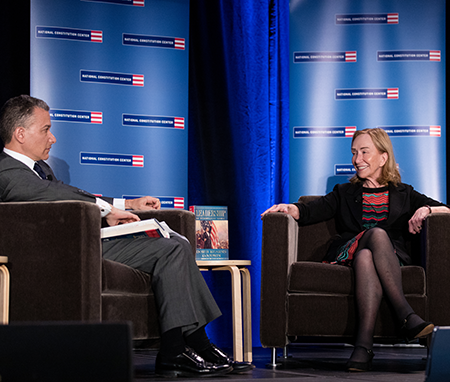

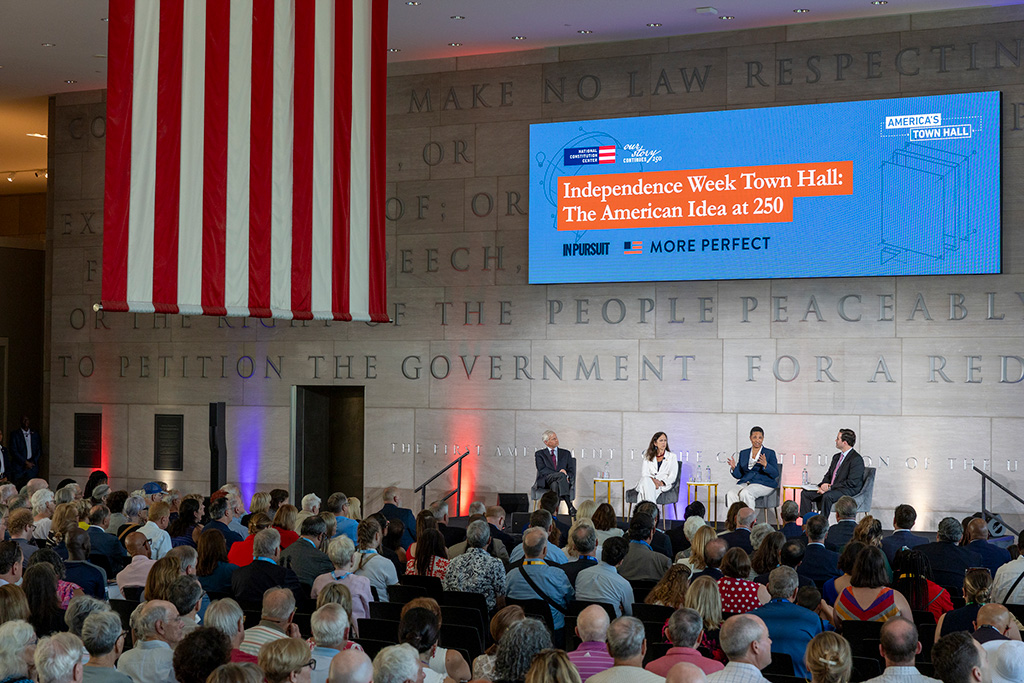


In this episode, Jonathan Adler of William & Mary Law School and Stephen Vladeck of Georgetown University Law Center explore a part of the Supreme Court’s work that has drawn growing public attention: its emergency, or “shadow,” docket. Julie Silverbrook, chief content and learning officer at the National Constitution Center, moderates.
Follow We the People, Live at the National Constitution Center, and Civic Parenting on Apple Podcasts, Spotify, or your favorite podcast app.
This episode was produced and mixed by Bill Pollock. With production support from Charles Sahm. Research was provided by Anna Salvatore, Trey Sullivan, and Tristan Worsham.
Participants
Jonathan Adler is Cabell Research Professor and Tazewell Taylor Professor of Law at William & Mary Law School. He is the author or editor of seven books, including Business and the Roberts Court. He is a regular contributor to the legal blog, The Volokh Conspiracy. He is a regular commentator on constitutional and regulatory issues, appearing on numerous radio and television programs, ranging from the PBS NewsHour and National Public Radio to the Fox News Channel and Entertainment Tonight.
Stephen Vladeck is Agnes Williams Sesquicentennial Professor of Federal Courts at Georgetown University Law Center. He has argued before the Supreme Court and serves as CNN’s Supreme Court analyst and as editor and author of One First, a weekly newsletter about the Supreme Court. Vladeck is the author of the New York Times bestselling book, The Shadow Docket: How the Supreme Court Uses Stealth Rulings to Amass Power and Undermine the Republic.
Julie Silverbrook is chief content and learning officer at the National Constitution Center, where she leads the strategy, development, and delivery of the Center’s content, public programs, and educational initiatives, advancing its mission of nonpartisan constitutional education and civil dialogue. She oversees the creation of public-facing constitutional content and works to ensure the Center’s programs, scholarly engagement, and educational resources operate as a coordinated national strategy serving students, educators, families, and lifelong learners across the country.
Additional Resources
- Jonathan Adler, “Reading the Clean Power Plan "Shadow Papers" in Context,” The Volokh Conspiracy (April 22, 2026)
- Jonathan Adler, “Mifepristone Returns to the Shadow Docket,” The Volokh Conspiracy (May 3, 2026)
- Stephen Vladeck, The Shadow Docket: How the Supreme Court Uses Stealth Rulings to Amass Power and Undermine the Republic (2024)
- Stephen Vladeck, “Chief Justice Roberts and the Clean Power Plan,” OneFirst (April 20, 2026)
- City of Los Angeles v. Lyons (1983)
- Massachusetts v. EPA (2007)
- Winter v. NRDC (2008)
- West Virginia v. EPA (2016)
- Biden v. Texas (2022)
- United States v. Texas (2023)
- FDA v. Alliance for Hippocratic Medicine (2024)
- Trump v. CASA (2024)
- NIH v. American Public Health Association (2025)
Excerpt from interview: Jonathan Adler argues that the prevalence of the so-called “shadow docket” is due to factors outside of the Supreme Court
Jonathan Adler: The Supreme Court, more so than the other branches, is a reactive institution. It responds to things that are filed by litigants. It responds to things that are going on or that have occurred in the lower Courts or that occur elsewhere in the legal system. And so what I think we see in the rise of what we refer to as the shadow docket, or the part of the shadow docket that has prompted so much attention and concern, is a reflection of what's going on more broadly. That is to say, Congress is less active at legislating, less aggressive or proactive in defending its own institutional prerogatives, less involved in revisiting and monitoring the enforcement and application of the statutes it enacts, and the executive branch filling that vacuum.
Excerpt from interview: Stephen Vladeck outlines his concerns with the Roberts Court's use of the "shadow docket."
Stephen Vladeck: Where I really start getting exasperated and concerned is that the Court is intervening so much more often than ever before, Julie, not just in a quantitative sense, but in a way in which it's not usually explaining itself. Very, very few of these decisions come with opinions of the Court. Some of them are completely unexplained other than a boilerplate order.
But also, Julie, now we have this added phenomenon of the Court expecting lower Courts to divine the tea leaves of unsigned, unexplained orders and going so far, as Justice Gorsuch did last August in the NIH case, of accusing lower Court judges of defying the Supreme Court for not properly reading between the lines. And so it seems to me that you can think that the Supreme Court is justified in intervening in these cases, many, all, some of them. But the way that the Court, I think, could dispel the charge that it's doing so and playing partisan political favorites in the process, is if it were providing coherent applications of neutral legal principles that were then accessible to lower Courts, to people like Jonathan and me and you. Right? Like, where we could actually talk about do we think the Court is following these principles correctly versus which principles do we think the Court was relying upon in this ruling? And so I think a big part of where we are right now is not the existence of the emergency docket. It's not the volume. It's that the Court is using it so often in cases with such dramatic consequences and so seldom telling us why.
Full Transcript
View Transcript (PDF)
This transcript may not be in its final form, accuracy may vary, and it may be updated or revised in the future.
Stay Connected and Learn More
- Questions or comments about the show? Email us at [email protected]
- Continue the conversation by following us on social media @ConstitutionCtr
- Explore the America at 250 Civic Toolkit
- Sign up to receive Constitution Weekly, our email roundup of constitutional news and debate
- Subscribe, rate, and review wherever you listen
- Join us for an upcoming live program or watch recordings on YouTube
- Support our important work