


It is rare for U.S. Supreme Court justices to be remembered for their writing style. “A page of history is worth a volume of logic.” “To have doubted one’s own first principles, is the mark of a civilized man.” “Eloquence may set fire to reason.” These are just a few of the aphorisms that have enshrined Oliver Wendell Holmes Jr. in the American constitutional canon. Quotability is influence, and Justice Holmes’ pithy, succinct writing continues to make its way into legal opinions long after his death. Yet beyond the rhetorical flash for which Justice Holmes is often remembered lies legal substance. From his legal realism to the “marketplace of ideas,” Justice Holmes left a lasting imprint on our law.
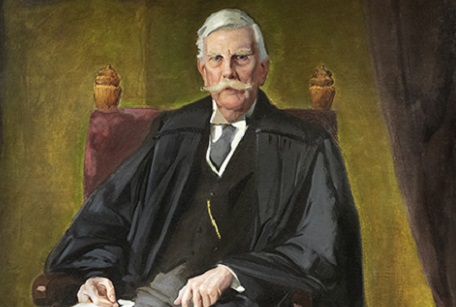 Oliver Wendell Holmes Jr. was born in Boston on March 8, 1841. His father, Holmes Sr., was famous throughout America and Europe for his poetry and medical prowess. Young “Wendell,” as Holmes Jr. was then known, grew up in the shadow of his celebrated father, fueling a lifelong rivalry between them. Navigating these paternal tensions, Holmes grew up as a member of Boston’s elite, learning history, mathematics, Greek, and Latin at a small private school run by Epes Dixwell, a family friend. Like so many of Boston’s young patricians, Holmes found himself at Harvard before long, matriculating in the fall of 1857.
In April 1861, the Civil War began when Confederate forces from South Carolina, the first state to secede from the Union, attacked the small Union garrison at Fort Sumter. Holmes was in his senior year at Harvard. Motivated by abolitionist sympathies and a strong sense of martial honor, Holmes left for Fort Independence to enlist in the Army. After briefly returning to Harvard to take his final exams and claim his degree, the young Holmes headed south as a lieutenant in the recently formed 20th Regiment.
Holmes was lucky to survive the Civil War. During his military service Holmes was shot in his stomach, chest, neck, and foot. The two musket balls lodged in his chest at the Battle of Ball’s Bluff were only a few inches from his heart and lungs. Each injury was life-threatening and required him to briefly travel home to recover before returning to the war. He went home for good in 1864, beleaguered and undoubtedly traumatized. As biographer Gary J. Achele notes, after the war, “[n]othing ever seemed quite right again” to Holmes. He was haunted by the “faces of his fallen comrades,” and attempted to “justify his life by achieving some great success.”
Before His Supreme Court Tenure
Holmes enrolled in Harvard Law School in the fall of 1864. In those days, legal education consisted largely of reading major treatises such as William Blackstone’s Commentaries and absorbing mountains of case law. As was not uncommon, Holmes left Harvard after two years to clerk for Robert Morse, a well-respected lawyer.
After passing the bar in March 1867, Holmes devoted much of his time to his law practice but remained strongly drawn to scholarship. Holmes seized the chance to become coeditor of the American Law Review, publishing six essays and around 60 notes over his three-year tenure. His first groundbreaking intellectual work came in 1880 when he was asked to deliver the Lowell Lectures, which he famously published under the title The Common Law. In analyzing the history of the common law, Holmes began to develop a philosophy of law often referred to as “legal realism”: the idea that law is shaped as much by how it operates in practice as by statutes and formal legal rules. In Holmes’ words, “[t]he felt necessities of the time … have a good deal more to do than the syllogism in determining the rules by which men should be governed.”
The Common Law earned Holmes a reputation as a legal scholar. He briefly accepted a post as a professor at Harvard Law School before being appointed to the Massachusetts Supreme Judicial Court in 1882. Alongside his judicial duties, Holmes continued to publish articles and speeches. Perhaps the most important of these came in 1897 in a dedication address at Boston University School of Law entitled The Path of the Law. In the speech, Holmes asked his audience to consider law from the perspective of a hypothetical “bad man.” “If you want to know the law and nothing else,” Holmes argued, “you must look at it as a bad man, who cares only for the material consequences which such knowledge enables him to predict.” This thought experiment was meant to dispel the “confusion between morality and law,” and offer to lawyers the ability to see the law as mere “prophecies of what the courts will do in fact.”
In 1899, Holmes succeeded Walbridge A. Field as chief justice of the Massachusetts Supreme Judicial Court. Holmes had been slowly increasing his workload, and, by this point, he was a seasoned jurist. His time in the post did not last long, however, as he was soon considered for a seat on the U.S. Supreme Court.
Holmes on the Supreme Court
In June 1902, Justice Horace Gray announced his plan to retire. Gray had himself served on the Massachusetts court where Holmes was then serving as chief justice. Holmes was recommended to President Theodore Roosevelt by Sen. Henry Cabot Lodge, who wrote to the president that “he is our kind right through.” It took a meeting between Holmes and Roosevelt at Oyster Bay to seal the deal. Oliver Wendell Holmes Jr. took the oath of office to join the Supreme Court in December of 1902.
In the 1905 Supreme Court case, Lochner v. New York, the Court invalidated a state law limiting work hours for bakers. The majority relied on “liberty of contract,” the right of an individual to freely sell his or her labor. In one of the most famous dissents in the Court’s history, Justice Holmes argued for judicial restraint and claimed the majority had read their own economic views into the Constitution. To Justice Holmes, his own “agreement or disagreement” with a given opinion “has nothing to do with the right of a majority to embody their opinions in law.” The Constitution, argued Justice Holmes, is not “intended to embody a particular economic theory” but is rather “made for a people of fundamentally differing views.”
During World War I, the Court upheld three convictions for anti-war speech under the 1917 Espionage Act. Justice Holmes wrote all three majority opinions, reasoning in Schenck v. United States that such speech presented a “clear and present danger” of obstructing military recruitment. Yet when a similar question was soon presented in Abrams v. United States, this time involving communist anti-war leaflets, Holmes did something remarkable: He changed his mind. As historian Thomas Healy has uncovered, through conversations with up-and-coming scholars Harold Laski and Felix Frankfurter, Holmes reconsidered his position, reimagining First Amendment jurisprudence in the process.
Justice Holmes’ Abrams dissent provided a powerful rationale for robust free speech protections based on the marketplace of ideas. “[W]hen men have realized that time has upset many fighting faiths,” wrote Justice Holmes, “they may come to believe … that the ultimate good desired is better reached by free trade in ideas.” The “best test of truth” does not come from government intervention but the “power of the thought to get itself accepted in the competition of the market.” In the estimation of Robert Post, Justice Holmes’s opinion “virtually invents First Amendment doctrine.”
The darkest blot on Justice Holmes’s legacy came in 1927 with the case Buck v. Bell. Justice Holmes wrote the majority opinion upholding a Virginia law allowing forced sterilization in mental health institutions. The decision is indefensible, even as a product of its time. As Victoria Nourse notes, by 1927 the “intellectual heyday” of eugenics had already passed, and multiple lower courts had rejected “eugenic sterilization.” The Justice’s opinion is, quite simply, lawless, motivated by prejudice rather than constitutional principle. It is hard to ever fully separate the rest of his life and career from the tragedy of Buck v. Bell.
Oliver Wendell Holmes Jr. retired from the Court in 1932, stating in his brief letter of resignation that “the time has come and I bow to the inevitable … My last word should be one of grateful thanks.” He passed away three years later. Scholarly interest in Holmes has hardly waned in the near century since his death. Once almost universally venerated, Holmes has been endlessly debated—labelled arrogant, heroic, nihilistic, and genius. In the words of G. Edward White, Holmes has been “all things to all commentators.” A flawed man who attempted to vindicate his survival of war by making something of his life, Holmes unquestionably succeeded in leaving his mark.
Tristan Worsham is a National Constitution Center content fellow and a graduate of the University of California, Berkeley.
References:
Abrams v. United States, 250 U.S. 616 (1919)
Gary J. Achele, Oliver Wendell Holmes, Jr. (Twayne Publishers, 1989).
Buck v. Bell, 274 U.S. 200 (1927)
Thomas Healy, The Great Dissent: How Oliver Wendell Holmes Changed His Mind—and Changed the History of Free Speech in America (Metropolitan Books, 2013)
Oliver Wendell Holmes Jr., The Common Law (Little, Brown, and Company, 1881).
Oliver Wendell Holmes Jr., “The Path of the Law,” Harvard Law Review 10, no. 8 (1897): 457-478.
Lochner v. New York, 198 U.S. 45 (1905)
David Luban, “The Bad Man and the Good Lawyer: A Centennial Essay on Holmes's The Path of the Law,” New York University Law Review 72 (1997): 1647-1543.
Victoria Nourse, “Buck v. Bell: A Constitutional Tragedy from a Lost World,” Pepperdine Law Review 39 (2011): 101-117.
Robert Post, “Writing the Dissent in Abrams,” Seton Hall Law Review 51 (2020): 21-39.
Schenck v. United States, 249 U.S. 47 (1919)
Edward White, “Looking at Holmes in the Mirror,” Law and History Review 4, no. 2 (1986): 439-465.