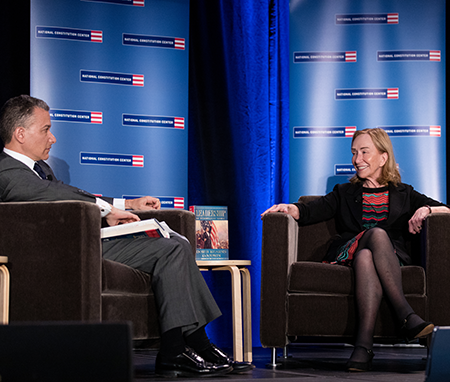



On April 29, 2026, in Louisiana v. Callais, the Supreme Court invalidated a Louisiana congressional map, holding that racial considerations cannot predominate in the drawing of electoral districts. The ruling narrowed Section 2 of the Voting Rights Act of 1965 by requiring plaintiffs to show intentional discrimination, not just discriminatory effects. In this episode, we explore the Court’s 6-3 decision and what it means for the future of the Voting Rights Act with two leading election law scholars: Edward Foley of The Ohio State University and Michael Morley of Florida State University College of Law. Julie Silverbrook, chief content and learning officer at the National Constitution Center, moderates.
Follow We the People, Live at the National Constitution Center, and Civic Parenting on Apple Podcasts, Spotify, or your favorite podcast app.
This episode was produced and mixed by Bill Pollock. With production support from Charles Sahm. Research was provided by Anna Salvatore, Trey Sullivan, and Tristan Worsham.
Participants
Edward B. Foley holds the Ebersold Chair in Constitutional Law at The Ohio State University, where he directs its election law program, and is widely recognized as one of the foremost experts on election law. He is also currently a visiting professor at the University of Arizona. During the 2024–25 academic year, he was a Crane Fellow in Law and Public Policy at Princeton University, and in 2023 received a Guggenheim Fellowship.
Michael T. Morley is the Sheila M. McDevitt Professor of Law and faculty director of the Election Law Center at Florida State University College of Law. He teaches and writes in election law, constitutional law, remedies, and the federal courts. Morley’s research focuses on election emergencies, the constitutional right to vote, and the Electoral Count Act, as well as equitable powers of the federal courts.
Julie Silverbrook is chief content and learning officer at the National Constitution Center, where she leads the strategy, development, and delivery of the Center’s content, public programs, and educational initiatives, advancing its mission of nonpartisan constitutional education and civil dialogue. She oversees the creation of public-facing constitutional content and works to ensure the Center’s programs, scholarly engagement, and educational resources operate as a coordinated national strategy serving students, educators, families, and lifelong learners across the country.
Additional Resources
- Edward Foley, “The Supreme Court’s indefensible evisceration of the Voting Rights Act,” SCOTUSblog, May 5, 2026
- Michael Morley, “Voting Rights Case Sets Stage for 2050’s Multiracial Democracy,” Bloomberg Law, May 6, 2026
- Louisiana v. Callais (2026)
- Allen v. Milligan (2023)
- Robinson v. Ardoin (2022)
- Brnovich v. Democratic National Committee (2021)
- Shelby County v. Holder (2013)
- Thornburg v. Gingles (1986)
- Voting Rights Act (1965)
- National Constitution Center, “The Supreme Court’s Callais decision sets new framework for racial gerrymandering” (April 30, 2026)
- National Constitution Center, Voting Rights Classroom Resources
- National Constitution Center, Elections and Voting in the Constitution (Constitution 101 Curriculum)
Excerpt from interview: Edward Foley explains the reasoning behind the Court’s limitation of Section Two of the Voting Rights Act in Lousiana v. Callais.
Edward Foley: Ultimately, what Justice Alito says for the Court is that he's doing a reinterpretation of Section Two and what Section Two requires in order to avoid some of the constitutional problems that we were just talking about. So I think the... It's fair to say the main thrust of the majority opinion is a rewrite of the statute.
What Justice Alito does is essentially turn the statute inside out or upside down, or however you wanna say it, because he basically recreates an intent standard, even though the statute's a results test. Now, he says we don't quite require a complete proof of intentional discrimination or intentional vote dilution, but if you go through the entirety of the opinion and you see how he discusses what plaintiffs actually have to do to win a case, it's functionally become an intent standard all over again.
I think many listeners will know the canon of constitutional avoidance, which is you try to construe statutes to avoid a constitutional problem. And I think everybody believes that that's a good doctrine. The issue is, as the Court has often said, in fact, Justice Alito himself has said in prior cases, you can't use that canon to undo the statute completely. You can't change yes into no or up into down and changing results into intent, I think is accurate to say a rewrite of the statute instead of a genuine interpretation of it. So you can debate about whether this is a faithful application of the doctrine of avoidance.
Excerpt from interview: Michael Morley explains two common interpretations of the Reconstruction Amendments: “anti-discrimination” and “anti-subordination.” The shift toward the former “color-blind” approach is one of the major themes of the Roberts Court in voting rights cases and beyond.
Michael Morley: One of the big picture stories of the Roberts Court is that many of their rulings, not just with regard to voting rights, but even with regard to constitutional issues much more broadly, is a focus on one of the core disputes about the proper interpretation of the Fourteenth Amendment. Going back to Brown versus Board of Education, there's two very different interpretations that have arisen. On the one hand, you can read provisions like the Equal Protection Clause, like the Fifteenth Amendment from, what is often called in literature, from an anti-discrimination perspective, where the core evil that these provisions are aimed at is government's classification of people based on race, government taking race into account when making decisions, when taking actions.
On the other hand, there's what's often referred to as an anti-subordination interpretation where the point of these amendments isn't necessarily to prevent all consideration of race, but rather it's to prevent the government from establishing racial hierarchies, to prevent the government from perpetuating systems of white supremacy.
I think that big picture, one of the main themes of the Roberts Court is shifting the Court's analysis away from an anti-subordination interpretation of the Fourteenth and Fifteenth Amendments toward an anti-discrimination interpretation. Where we see this in the affirmative action cases, we see this here in Callais. I think it's certainly one of the underpinnings of Shelby County. I think that that's one of the main ideological and philosophical and constitutional underpinnings that links together what we're seeing across many of these otherwise disparate opinions.
Full Transcript
View Transcript (PDF)
This transcript may not be in its final form, accuracy may vary, and it may be updated or revised in the future.
Stay Connected and Learn More
- Questions or comments about the show? Email us at [email protected]
- Continue the conversation by following us on social media @ConstitutionCtr
- Explore the America at 250 Civic Toolkit
- Explore Pursuit: The Founders’ Guide to Happiness
- Sign up to receive Constitution Weekly, our email roundup of constitutional news and debate
- Subscribe, rate, and review wherever you listen
- Join us for an upcoming live program or watch recordings on YouTube
- Support our important work