

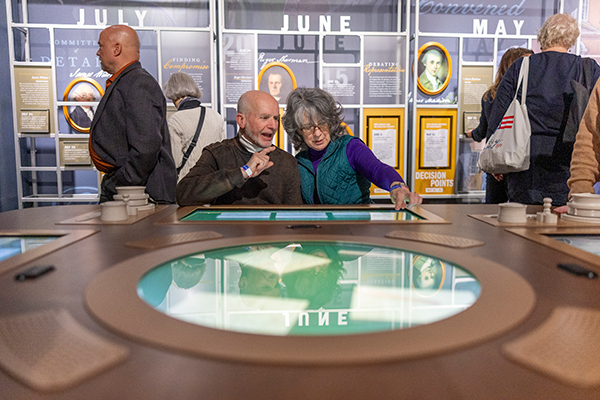

At the National Constitution Center, we value civil dialogue, which empowers students to speak about constitutional and historical topics in ways that remain civil, respectful, and reflective. As you prepare to discuss these topics in your classroom, we encourage you to establish norms such as:
- Stay calm
- Listen patiently
- Listen actively
- Don’t speak twice until everybody has spoken once
You can find more support for establishing norms and civil dialogue practices in our Civil Dialogue Toolkit.
Media Asset
Constitution Daily Blog Post: How the Supreme Court ruled on press censorship cases after World War II, by Scott Bomboy, editor in chief at the National Constitution Center
Big Constitutional Questions
How has the Supreme Court defined the scope of press freedom in the post-World War II era?
Headline Story
After World War II, new First Amendment cases reshaped the relationship between the press, the public, and the government. New York Times v. Sullivan (1964) created the actual malice standard, shielding journalists and anyone who speaks or writes about public officials from liability unless the statements were knowingly false or made with reckless disregard for the truth. Later decisions reaffirmed that robust debate, even sharp criticism involving some falsehood or exaggeration, was essential to democracy.
The Court also strengthened press protections in New York Times Co. v. United States (1971) (the “Pentagon Papers” case), rejecting government efforts to block publication of the Pentagon Papers, reaffirming the strong presumption against prior restraints expressed in Near v. Minnesota (1931). Other cases such as Branzburg v. Hayes (1972) on confidential sources and Hazelwood v. Kuhlmeier (1988) on student journalism tested how far those freedoms extend in different contexts.
Most recently, in National Rifle Association v. Vullo (2024), the Court unanimously ruled that officials cannot pressure private companies to punish or suppress disfavored viewpoints. That decision echoes current debates about government influence over media platforms and broadcasters.
Amendment / Clause Focus
- First Amendment
- Free speech, freedom of the press: protects the press from government interference.
- Actual malice standard for defamation/libel
- Brandenburg imminent lawless action test
- Presumption against prior restraint
Justices of the Court Perspectives
|
Scholar |
Key Ideas & Quote |
Why It Matters |
|
Justice William Brennan, Jr.
|
“A public official may not recover damages for a defamatory falsehood… unless he proves that the statement was made with ‘actual malice’ that is, with knowledge that it was false or with reckless disregard of whether it was false or not.”— New York Times v. Sullivan (1964) |
This case protects your right to criticize people in power. It means journalists and everyday citizens can challenge public officials without being silenced by fear of lawsuits, as long as they’re not spreading lies on purpose or recklessly. |
|
Justice Hugo Black (Concurring) |
“The Federal Constitution has dealt with this deadly danger to the press… by granting the press an absolute immunity for criticism of the way public officials do their public duty.” |
Justice Black believed free speech should be nearly unlimited when it comes to holding leaders accountable. Even reading robust free speech and press protections broadly, the Supreme Court has never gone this far. Even so, Black’s view invites you to think about how far freedom of the press should go and whether the Constitution permits any limits. |
Primary Source Spotlight (Embedded Excerpts)
First Amendment (1791): “Congress shall make no law...abridging the freedom of speech, or of the press...”
New York Times v. Sullivan (1964): the actual malice standard
Brandenburg v. Ohio (1969): imminent lawless action test
New York Times Co. V. United States (1971): presumption against prior restraints (Pentagon Papers)
Hazelwood School District v. Kuhlmeier (1988): set limits on free press in public schools
National Rifle Association v. Vullo (2024): “ (anti-jawboning)
Think, Talk, Create
Download Think, Talk, Create PDF
Student Questions
- What is the actual malice standard? How does this standard provide broad First Amendment protections of freedom of speech and press?
- Using a Supreme Court case example from the blog post, how would you describe the protections related to prior restraint in the post-World War II era?
- In Hazelwood School District v. Kuhlmeier (1988), Justice Byron White, in his majority opinion, wrote, “A school need not tolerate student speech that is inconsistent with its basic educational mission, even though the government could not censor similar speech outside the school.” In your own words, explain how public schools might be able to limit free speech and press for students in ways that the federal government cannot for ordinary Americans outside of the school context.
Student Choice Options
- Choose one of the Supreme Court cases mentioned in the blog post and create an infographic that highlights the justices on the Court and how they voted, quotes from the majority and any concurring or dissenting opinions, and provides graphics that help explain the case and its impact on free speech in the post-World War II era.
- Pulling together the court cases from the blog post about free press during WWI and the blog post about free press post-World War II, create a Venn diagram that compares free speech between the two time periods.
- Questions to consider: What were the major cases in each period? How did the cases in each period limit or expand free speech and press rights? Did any cases build on prior decisions? How do the decisions from these periods affect free speech today?
- To complete the Constitution in the Headlines First Amendment: Free Speech and Press series, have students engage in a fishbowl dialogue. Students are divided into two groups; one group will form the “fishbowl” in the center, while the other group sits around them. The center group participates in the discussion at hand, while the students in the audience take notes. After a set amount of time, the students switch and the new “fishbowl” discusses the essential question.
- Constitutional questions to consider:
- What does the Constitution say about free speech on the airwaves?
- What limits has the Supreme Court permitted on press freedoms in times of war? How do those decisions square (or not) with the twenty-first century approach to the First Amendment?
- How has the Supreme Court defined the scope of press freedom from libel and national-security censorship to student journalism and modern claims of government “coercion”?
- Constitutional questions to consider:
Beyond the Headlines
- We The People podcast: Can Government Officials Pressure Private Companies and Universities to Restrict Speech?
- First Amendment Gallery: Exhibit exploration and interactives
- Constitution 101
- Module 10, First Amendment (High School)
- Module 10, First Amendment (Middle School)
- Interactive Constitution
- Supreme Court Cases Library