

As students across the U.S. protest federal immigration policies, legal experts are re-evaluating the boundaries of student free speech established by judicial precedent.
 Thousands of students have taken part in protests at public schools in Florida, Pennsylvania, Virginia, Iowa, California, Arkansas, and Texas against U.S. Immigration and Customs Enforcement (ICE) enforcement actions. In some cases, students have faced suspensions for walking out of school. In others, their schools have collaborated with local law enforcement to allow peaceful off-campus protests with no suspensions.
News reports on these protests have frequently mentioned the constitutional rights of students who attend publicly funded schools. These rights are defined by two landmark Supreme Court cases from the mid-twentieth century.
Political free speech for some (but not all) students
Courts have held since the late 1960s that public secondary school officials can regulate student protests on campus that they view as disruptive. But not all protests can be regulated by schools, especially those that express “pure speech.”
First Amendment protections rarely extend to private schools. And even within the public system, a clear legal divide exists between the restricted rights of high schoolers and the broader liberties afforded to college students.
Unlike high schoolers, public university students enjoy the full speech protections afforded to adults. However, their right to protest is still subject to the standard "time, place, and manner" restrictions that apply to any public forum.
The foundational case for public secondary schools is Tinker v. Des Moines Independent Community School District (1969). In his 7-2 majority opinion, Justice Abe Fortas said, “First Amendment rights, applied in light of the special characteristics of the school environment, are available to teachers and students. It can hardly be argued that either students or teachers shed their constitutional rights to freedom of speech or expression at the schoolhouse gate.”
Fortas’s quote is central to any discussion of students’ speech rights in public schools. Since 1969, his ruling has been repeatedly cited by the Supreme Court when defining the boundaries of student expression.
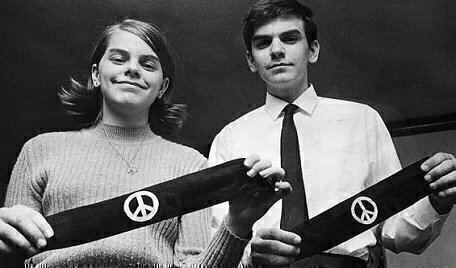
In December 1965, at the height of the Vietnam War, three students, including Mary Beth Tinker, a 13-year-old student at Warren Harding Junior High School in Des Moines, Iowa, wore black armbands to school to protest the war. They were all suspended.
Fortas said that students’ free speech rights didn’t extend to conduct that “materially disrupts classwork or involves substantial disorder or invasion of the rights of others.” But he also held that silent protests—such as wearing armbands—were constitutionally permitted. “Our problem involves direct, primary First Amendment rights akin to ‘pure speech.’ The school officials banned and sought to punish petitioners for a silent, passive expression of opinion, unaccompanied by any disorder or disturbance on the part of petitioners,” Fortas concluded.
The Tinker decision cited a famous Supreme Court decision from 1943, West Virginia v. Barnette, which allowed public school students to decline to pledge allegiance to the American flag on religious grounds. In his majority opinion, Justice Robert Jackson wrote that school officials had “important, delicate, and highly discretionary functions, but none that they may not perform within the limits of the Bill of Rights.”
In his dissent, Justice Hugo Black called the Barnette majority decision “the beginning of a new revolutionary era of permissiveness in this country fostered by the judiciary” if students could “defy and flout orders of school officials to keep their minds on their own schoolwork.”
Beyond Tinker and West Virginia v. Barnette
While Tinker and Barnette set the stage, later decisions have clarified how students' First Amendment rights apply to present-day challenges such as social media and student-led journalism.
In 1988, the Supreme Court decided in Hazelwood v. Kuhlmeier that public high school officials could censor a student-run newspaper's planned stories on divorce and teenage pregnancy. Writing for the majority, Justice Byron White said that “a school need not tolerate student speech that is inconsistent with its basic educational mission, even though the government could not censor similar speech outside the school.” In his dissent, Justice William Brennan concluded that the majority had ignored Tinker, and indeed, that its opinion “teach[es] youth to discount important principles of our government as mere platitudes.”
Two years earlier, the Court had determined that public school students cannot claim First Amendment protection for using vulgar language on school grounds. The Supreme Court ruled in Bethel School District v. Fraser (1986) that a student who used sexually explicit language at a school assembly wasn’t protected by the First Amendment. “Under the First Amendment, the use of an offensive form of expression may not be prohibited to adults making what the speaker considers a political point, but it does not follow that the same latitude must be permitted to children in a public school,” said Chief Justice Warren Burger in the majority decision.
The Supreme Court further narrowed student speech rights in 2007 with Morse v. Frederick, a case that tested whether schools could censor messages promoting illegal drug use. There, the justices considered a student who unfurled a 14-foot 'Bong Hits 4 Jesus' banner during a school-supervised event. After the principal confiscated the banner and suspended the student, a divided Court said that the First Amendment allows schools to prohibit speech that reasonably appears to promote illegal drug use.
In his majority opinion, Chief Justice John Roberts referenced Tinker, Hazelwood, and Bethel School District, concluding that “schools may take steps to safeguard those entrusted to their care from speech that can reasonably be regarded as encouraging illegal drug use.” Justice Clarence Thomas argued that Tinker should be overturned, while Justice John Paul Stevens wrote that punishing a student for a “nonsense banner” violated the First Amendment because it effectively punished the student “for expressing a view with which it [the school] disagreed.”
Recent cases and broader exceptions
In 2021, the Supreme Court considered whether schools can punish students for private, off-campus speech. In Mahanoy Area School District v. B.L., the justices held that a student’s off-campus Snapchat outburst did not warrant a suspension, even though it targeted a school-related activity like cheerleading.
In his 8-1 majority opinion, Justice Stephen Breyer said that schools have a substantial interest in regulating certain kinds of off-campus conduct. But In B.L.’s specific case, Breyer continued, her conduct did little “to suggest a substantial interference in, or disruption of, the school’s efforts to maintain cohesion on the school cheerleading squad.”
However, the Court made clear that there were some areas where school administrators could discipline students for their off-campus conduct, including “serious or severe bullying or harassment targeting particular individuals; threats aimed at teachers or other students.”
For high school students who have been walking out without their schools’ consent, legal experts disagree on the scope of their First Amendment protection. It’s clear under Tinker that schools can discipline students for leaving class without permission. But if administrators impose harsher-than-normal penalties because of the protest’s message, there could be serious ramifications.
In a recent blog post, Adam Goldstein from the Foundation for Individual Rights and Expression (FIRE) noted this basic constitutional concept: “If a school does choose to discipline a student for walking out to join a protest, it has to do it consistently with how it would punish any other student for cutting class. Punishing a student more harshly because they wanted to express their opinion would be viewpoint discrimination, which is never permissible under the First Amendment.”
Student’s free speech rights may soon be tested yet again in the courts. But as Freedom Forum noted last year, “While students’ free speech rights in school aren’t absolute, the Supreme Court consistently has reiterated that students are people under the Constitution and possess First Amendment rights.”
Scott Bomboy is the editor in chief of the National Constitution Center.