
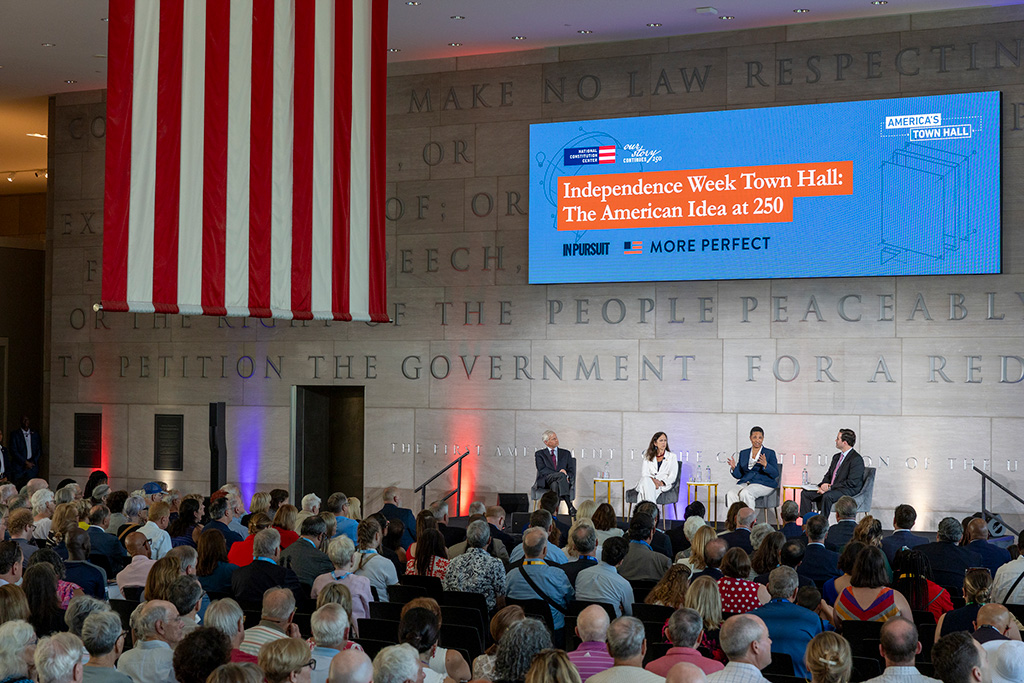
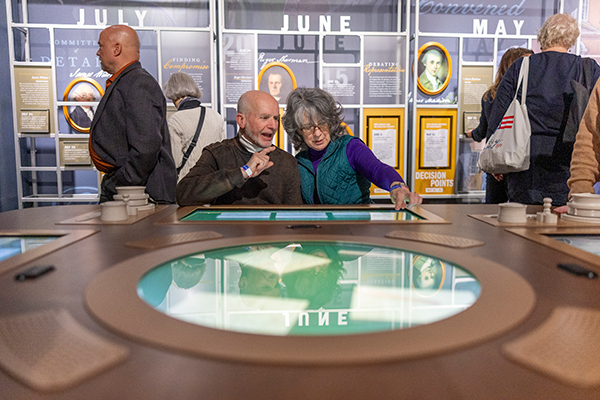

At the National Constitution Center, we value civil dialogue, which empowers students to speak about constitutional and historical topics in ways that remain civil, respectful, and reflective. As you prepare to discuss these topics in your classroom, we encourage you to establish norms such as:
- Stay calm
- Listen patiently
- Listen actively
- Don’t speak twice until everybody has spoken once
You can find more support for establishing norms and civil dialogue practices in our Civil Dialogue Toolkit.
Media Asset
National Constitution Center's Constitution Daily Blog - Supreme Court denies artificial authorship claim for artwork copyright, by Scott Bomboy
Big Constitutional Questions
Can works “outputted” by an AI system, without direct human authorship, be copyrighted?
Headline Story
For now, the Supreme Court has ended a controversial bid for a machine to be named as the original author of artwork sent to the U.S. Copyright Office for protection.
On March 2, 2026, the Court without comment denied a petition for review in Thaler v. Perlmutter. Nearly a year earlier, the U.S. Court of Appeals for the District of Columbia Circuit determined that the Copyright Office correctly denied Dr. Stephen Thaler’s copyright claim for an AI-created picture titled “A Recent Entrance to Paradise.”
Thaler, a computer scientist, created a generative artificial intelligence named the “Creativity Machine,” which then created the picture on its own. On a copyright registration application, Thaler listed the Creativity Machine as the work’s sole author, and himself as the work’s owner.
In his petition to the Supreme Court, Thaler asked the justices to consider whether “works outputted by an AI system without a direct, traditional authorial contribution by a natural person could be copyrighted.”
Amendment / Clause Focus
- Article I, Section 8: “To promote the Progress of Science and useful Arts, by securing for limited Times to Authors and Inventors the exclusive Right to their respective Writings and Discoveries”
Scholar Perspectives
|
Scholar |
Key Ideas & Quote |
Why It Matters |
|
Judge Beryl A. Howell |
“The Copyright Office acted properly in denying copyright registration for a work created absent any human involvement.” Judge Howell explained that copyright law “has never stretched so far, however, as to protect works generated by new forms of technology operating absent any guiding human hand, as plaintiff urges here. Human authorship is a bedrock requirement of copyright.” |
This quote is important because it establishes the current legal principle around copyright which is that it requires human authorship. It also signals how similar AI-authorship disputes may be decided in the future. |
|
Judge Patricia A. Millett |
“The Creativity Machine cannot be the recognized author of a copyrighted work because the Copyright Act of 1976 requires all eligible work to be authored in the first instance by a human being.” “The rule requires only that the author of that work be a human being—the person who created, operated, or used artificial intelligence—and not the machine itself.” |
The appellate court in this case—in an opinion by Judge Millett— affirmed the original decision of the lower court – closing the door on claims that nonhuman systems can hold a copyright. It also directly ties the decision to the Copyright Act of 1976. |
|
Ryan Abbott |
Abbott argued that a “straightforward reading” of the Copyright Act results in the conclusion that “works without a direct, traditional authorial contribution by a natural person can be copyrighted.” “The U.S. Copyright Office, however, imports words into the Act that Congress never drafted and requires vague elements of human authorship that arose from the Copyright Office itself—without statutory support. Indeed, the Copyright Act explicitly permits nonhuman authorship,” Abbott concluded. |
Abbott’s claim here provides a counterargument to the judges’ conclusions by suggesting that the Copyright Act’s text can be read to allow nonhuman authorship. It focuses attention on what counts as an “author” and whether the Act’s language is specific enough to exclude or include AI, which is at the heart of this debate. |
Primary Source Spotlight
Download Think, Talk, Create PDF
Student Questions
- In the case of Thaler v. Perlmutter, the lower courts used precedent to make their decisions regarding authorship, affirming that copyright requires a human author. What role does precedent—or arguments from doctrine— play in judicial decision-making?
- What are the strongest arguments for and against keeping human authorship as a copyright requirement in the age of generative AI? Cite the blog post and other reputable sources in your response.
- What insight does the Copyright Clause provide into questions around authorship? Based on the language of this constitutional provision, how do you think “authorship” is defined? Defend your response with evidence from the blog post and your understanding of the Copyright Clause in Article I, Section 8, of the Constitution.
Student Choice Options
- Test the decision! Use a school-approved AI tool to create an image of your imagination. As you create the image, be sure to note the process through which you prompted the AI tool, any edits or selections you had to make until the image appeared as you envisioned, the creative decision-making, and who ultimately selected the final version. Then, draft a brief ”copyright claim," a brief paragraph in defense of your response that argues whether a human author exists under those facts and explains why.
- Given the prevalence of AI in our society today, imagine proposing new language to the Copyright Act to clarify copyright law for AI outputs. To support your revisions, familiarize yourself with the Copyright Clause in Article I, Section 8 of the Constitution and the Copyright Act of 1976. Your draft should include 3-6 sentences that helps to define the “author,” create registration rules for AI-assisted works, and any other language that might support your vision of new copyright law in an AI world.
- Using the consensogram protocol, have students respond to the prompt on a likert scale: Works outputted by an AI system cannot be copyrighted because copyright requires human authorship. Students should defend their position by citing the blog post and related constitutional clauses and court cases. Then, have students engage in civil dialogue among their peers to defend their claims.
Beyond the Headlines
- Interactive Constitution
- Article I, Section 8: Copyright Clause
- Thaler v. Perlmutter
- Precedent Copyright Cases
- Copyright Act of 1976
- Constitution Daily Blog
- America's Town Hall