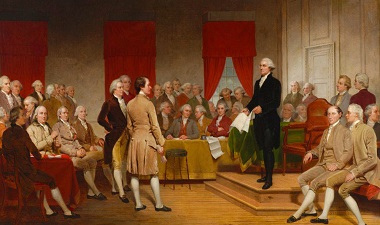


On February 28, President Trump announced “major combat operations in Iran.” The operation, known as Epic Fury, has renewed a long-standing debate about the scope of presidential war powers and who decides when the nation goes to war. Last week, Congress rejected legislation that sought to require President Trump to obtain congressional approval for military actions against Iran. The Constitution divides war powers between Congress, which has the authority to declare war, and the president, who serves as Commander in Chief.
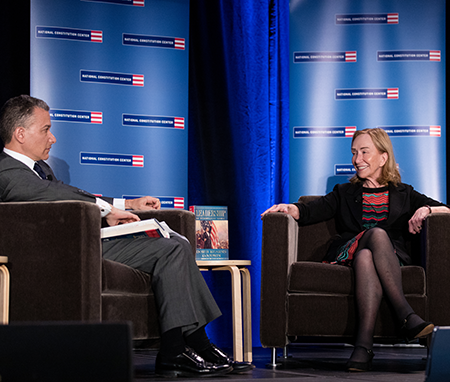
In this episode, Harold Hongju Koh of Yale Law School and Michael D. Ramsey of San Diego Law School explore the constitutional foundations of war powers, as well as the War Powers Resolution of 1973, and how they inform the constitutional authority debates about the use of military force today. Julie Silverbrook, Chief Content and Learning Officer at the National Constitution Center, moderates.
Follow We the People, Live at the National Constitution Center, and Pursuit: The Founders’ Guide to Happiness on Apple Podcasts, Spotify, or your favorite podcast app.
This episode was produced and mixed by Bill Pollock. With production support from Charles Sahm. Research was provided by Anna Salvatore, Trey Sullivan, and Tristan Worsham.
Participants
Harold Hongju Koh is the Sterling Professor of International Law and former dean at Yale Law School. He is a leading expert in public and private international law, national security law, human rights, and the author of many books. His landmark book, The National Security Constitution: Sharing Power After the Iran-Contra Affair, traced the evolution of the constitutional struggle and balance of institutional powers in American foreign affairs and national security policy across America’s history.
Michael D. Ramsey is the Warren Distinguished Professor of Law at the University of San Diego School of Law. Michael clerked for Judge J. Clifford Wallace of the U.S. Court of Appeals for the Ninth Circuit and for Justice Antonin Scalia of the U.S. Supreme Court. He co-edited the book International Law in the U.S. Supreme Court: Continuity and Change.
Julie Silverbrook is Chief Content and Learning Officer at the National Constitution Center. She oversees the Center’s content and learning strategy, and the development and distribution of the Center’s resources and programs.
Additional Resources
- Article I, Section 8, Declare War Clause, NCC’s Interactive Constitution
- Article II, Section 2, Commander in Chief Clause, NCC’s Interactive Constitution
- War Powers Resolution, congress.gov
- Michael D. Ramsey, “The Constitution’s Check on Warmaking,” Law & Liberty, (January 27, 2026)
- Michael D. Ramsey, “Textualism and War Powers,” University of Chicago Law Review 69, no. 4 (2002)
- Harold Hongju Koh, The National Security Constitution: Sharing Power After the Iran-Contra Affair (Second Edition, 2024)
- Harold Hongju Koh, “Humanitarian Intervention: Time for Better Law,” American Journal of International Law Unbound 111 (2017)
- National Constitution Center, “Does the War Powers Resolution debate take on a new context in the Iran conflict?,”Constitution Daily Blog, (March 3, 2026)
- National Constitution Center, “When Congress last used its powers to declare war,” Constitution Daily Blog, (December 8, 2018)
- Learning Resources, Inc. v. Trump (2026)
- Dellums v. Bush (1990)
- Prize Cases (1863)
- Ange v. Bush (D.D.C. 1990)
Stay Connected and Learn More
- Questions or comments about the show? Email us at [email protected]
- Continue the conversation by following us on social media @ConstitutionCtr
- Explore the America at 250 Civic Toolkit
- Sign up to receive Constitution Weekly, our email roundup of constitutional news and debate
- Subscribe, rate, and review wherever you listen
- Join us for an upcoming live program or watch recordings on YouTube
- Support our important work