


Update: On March 4, 2026, the Senate rejected a war powers resolution, by a 47-53 vote, that sought to force President Trump to get consent from Congress for military actions against Iran. A day later, a similar resolution failed to pass in the House of Representatives.
The recent military actions in Iran by Israel and the United States has reignited a simmering constitutional debate: the ability of the president to use military force without prior congressional approval.
 On Feb. 28, 2026, the joint attacks by Israel and the United States forces were met with counterattacks by Iran on other Middle East nations, as well as Israeli and American assets. Israeli and United States forces also killed Iran’s Ayatollah Ali Khamenei, and other Iranian leaders.
Almost immediately, some members of Congress claimed President Donald Trump’s actions violated the Constitution’s Article I, Section 8, Clause 11, which grants the power to “declare War’ to Congress, and a congressional act from 1973, the War Powers Resolution.
“Trump’s military attack on Iran is illegal and unconstitutional. It was not approved by Congress and holds dangers for all Americans,” said Sen. Ed Markey (D-Mass.) in a statement that echoes other critics’ comments. House Speaker Mike Johnson (R-La.) responded by calling these critiques of presidential power a “frightening prospect.”
As recently as early January 2026, the same debate was ongoing after United States military forces captured Venezuela’s president, Nicolas Maduro, and his wife, Cilia Flores, in Caracas, and removed them to the United States to stand trial on narco-terrorism, cocaine-importation, and weapons charges.
The Declare War Clause: Text and History
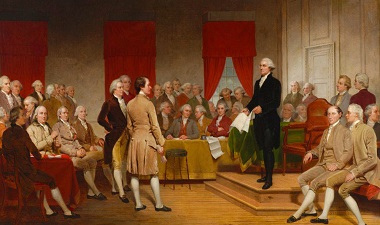
The Founding generation looked to divide the responsibility of declaring and conducting war between Congress and the president. Congress’s power to authorize military actions is rooted in the Constitution’s Declare War Clause. The clause is among the enumerated, or listed, powers granted to Congress by the Constitution in Article I, Section 8. The president’s commander in chief powers emanate from Article II, Section 2, which states, “The President shall be Commander in Chief of the Army and Navy of the United States, and of the Militia of the several States, when called into the actual Service of the United States.”
Beginning in the early republic, presidents have used military force in smaller actions without explicit congressional approval, including forays into West Florida, Mexico, and the Caribbean. However, many presidents still sought congressional authorization for the use of military force. President Thomas Jefferson took action against pirates in the First Barbary War, starting in 1801, with congressional approval by statute. During the Second Barbary War in 1815, Commodore Stephen Decatur attacked Algiers under powers authorized by Congress. And, with the War of 1812, Congress issued a formal declaration of war against Great Britain. In 1846, Congress similarly declared war against Mexico.
Congress and the War Powers Resolution
Congress has not approved a formal declaration of war since World War II. Since then, the use of American forces in overseas combat took a different turn. In Korea, President Harry Truman claimed he was taking part in a United Nation’s police action that did not need congressional approval. He also argued that Congress had implicitly approved of his actions by continuing to fund the military. However, some congressional leaders such as Sen. Robert Taft objected, claiming Truman was declaring “a de facto war . . . without consulting Congress and without congressional approval.” Truman’s State Department cited more than 80 past incidents of presidents deploying forces overseas without express congressional authorization. The Korean conflict went on without explicit congressional approval.
The Vietnam conflict was also not a declared war, but Congress approved a joint resolution requested by President Lyndon B. Johnson in 1964 after the Gulf of Tonkin incident—the Gulf of Tonkin Resolution. The fallout from the Vietnam War and ongoing conflicts between President Richard Nixon and Congress led Congress to enact the War Powers Resolution (1973) over President Nixon's veto. (President Nixon argued that the War Powers Resolution was both unconstitutional and unwise.)
The War Powers Resolution required that, in the absence of the authorization for the use of military force by Congress, a president must report to Congress within 48 hours after introducing military forces into hostilities and must end the use of such forces within 60 days unless Congress permits otherwise. The War Powers Resolution also requires the president “in every possible instance” to consult with Congress before introducing the military into imminent hostilities. It also gives Congress the ability to terminate the use of force used in unauthorized hostilities at any time by concurrent resolution of the House and Senate. (These resolution powers were later modified by a Supreme Court decision in 1983.)
Actions taken after the War Powers Resolution was passed
Since 1973, presidents have dealt with the War Powers Resolution in several ways. In 1993, President Bill Clinton ordered U.S. military forces to take part in NATO activities in Bosnia, including the use of air strikes. In 2011, President Barack Obama authorized U.S. military operations in Libya including air strikes, stating the actions were not “hostilities” under the language of the War Powers Resolution that required formal approval from Congress. But in 2013, Obama asked Congress to approve intervention in the Syrian civil war; Congress then declined to act. In 2018, President Trump ordered airstrikes in Syria and, in 2020, an airstrike in Iraq that killed General Qasem Soleimani, the leader of Iran’s Revolutionary Guards. Trump cited an authorization for the use of military force (AUMF) issued 2002 during Bush administration within the purview of his Commander in Chief authority.
In 2021, President Joe Biden cited the AUMF of 2002 and his Article II powers in taking military actions against Iran-backed militant groups in Iraq, Syria, and Yemen. In June 2025, the United States attacked nuclear facilities in Iran during that nation’s conflict with Israel. President Trump submitted a War Powers Resolution report to Congress. After the capture of Maduro, Trump also filed a report as required to Senate president pro tempore Charles Grassley. In the above cases, there were stated objections from members of Congress and others to the presidential use of war powers without congressional consultation and approval.
The current debate in Congress
According to media reports, President Trump has filed a 48-hour report with the Senate about the latest military actions in Iran. He also has stated publicly that military actions in the conflict could last for some time.
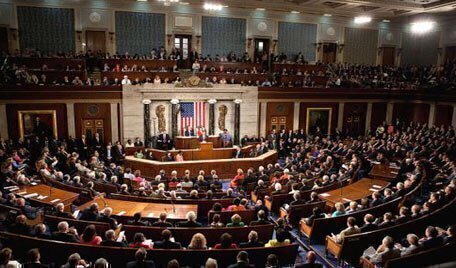
So far in Trump’s second term, Congress has failed to advance a resolution in response to the president’s actions in this context. On Jan. 14, 2026, the Senate failed to approve a proposed joint resolution related to the situation in Venezuela by one vote. A similar vote failed last June related to Iran. Currently, a resolution about Iran sponsored by Sen. Tim Kaine (D-Va.) and Sen. Rand Paul (R-Ky.) is up for consideration.
While the gravity and scope of the Iran attacks could lead to the resolution narrowly passing the House and the Senate, it is subject to a veto by President Trump. In that case, the Senate and the House would need two-thirds majorities to override the veto under Article I, Section 7, of the Constitution. Congress did approve a resolution in May 2020 limiting Trump’s ability to act against Iran without congressional consent a U.S. drone strike killed Qasem Soleimani, head of the Islamic Revolutionary Guard Corps Quds Force. The Senate failed to override the veto in a 49-44 vote.
The basic constitutional debate about the War Powers Resolution is unlikely to fade away. In 1973, President Nixon said in his veto message a constitutional amendment was needed to resolve the matter. Still others are convinced the resolution is fully within the powers of Congress.
One person who offered an early view in 1975 was a young assistant attorney general, Antonin Scalia, who wrote a opinion for Justice Department’s Office of Legal Counsel about President Gerald Ford’s powers under the resolution to evacuate Americans from Vietnam. Scalia believed the resolution “was intended only as an expression of Congress’ interpretation of the Constitution.”
So far, the Supreme Court has not considered the matter, but its ruling in INS v. Chada (1983) extended the president’s veto power to current resolutions of Congress such as war powers resolutions. The Court found that concurrent resolutions that approved or disapproved of presidential action were unconstitutional because at the time they did not require their presentation to the president.
Scott Bomboy is the editor in chief of the National Constitution Center.