

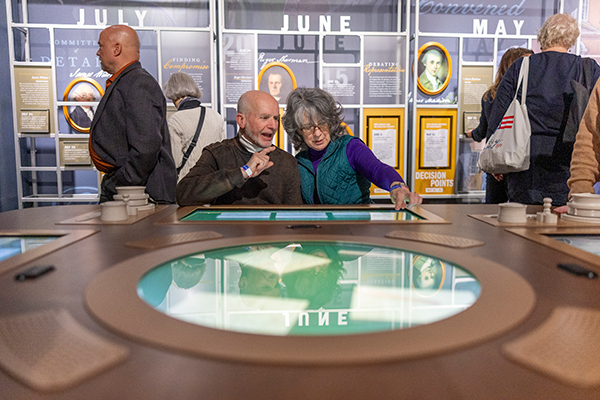

At the National Constitution Center, we value civil dialogue, which empowers students to speak about constitutional and historical topics in ways that remain civil, respectful, and reflective. As you prepare to discuss these topics in your classroom, we encourage you to establish norms such as:
- Stay calm
- Listen patiently
- Listen actively
- Don’t speak twice until everybody has spoken once
You can find more support for establishing norms and civil dialogue practices in our Civil Dialogue Toolkit.
Media Asset
National Constitution Center’s Constitution Daily Blog – The Supreme Court considers expanding gun possession guidelines, by Scott Bomboy
Big Constitutional Questions
- To what extent does the Second Amendment limit the power of states to regulate firearms in the interest of public safety?
Headline Story
The U.S. Supreme Court is considering an important case about whether a state may limit where concealed carry permit holder may bring their firearms.
This case follows the Court’s 2022 decision in New York State Rifle & Pistol Association v. Bruen, which ruled that the Second Amendment protects an individual’s right to carry a handgun for self-defense outside the home. After that ruling, states could still restrict guns in certain “sensitive places,” such as courthouses or polling locations, but they needed historical evidence showing that similar restrictions existed in the past.
In response to the Bruen decision, Hawaii passed a law limiting where concealed carry permit holders could bring firearms. The law prohibited guns on most private property open to the public, such as restaurants, parks, and banks, unless the property owner gave permission. Gun owners challenged the law, arguing that it conflicted with their Second Amendment rights.
The Supreme Court agreed to hear Wolford v. Lopez to resolve disagreements between lower federal courts about whether these types of restrictions are consistent with the Second Amendment. During oral arguments, the justices explore how states might balance Second Amendment rights with private property rights, and whether the history of gun regulation in America offers support for modern gun regulations.
Similar legal disputes are also taking place in other states, including Maryland, where courts have debated how broadly states can define “sensitive places” where firearms may be restricted.
The Supreme Court’s decision, expected by this summer, could clarify how far states may go in regulating where legally permitted firearms can be carried and how Second Amendment rights interact with public safety and private property rules.
Amendment / Clause Focus
- Second Amendment: Right to Bear Arms
Scholar Perspectives
|
Scholar |
Key Ideas & Quote |
Why It Matters |
|
Nelson Lund and Adam Winkler |
The Second Amendment originally applied only to the federal government, leaving the states to regulate weapons as they saw fit. |
Originally, the Second Amendment restricted only the federal government, meaning states could regulate firearms without being bound by it. After the Fourteenth Amendment was adopted, the Supreme Court later ruled that the right to bear arms also applies to state governments. Constitutional rights are not fixed in their application. They can extend over time, and Supreme Court decisions can reshape the balance of power between state and federal authority. |
|
Nelson Lund |
“Most gun control laws can be viewed as efforts to save lives and prevent crime, which are perfectly reasonable goals. If that’s enough to justify infringements on individual liberty, neither constitutional guarantee means much of anything.” |
Constitutional rights are meant to protect individual freedoms, even when the government has legitimate reasons for limiting them. If courts allowed restrictions simply because they seem reasonable or helpful, important rights like free speech or the right to keep and bear arms could be weakened over time. |
|
Adam Winklery |
“Bruen’s history and tradition test . . . has led to disagreement in the courts on the constitutionality of a wide variety of gun regulations, including age-based restrictions on firearms, regulation of ghost guns, bans on assault weapons, and prohibitions on guns in sensitive places.” |
The Supreme Court’s new “history and tradition” test has not created clarity. It has led to disagreements. Courts across the country are reaching different conclusions about similar gun laws, meaning the scope of Second Amendment rights can vary depending on where someone lives. |
Download Think, Talk, Create PDF
Student Questions
- Read the blog post carefully and answer the following:
- What are the constitutional arguments for and against the constitutionality of the gun regulation at issue?
- How might expanding gun possession guidelines affect the balance between individual rights and public safety?
- How does historical evidence and lower court decisions influence the current Supreme Court's approach to the Second Amendment considerations?
Student Choice Options
- Create a political cartoon that represents the main arguments in Wolford v. Lopez as outlined in the blog post.
- Using the Matters of Debate over the Second Amendment, create a Claim-Evidence-Reasoning chart that outlines each scholar's claim, evidence from the text of their essay, and explains the reasoning for their claims. Excerpts have been provided in the Scholar Perspectives section of this Constitution in the Headlines, as well.
- Using the Consensogram protocol, have students assess their level of agreement with the following statement: The Second Amendment sets limits on the power of states to regulate firearms in the interest of public safety. As students share their responses and engage in dialogue, they should be sure to:
- Cite at least one historical precedent
- Reference at least one U.S. Supreme Court Case
- Cite evidence from the blog post or scholar interpretations of the Second Amendment
Beyond the Headlines
- Interactive Constitution
- Second Amendment: The Right to Bear Arms
- Supreme Court Cases Library
- Constitution Daily Blog
- Constitution 101