

Is it against the law for someone to possess a firearm who is considered an “unlawful user” of any controlled substance, including marijuana? The exact definition of those terms is at the heart of one of the biggest Supreme Court decisions this term.
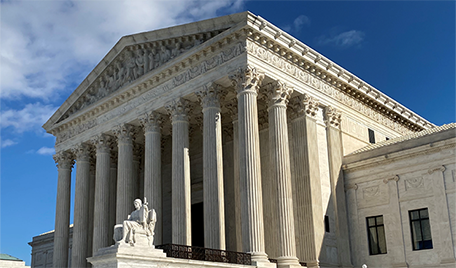 On March 2, 2026, the justices will hear arguments in United States v. Hemani, a case from the U.S. Court of Appeals for the Fifth Circuit, where the appeals bench struck down the application of a federal law banning anyone who is “an unlawful user of or addicted to any controlled substance” from possessing firearms or ammunition.
The Federal Bureau of Investigation arrested Ali Danial Hemani after it obtained a warrant to search his home. Agents found a 9mm pistol, 60 grams of marijuana, and 4.7 grams of cocaine in Hemani’s possession, according to court documents. The government believed that Hemani was a habitual marijuana user. A grand jury found that Hemani had violated the “unlawful user” provision” of U.S.C. 922(g)(3) by possessing a handgun while in the possession of marijuana. Hemani said that U.S.C. 922(g)(3) didn’t apply to his case and that the arrest violated his rights under the Second Amendment, which protects an individual’s right to keep and bear arms.
The case has attracted a considerable amount of attention, with groups like the National Rifle Association (NRA), the National Organization for the Reform of Marijuana Laws (NORML), the New York State Rifle & Pistol Association, and the Cato Institute filing briefs supporting Hemani. In addition to United States Solicitor General John Sauer, a group of 19 states, Everytown For Gun Safety, and the Brady Center to Prevent Gun Violence support the federal government’s position.
The Facts in the Case
A magistrate judge initially ruled in favor of Hemani finding the government lacked sufficient “historical analogues,” required by the Supreme Court’s 2022 decision in New York State Rifle & Pistol Association, Inc. v. Bruen, to prosecute him. “When the Second Amendment’s plain text covers an individual’s conduct, the Constitution presumptively protects that conduct,” said Justice Clarence Thomas in Bruen. “The government must then justify its regulation by demonstrating that it is consistent with the Nation’s historical tradition of firearm regulation.”
On June 21, 2024, Supreme Court applied the Bruen test for the first time in United States v. Rahimi, ruling that an individual found by a court to pose a credible threat to the physical safety of another person may be temporarily disarmed under 18 U.S.C. § 922(g)(8), without violating the Second Amendment.
Hemani’s case was considered in the context of several other court decisions as it headed toward the Fifth Circuit. The appeals court ruled in favor of Hemani in Jan. 31, 2025. It cited United States v. Connelly (2024) also from the same circuit, which found that a marijuana-smoking gunowner who was not impaired could not be charged under U.S.C. 922(g)(3).
The Basic Arguments at the Supreme Court
In his petition to the Supreme Court, Solicitor General Sauer said the Fifth Circuit’s Connelly decision was wrong, and there was enough evidence historically to support U.S.C. 922(g)(3)’s firearms restrictions for a person who “is an unlawful user of or addicted to any controlled substance,” and such restrictions applied to Hemani. The Court accepted the case on Oct. 20, 2025.
In his most recent brief to the Supreme Court, Sauer cites Bruen and Rahimi, and he argues the government can show the application of the law “is consistent with this Nation’s historical tradition of firearm regulation.” Sauer notes, “[T]his case presents narrow circumstances where the government can satisfy that rigorous burden.”
Sauer believes the historical record supports disarming people actively under the influence of alcohol or controlled substances, and it also supports temporarily disarming people who habitually use alcohol and, by association today, controlled substances. “Early American legislatures recognized that habitual drunkards present heightened dangers of crime and violence,” he states. “They classified drunkards as criminal vagrants subject to confinement in jail or workhouses, committed drunkards to lunatic asylums, and subjected drunkards to surety laws backed by threat of jail.”
The Solicitor General notes that Congress and the states have restricted firearms possession by illegal drug users “for as long as that social evil has plagued America” and the Supreme Court should reverse the Fifth Circuit’s ruling.
In their latest brief, Hemani’s attorneys believe the case’s core question is if U.S.C. 922(g)(3) can be applied to a person who occasionally uses marijuana and is not a habitual consumer: “The only question before this Court is whether §922(g)(3) is constitutional as applied to someone who admits to consuming marijuana a few times a week. It is not.”
The government’s case against Hemani also has other problems, they believe: “Lower courts have long recognized that it is not clear what the ‘unlawful user’ prong covers at all, and some have candidly admitted that it is likely unconstitutionally vague absent at least some sort of temporal connection between drug use and gun possession.”
They also don’t agree with the historical precedents cited by the government as permitting a restriction of Hemani’s Second Amendment rights. The government’s interpretation is “broad enough to encompass anyone who drank beer, wine, or spirits with meals a few days a week,” they argue. “By the government’s logic much of the Founding generation—not to mention tens of millions of Americans today—could have been deprived of the right to keep a firearm in the home for self-defense.”
Broader Second Amendment Trends
United States v. Hemani is one of two major Second Amendment cases at the Court this term. The justices heard arguments on Jan. 20, 2026 in Wolford v. Lopez, which may clarify when and where people with gun-ownership permits can possess firearms in publicly accessible private locations. A core question in that case is if the owner of a concealed gun permit can enter many private properties without informing owners they are carrying a gun legally unless asked.
In both of the current cases, the justices will consider the new tests proposed in Bruen and Rahimi, and if the basic Second Amendment rights of citizens will be expanded or restricted based on historical interpretations from the Court.
The decision in United States v. Hemani will likely come down from the Court by late June.
Scott Bomboy is the editor in chief of the National Constitution Center.