
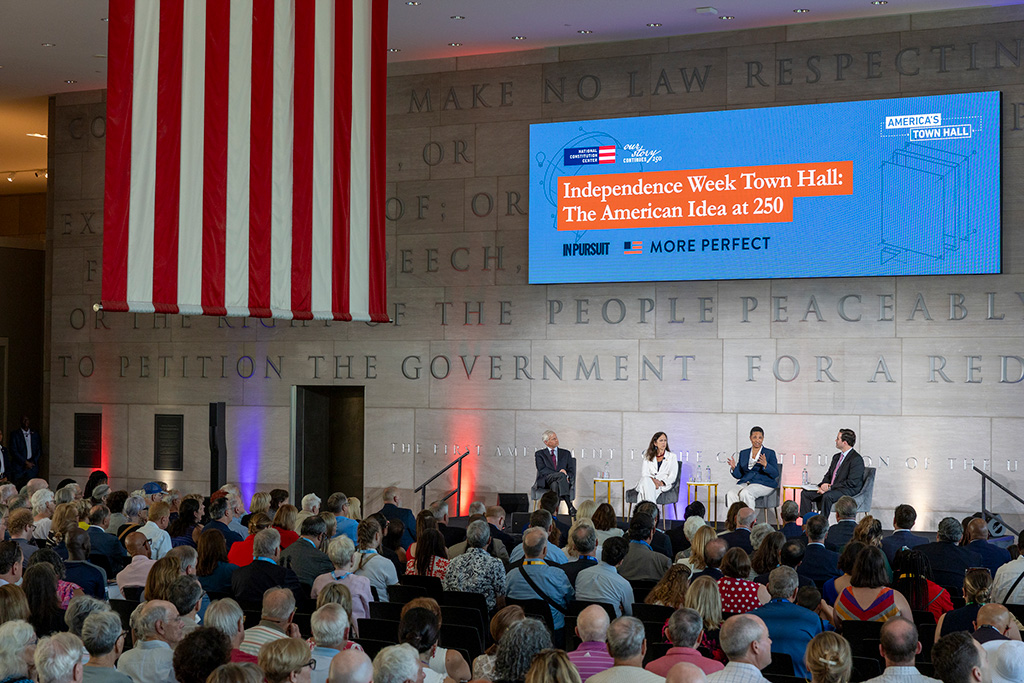



At the National Constitution Center, we value civil dialogue, which empowers students to speak about constitutional and historical topics in ways that remain civil, respectful, and reflective. As you prepare to discuss these topics in your classroom, we encourage you to establish norms such as:
- Stay calm
- Listen patiently
- Listen actively
- Don’t speak twice until everybody has spoken once
You can find more support for establishing norms and civil dialogue practices in our Civil Dialogue Toolkit.
Media Asset
National Constitution Center’s Constitution Daily Blog – Does the War Powers Resolution apply to military actions taken in Venezuela? By Scott Bomboy
Big Constitutional Questions
- Does the War Powers Resolution apply to military actions taken in Venezuela?
Headline Story
In January 2026, the United States used military force in Venezuela to capture President Nicolás Maduro and his wife, Cilia Flores, and bring them to the United States to face criminal charges. This action followed earlier U.S. efforts, such as stopping oil shipments and targeting boats suspected of drug trafficking. Together, these actions raised constitutional questions about whether the president’s actions were legal.
At the center of the debate is the War Powers Resolution of 1973, a law designed to limit how presidents use military force. The Constitution gives Congress the power to declare war, while Article II names the president as commander in chief. The War Powers Resolution tries to balance these powers by requiring the president to notify Congress within 48 hours of military action and to end that action within 60 days unless Congress agrees to continue it.
Presidents from both parties have often argued that this law limits their constitutional authority and have pointed to their commander-in-chief and foreign-affairs powers to justify acting without advance congressional approval. In late 2025, Congress narrowly rejected efforts to restrict military action in Venezuela, and although lawmakers renewed those efforts after January 2026, any resolution would still face a possible presidential veto, one that would be difficult for Congress to override.
Amendment / Clause Focus
- Article I, Section 8, Clause 11: Declare War Clause
- Article I, Section 2: Commander in Chief Clause
Scholar Perspectives
|
Constitution/Scholar |
Key Ideas & Quote |
Why It Matters |
|
Constitutional Text |
To declare War, grant Letters of Marque and Reprisal, and make Rules concerning Captures on Land and Water –Article 1, Section 8 |
This clause is important because it was designed to prevent one person from deciding to take the country into war on their own. By placing the power to declare war in Congress, the Constitution ensures debate, accountability, and shared decision-making before the United States enters a conflict. |
|
Michael Ramsey and Steve Vladeck, |
The law of the Declare War Clause is unsettled in part because there have been very few judicial decisions interpreting it. |
This matters because there is no clear court ruling that fully explains who has the final say over starting wars. Since courts usually avoid these cases, disagreements about military power are left to Congress and the president to work out politically. This helps explain why debates over war powers keep happening and why the Constitution does not always give easy answers. |
|
Michael Ramsey, Professor of Law at the University of San Diego School of Law |
The solution appears to be that by “declare war” the framers meant something broader than just formal declarations. |
This matters because most modern wars do not begin with an official declaration. The Constitution was written so that Congress, not the president alone, decides when the United States begins a war even if that war starts through actions instead of words. Understanding this helps evaluate when military actions raise constitutional questions about who should have the power to decide. |
|
Steve Vladeck, |
The Declare War Clause is not violated when the President’s actions do not initiate war.” It is also not violated when the Executive Branch uses military force (of whatever intensity) pursuant to statutory authorization; in such circumstances, the President is only carrying out authority Congress delegated pursuant to the Declare War Clause and its other war powers. |
This matters because it explains that not every use of the military automatically breaks the Constitution. If the president is responding to a situation that does not start a war, or is acting under authority Congress has already given, the Constitution may allow that action. Understanding this helps see why debates about war powers often focus on whether an action starts a war and who gave permission for it. |
Primary Source Spotlight (Embedded Excerpts)
Download Think, Talk, Create PDF
Think, Talk, Create
Student Questions
- What are the war powers in the Constitution and which branch of government are they assigned to? How do these powers provide checks and balances between the branches when it comes to military action?
- In your own words, explain the War Powers Resolution and its effect on military activities since World War II.
- How have Presidents used their constitutional war powers to engage in military conflict since the passage of the War Powers Resolution? Cite a specific example from the blog post.
Student Choice Options
- Create a political cartoon that shows the tensions between Congress and the President as it pertains to war powers, especially post-World War II and the passage of the War Powers Resolution.
- Read the summary (or full text) of the War Powers Resolution. As you read, use the Window Notes organizer to consider the facts, feelings, questions, and connections that come up for you as you engage with the primary source.
- Using the content from the blog post and other primary sources from “beyond the headlines,” answer the question: does the War Powers Resolution apply to military actions taken in Venezuela?
- Step 1: Write your response in a journal or notebook.
- Step 2: Share your response with a partner or small group.
- Step 3: Engage in a whole group debrief. (Consider using a Socratic Seminar if appropriate.)
Note: Teachers should revisit classroom norms before engaging in steps 2 and 3. If you need support in norms creation, refer to NCC’s guidelines here.
Beyond the Headlines
- Interactive Constitution:
- Article I, Section 8: Powers of Congress
- Article I, Section 8, Clause 11: Declare War Clause
- Article II: The Executive Branch
- Article I, Section 2: Commander in Chief Clause
- War Powers Resolution: Summary and Full Text
- Authorizations for the Use of Military Force (AUMFs)
- United States v. Curtiss-Wright Export Corporation (1936)