




Balancing Liberty and Stability
Grounded in History
In this video, we examine moderation as a core principle of the Constitution’s design, showing how institutional checks were created to slow passion and give reason time to govern.
Madison’s Education and Historical Warnings
You will examine how James Madison’s education and study of past democracies shaped his thinking about faction and the Constitution’s moderating design.
- 1751–1771
Early Education
Madison studied at the College of New Jersey under John Witherspoon, where he engaged with the writings of Enlightenment thinkers, such as Locke, Montesquieu, and Hume.
- 1786–1787
Pre-Convention Reading
Madison conducted an extensive study on the failures of democracies like Athens and Rome, with materials sent by Jefferson from Paris.
- 1786–1787
Shays’ Rebellion
Unrest in Massachusetts, particularly Shays’ Rebellion, highlighted the risks of unchecked factionalism and influenced Madison’s conviction that a more balanced and effective national government was necessary.
- 1787–1788
Federalist Papers Writing
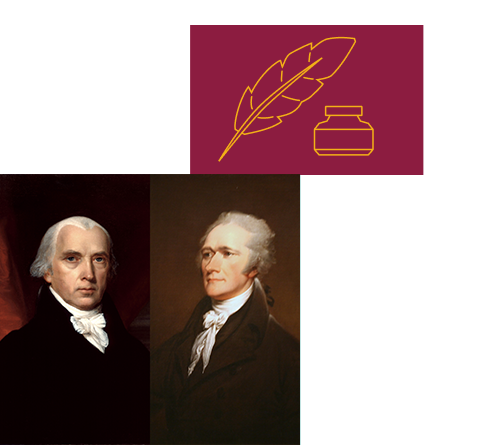
Alongside Alexander Hamilton and John Jay, Madison helped write The Federalist essays, arguing that the Constitution’s structure would slow passion, channel ambition, and reduce the dangers of faction.
The Virtue of Moderation in the Constitution
Explore multiple dimensions of moderation embedded in the Constitution’s design. As you work through each section, consider how these features slow decision-making, encourage reflection, and allow reason to govern passion in public life.
Moderation stood at the heart of the Founders’ design for constitutional self-government. Madison warned that faction arises when citizens are united by passion or interest adverse to others’ rights. Unchecked majorities could allow passion to wrest the scepter from reason. Liberty required structures strong enough to cool sudden impulses before they hardened into injustice. The Constitution was built as a system of restraint and reflection. An extended republic, bicameralism (having the legislature divided into two chambers), separated powers, and checks and balances force time, widen perspective, and encourage compromise.
Madison’s Enlightenment formation taught him that reason must moderate passion in both the soul and the state. The Constitution embodies that insight. Separation of powers, checks and balances, bicameralism, and an energetic but limited executive slow decisions and compel deliberation, aiming to secure the deliberate sense of the community rather than a sudden surge of faction. Drawing on faculty psychology, Madison and Hamilton likened the state to the mind. The legislature, holding the purse, expresses will. The executive, wielding the sword, expresses energy. The judiciary, with neither force nor will but judgment, functions like conscience. In this design, ambition counteracts ambition and calmer faculties check the turbulent ones.
Moderation was not timidity or mere restraint. It was an active discipline, the steady work of cooling passion with reflection and channeling energy through reason. The Founders believed that the same faculties that must be governed within the individual, such as will, ambition, and resentment, must also be governed within the state. Personal self-government was therefore a precondition for political self-government. Citizens and leaders alike were called to practice moderation in judgment, speech, and action. Institutions could slow and filter public passion, but their success ultimately depended on people willing to deliberate, compromise, and prefer long-term stability over momentary victory.
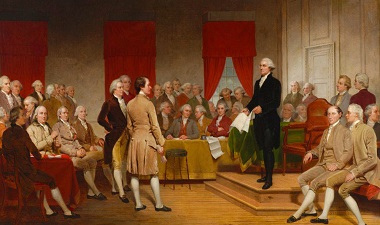
The Constitutional Convention itself was a testament to moderation. Delegates set aside extreme positions and found middle ground on contentious issues like representation and federalism.
This spirit of compromise was crucial to the Constitution’s success and enduring stability.
The Federalist Papers and the Problem of Faction
You will compare Madison’s and Hamilton’s perspectives on faction and the role of reason versus passion in governance. Focus on how their Federalist essays defend constitutional mechanisms designed to moderate factional impulses.
In this section, you will work through the key ideas of James Madison’s Federalist 10 to understand how the Constitution is designed to manage, rather than eliminate, political conflict. As you move through, focus on four questions:
- What does Madison mean by “faction”?
- Where do factions come from, and why can’t we just get rid of them?
- Why is a majority faction more dangerous than a minority faction?
- How does a large, representative constitutional democracy help to moderate the dangers of faction?
Keep Federalist 10 open (or in mind) as you go. Each step will unpack one of these key ideas.
What does Madison Mean by "Faction"?
Madison’s “republican remedy” for faction has two key elements:
- Representation
- In a constitutional democracy, citizens choose representatives.
- This can “refine and enlarge” public views, because representatives are expected to deliberate, weigh competing interests, and look beyond short‑term passions.
- An Extended Sphere (a large constitutional democracy)
- A larger constitutional democracy includes more people, interests, and factions.
- The greater the variety of interests, the harder it is for any one majority faction to form and then act in unison across the whole union.
This design does not eliminate faction. Instead, it moderates its effects by:
- Making it less likely that an unjust majority will arise, and
- Making it more difficult for such a majority to coordinate and carry out oppressive plans.
The Causes of Faction
Madison argues that the causes of faction are rooted in human nature and in the way societies are organized:
- People naturally form different opinions (about religion, government, and public policy).
- They attach themselves to different leaders and causes.
- Most importantly, societies develop an unequal distribution of property, which creates conflicting economic interests (creditors vs. debtors, landed vs. commercial, etc.).
For Madison, these differences are inevitable. They cannot be removed without destroying liberty or forcing everyone to think and live the same way. As a result, the key question is not how to eliminate the causes of faction, but how to manage their effects.
Minority vs. Majority Faction
Madison distinguishes between minority and majority factions:
- A minority faction can be dangerous and disruptive, but in a constitutional democracy it can usually be outvoted through the “republican principle.”
- A majority faction is far more dangerous because it can control the government itself and use lawful procedures to pursue unjust policies.
In a popular government, a majority faction can:
- “Sacrifice” the rights of other citizens, and
- Undermine the public good,
all while acting through the normal institutions of lawmaking.
For Madison, the central design problem becomes: How can we protect rights and the common good when the threat comes from a majority, not just a minority?
How a Large Constitutional Democracy Moderates Faction
Madison’s “republican remedy” for faction has two key elements:
- Representation
- In a constitutional democracy, citizens choose representatives.
- This can “refine and enlarge” public views, because representatives are expected to deliberate, weigh competing interests, and look beyond short‑term passions.
- An Extended Sphere (a large constitutional democracy)
- A larger constitutional democracy includes more people, interests, and factions.
- The greater the variety of interests, the harder it is for any one majority faction to form and then act in unison across the whole union.
This design does not eliminate faction. Instead, it moderates its effects by:
- Making it less likely that an unjust majority will arise, and
- Making it more difficult for such a majority to coordinate and carry out oppressive plans.
Check Your Understanding
The following activities will help you reinforce and assess your understanding of moderation as practiced by Madison, Hamilton, and the Constitution. Take a moment to reflect on what you’ve learned before moving forward.
Which constitutional mechanism best embodies the virtue of moderation by encouraging deliberation and preventing rash decisions?
Concluding Module 9
Rethinking the Pursuit of Happiness
In this module, you examined how James Madison and Alexander Hamilton understood moderation as a guiding principle of constitutional design. You explored Madison’s intellectual formation and the historical lessons that shaped his concern about passion and faction, as well as how both Madison and Hamilton defended a framework that favored deliberation over impulse in The Federalist. By examining the Constitution’s structure and procedures, you saw how moderation was woven into its design as a means of sustaining liberty, stability, and self-government over time.
Key Takeaways
- Moderation was a foundational virtue for the Constitution's framers, aimed at cooling political passions through reasoned institutions.
- Madison's education and study of failed democracies deeply influenced his commitment to moderation and the avoidance of faction.
- The Federalist Papers articulate contrasting but complementary views on managing faction and passion in a constitutional democracy.
- Constitutional structures like separation of powers and checks and balances embody moderation by slowing decision-making and balancing interests.
- The pursuit of happiness, as understood by the Founders, requires disciplined self-government and political moderation.
Food For Thought
- Moderation encourages the pursuit of common ground, supporting dialogue and tempering polarization in political discussion.
- In daily life, moderation takes the form of attentive listening, careful judgment, and respectful engagement with opposing views.
- A moderate approach helps balance liberty and order, preserving individual freedom while supporting the conditions necessary for shared civic life.
Optional Reading
- Jeffrey Rosen, The Pursuit of Happiness, Chapter 8
- The U.S. Constitution (opens in a new tab)
- James Madison, Vices of the Political System of the United States (opens in a new tab)
- The Federalist Papers, Selected Essays
- No. 1(opens in a new tab)
- No. 10(opens in a new tab)
- No. 51(opens in a new tab)
- No. 70 (opens in a new tab)
- No. 78 (opens in a new tab)
- Montesquieu, The Spirit of the Laws (opens in a new tab)
- David Hume, “The Idea of a Perfect Commonwealth”
Created in partnership with Arizona State University.