

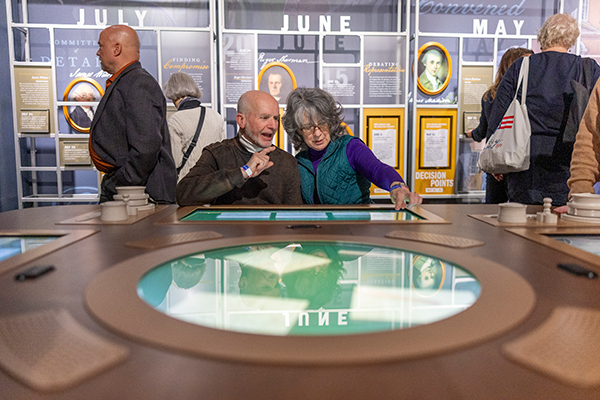
When the Civil War ended in 1865, the task remained to restore the Union. The emancipation of the slaves forced Americans to define citizenship and the rights that went with it. We took one step closer to creating that “more perfect Union” by adding three amendments to the Constitution to expand the ideals of liberty and equality upon which the country was built. One amendment banned slavery outright. Another granted former slaves citizenship and guaranteed equal protection of the laws. And another secured the vote for black men. In the era after the Civil War, known as Reconstruction, as many as one million African American men went to the polls for the very first time; some were elected to Congress. But eliminating racial injustice wouldn’t be easy. When Reconstruction ended in 1877, the national government retreated from protecting equal rights. The famous case of Plessy v. Ferguson in 1896 made matters worse, as segregation spread in the South and in the North. |
| |
|
 |
 |
| |
 |
April 9, 1866
On this day Congress passes Civil Rights Act of 1866 over President Johnson’s veto
|
 |
 |
 |
June 13, 1866
States ratify 14th Amendment, granting former slaves citizenship and promising “equal protection of the laws”
|
 |
| |
 |
March 2, 1867
On this day Reconstruction Act sets up military rule in former Confederate states
|
 |
| |
 |
March 30, 1867
On this day U.S. purchases Alaska from the Russian government for $7.2 million
|
 |
 |
 |
May 16, 1868
For the first time ever, a President stands trial
|
 |
 |
 |
July 9, 1868
The idea of equality enters the Constitution
|
 |
| |
 |
March 4, 1869
On this day Republican Civil War general Ulysses S. Grant inaugurated as president
|
 |
 |
 |
May 10, 1869
The “greatest railroad on earth” spurs a new national market
|
 |
| |
 |
December 10, 1869
On this day Wyoming Territory extends voting rights to women
|
 |
 |
 |
February 3, 1870
We amend the Constitution
|
 |
 |
 |
February 3, 1870
States ratify 15th Amendment, guaranteeing the right to vote regardless of race
|
 |
 |
 |
February 25, 1870
Black citizens join “We, the People”
|
 |
 |
 |
1870
Map of canals and railroads
|
 |
| |
 |
March 3, 1871
On this day Indian Appropriation Act declares all Indian treaties void and makes all Indians wards of the federal government
|
 |
| |
 |
April 20, 1871
On this day Congress passes Ku Klux Klan Act, allowing President to impose martial law when southern governments violate civil rights
|
 |
| |
 |
November 18, 1872
On this day Susan B. Anthony arrested in Rochester, NY, for trying to vote in presidential election
|
 |
| |
 |
April 14, 1873
On this day Supreme Court, in Slaughterhouse Cases, rejects view that 14th Amendment applies the Bill of Rights to the states
|
 |
 |
 |
June 18, 1873
Headlines blared: “The Woman Who Dared”
|
 |
 |
 |
1874
Should women have the right to vote?
|
 |
| |
 |
February 23, 1875
On this day First Jim Crow law is enacted in Tennessee
|
 |
| |
 |
March 7, 1876
On this day Alexander Graham Bell patents telephone
|
 |
| |
 |
November 7, 1876
On this day Contested presidential election between Rutherford B. Hayes and Samuel J. Tilden ends in electoral deadlock
|
 |
| |
 |
March 5, 1877
On this day Hayes declared winner and inaugurated as president; reconstruction ends
|
 |
 |
 |
June 13, 1877
An election mess we can’t forget
|
 |
| |
 |
January 4, 1879
On this day Supreme Court sustains federal enforcement of anti-polygamy laws against Mormons in Reynolds v. U.S.
|
 |
| |
 |
March 4, 1881
On this day James Garfield inaugurated as president
|
 |
| |
 |
September 19, 1881
On this day Following assassination of James Garfield, Chester A. Arthur becomes president
|
 |
| |
 |
January 2, 1882
On this day John D. Rockefeller incorporates Standard Oil Trust
|
 |
| |
 |
May 6, 1882
On this day Congress passes Chinese Exclusion Act, banning Chinese immigration for ten years
|
 |
| |
 |
January 16, 1883
On this day Congress passes Pendleton Reform Act, establishing permanent Civil Service Commission
|
 |
| |
 |
March 4, 1885
On this day Democrat Grover Cleveland inaugurated as president
|
 |
| |
 |
May 10, 1885
On this day Supreme Court, in Yick Wo v. Hopkins, rules that aliens (persons living in the U.S. who are not citizens) are protected by 14th Amendment
|
 |