


Constitution FAQs
Get your questions about the U.S. Constitution answered, courtesy of the National Constitution Center—the place where the Constitution is celebrated, debated, and illuminated.
What is the U.S. Constitution?
The U.S. Constitution is the fundamental framework of America’s system of government.
The Constitution:
- Creates a government that puts the power in the hands of the people
- Separates the powers of government into three branches: the legislative branch, which makes the laws; the executive branch, which executes the laws; and the judicial branch, which interprets the laws
- Sets up a system of checks and balances that ensures no one branch has too much power
- Divides power between the states and the federal government
- Describes the purposes and duties of the government
- Defines the scope and limit of government power
- Prescribes the system for electing representatives
- Establishes the process for the document’s ratification and amendment
- Outlines many rights and freedoms of the people
What is the difference between the Constitution and the Declaration of Independence?
Though connected in spirit, the Constitution and the Declaration of Independence are separate, distinct documents.
The Declaration of Independence was written in 1776. It was a list of grievances against the king of England intended to justify separation from British rule.
The Constitution was written and signed in 1787. It was a charter of government that came to be ratified by the states, and it continues to be the supreme law of the land.
Both documents have played an important role in American history and the spread of democratic ideals around the world. They were both signed at Independence Hall, steps from where the National Constitution Center now stands.
When and where was the Constitution written and signed?
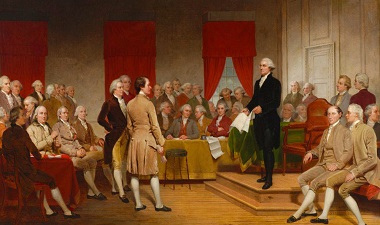
The Constitution was written and signed in Philadelphia in the Assembly Room of the Pennsylvania State House, now known as Independence Hall. This was the same place the Declaration of Independence was signed.
The Constitution was written during the Philadelphia Convention—now known as the Constitutional Convention—which convened from May 25 to September 17, 1787. It was signed on September 17, 1787.
Where is the Constitution? Is it at the National Constitution Center?
The National Constitution Center owns a rare, original copy of the first public printing of the Constitution. This printing was published in a newspaper, The Pennsylvania Packet and Daily Advertiser, on September 19, 1787—two days after the Constitution was signed.
The Constitutional Convention was conducted under an oath of secrecy, so this printing represents the first time that Americans—“We the People”—saw the Constitution.
The original signed, handwritten Constitution is at the National Archives in Washington, D.C.
When did the Constitution go into effect?
The Constitution did not go into effect the moment it was signed by the delegates. It needed to be approved by the people through the ratification process. Article VII of the Constitution established the process for ratification, by simply stating that. “The Ratification of the Conventions of nine States, shall be sufficient for the Establishment of this Constitution between the States so ratifying the Same.” On June 21, 1788, New Hampshire became the ninth state to ratify; and the Confederation Congress established March 4, 1789, as the date to begin operating a new government under the Constitution.
Who wrote the Constitution?
Because many of James Madison’s ideas made their way into the Constitution, he is often referred to as the “Father of the Constitution.” Indeed, he was a driving force of the convention throughout the summer of 1787, and his notes of the deliberations have provided valuable insights into the proceedings.
However, the Constitution was the result of months of passionate, thoughtful deliberation among the delegates. Many others besides James Madison made important contributions, particularly those who served on the Committee of Detail, which included Oliver Ellsworth, Nathaniel Gorham, Edmund Randolph, John Rutledge, and James Wilson; and those on the Committee of Style, which included Alexander Hamilton, William Johnson, Rufus King, and Gouverneur Morris. Other notable delegates included Benjamin Franklin and George Washington (who served as president of the convention).
Why was the Constitution written?
In 1787, Congress authorized delegates to gather in Philadelphia and recommend changes to the existing charter of government for the 13 states, the Articles of Confederation, which many Americans believed had created a weak, ineffective central government.
From the start of the convention, however, it became clear that the delegates were forming an entirely new form of government.
The Preamble of this history-changing document makes it clear why it was written:
“We the People of the United States, in Order to form a more perfect Union, establish Justice, insure domestic Tranquility, provide for the common defence, promote the general Welfare, and secure the Blessings of Liberty to ourselves and our Posterity, do ordain and establish this Constitution for the United States of America.”
Why is the Constitution so important?
In The Constitution: The Essential User’s Guide, the Honorable Sandra Day O’Connor, former associate justice of the Supreme Court, put it this way:
“What makes the Constitution worthy of our commitment? First and foremost, the answer is our freedom. It is, quite simply, the most powerful vision of freedom ever expressed. It’s also the world’s shortest and oldest national constitution, neither so rigid as to be stifling, nor so malleable as to be devoid of meaning.
Our Constitution has been an inspiration that changed the trajectory of world history for the perpetual benefit of mankind. In 1787, no country in the world had ever allowed its citizens to select their own form of government, much less to select a democratic government. What was revolutionary when it was written, and what continues to inspire the world today, is that the Constitution put governance in the hands of the people.”
What is Constitution Day?
Constitution Day is a federal observance that commemorates the U.S. Constitution. It is observed on September 17, the day the Constitution was signed in 1787.
Constitution Day was established by law in 2004. In addition to creating Constitution Day (on the day that had formerly been known as Citizenship Day), the act requires that any educational institution that receives federal funds holds an educational program on the Constitution on September 17.
Fulfill the Constitution Day education requirement using resources on the Center's Interactive Constitution: Classroom Edition.
How can I learn more about the Constitution?
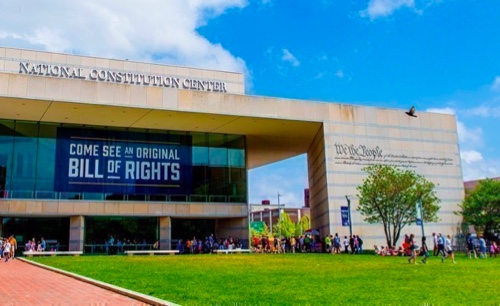
You’re in the right place! The National Constitution Center is the place where the Constitution is celebrated, debated, and illuminated.
Visit our Museum
Explore the Constitution
Educational Resources
Read our Blog