
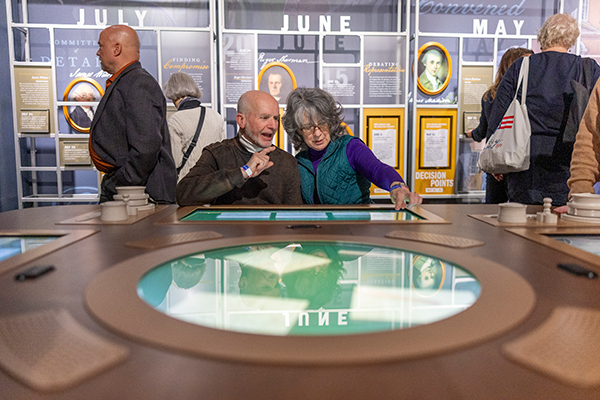

At the National Constitution Center, we value civil dialogue, which empowers students to speak about constitutional and historical topics in ways that remain civil, respectful, and reflective. As you prepare to discuss these topics in your classroom, we encourage you to establish norms such as:
- Stay calm
- Listen patiently
- Listen actively
- Don’t speak twice until everybody has spoken once
You can find more support for establishing norms and civil dialogue practices in our Civil Dialogue Toolkit.
Media Asset
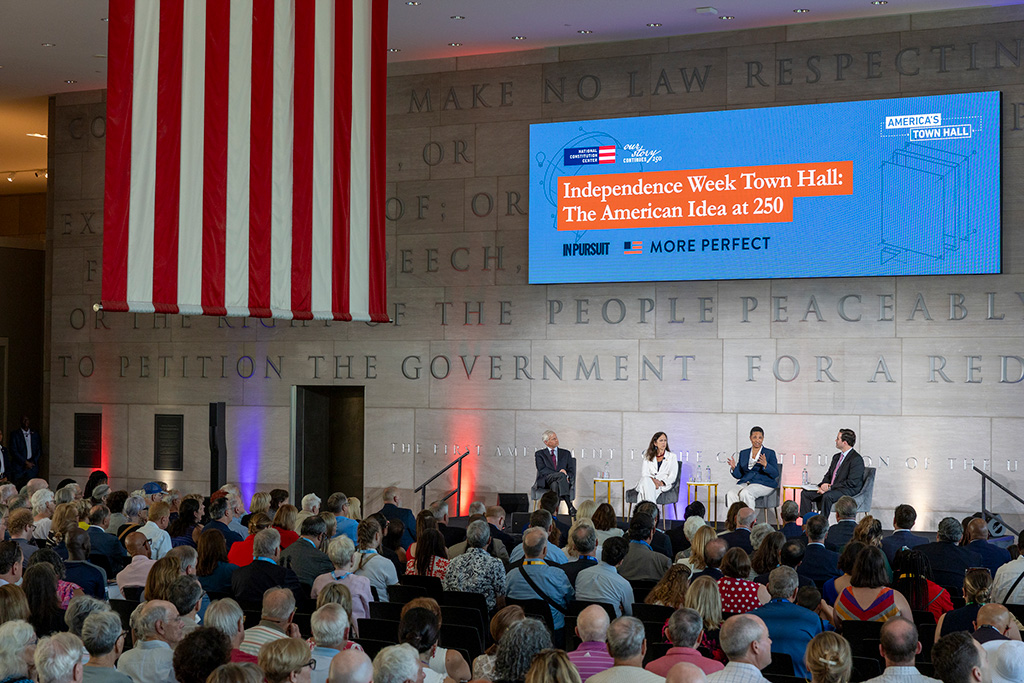
National Constitution Center’s America's Town Hall– Amending the Constitution and the Article V Project
- Professor Rappaport’s argument about limited conventions: 14:50 – 20:55
- Professor Levinson’s argument about conventions and popular sovereignty: 40:36 – 43:56
- Professor Sachs’s argument about changing the convention process: 53:15 – 55:23
Big Constitutional Questions
- How does Article V balance constitutional stability with the need for change?
- What risks and opportunities do Article V conventions present?
Headline Story
What are the ways in which Americans can change the Constitution? Article V lays out that process, balancing stability and change, continuity and possibility, in a way that makes constitutional theory important in practice. The amendment process has been a live and contested debate since the Constitution’s ratification in 1787. This year, the Idaho House of Representatives considered a resolution calling on Congress to convene an Article V convention to pursue a balanced-budget amendment, renewing attention to the risks and possibilities of an open convention for proposing constitutional amendments, a mechanism that has never been used in U.S. history.
It is against this backdrop that, in 2025, the National Constitution Center launched the Article V Project, a new initiative exploring the founders’ vision for Article V and a historical look at the use of the Article V process from 1789 to the present. Project contributors and constitutional law experts Gerard Magliocca, Sanford Levinson, Michael Rappaport, and Stephen Sachs explore the origins, debates, and ongoing challenges surrounding Article V, as presented in their new essays. Jeffrey Rosen, CEO Emeritus of the National Constitution Center, moderates.
Amendment / Clause Focus
- Article V: The Amendment Process
- “The Congress, whenever two thirds of both Houses shall deem it necessary, shall propose Amendments to this Constitution, or, on the Application of the Legislatures of two thirds of the several States, shall call a Convention for proposing Amendments, which, in either Case, shall be valid to all Intents and Purposes, as Part of this Constitution, when ratified by the Legislatures of three fourths of the several States, or by Conventions in three fourths thereof, as the one or the other Mode of Ratification may be proposed by the Congress; Provided that no Amendment which may be made prior to the Year One thousand eight hundred and eight shall in any Manner affect the first and fourth Clauses in the Ninth Section of the first Article; and that no State, without its Consent, shall be deprived of its equal Suffrage in the Senate.”
Scholar Perspectives
|
Scholar |
Key Ideas & Quote |
Why It Matters |
|
Gerard Magliocca |
“The lack of a second national convention after 1787 does not mean that the state summoning power is irrelevant.” |
Article V shows the tension between stability and change in American democracy. State calls for amendments can pressure Congress to act, even without a convention, revealing how power is shared between the people, states, and federal government. |
|
Sanford Levinson |
“Article V, which explicitly contemplates the possibility of a new convention, is basically a Pandora’s box with regard to laying out any specifics, beginning with the selection of delegates.” |
Article V leaves major questions unanswered about how a constitutional convention would work, which is why scholars continue to debate its risks, limits, and democratic legitimacy and why the amendment process remains both powerful and rarely used. |
|
Michael Rappaport |
“Congress is unlikely to pass such an amendment, so the convention method is the only route for bypassing this congressional veto.” |
Article V’s convention method exists to allow constitutional change when Congress has a conflict of interest, but fear of a runaway convention has made that pathway Article V’s convention method exists to allow constitutional change when Congress has a conflict of interest, but fear of a runaway convention has made that pathway effectively unusable, leaving Congress with a de facto veto over constitutional reform. |
|
Stephen Sachs |
“Article V used conventions in two ways: to let states be the first movers of constitutional change, and to let the People get around their ordinary lawmakers.” |
Article V was designed to break political gridlock by allowing constitutional change without relying solely on Congress or state legislatures, highlighting a democratic pathway that exists in theory but is rarely used in practice. |
Download Think, Talk, Create PDF
Think, Talk, Create
Student Questions
- Create an infographic that maps the two pathways for amending the Constitution according to Article V.
- Use a 3-circle Venn Diagram to compare the views of Professors Rappaport, Sachs, and Levinson about the scope of conventions to support the amendment process. Once complete, write an essay that compares how the professors view the risks of constitutional conventions. In your opinion, which scholar’s approach offers the most realistic path forward for constitutional change today?
- Complete the Scope of Agreement protocol as you watch each scholar’s video clip. Once the worksheet is complete, engage in a civil dialogue with classmates that addresses the following questions:
- Which concerns raised by the scholars do you find most reasonable (even if you don’t fully agree with that scholars’ argument)?
- What responsibilities do people have when they advocate for major constitutional change?
Beyond the Headlines
- Interactive Constitution:
- Article V: The Amendment Process
- Article V Project
- Scholar Essays
- Gerard Magliocca, Report: Article V Constitutional Conventions
- Sanford Levinson, Reflections on the Possibility of a New Constitutional Convention
- Michael B. Rappaport, The Convention Method for Proposing Amendments: Essential, Misunderstood, and Broken
- Stephen E. Sachs, Restoring Conventions, One Amendment at a Time
- Scholar Essays
- Scholar Exchange: Amending the Constitution