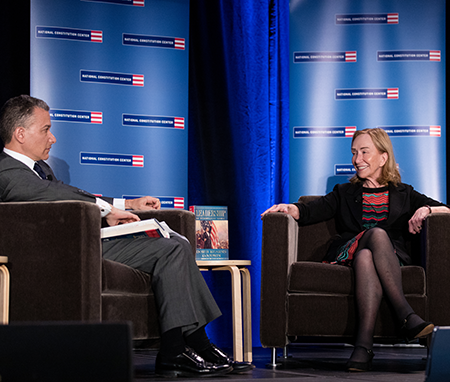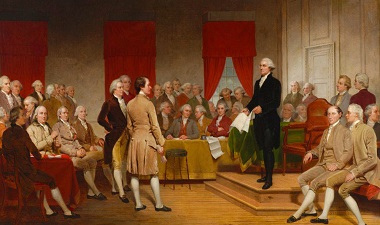

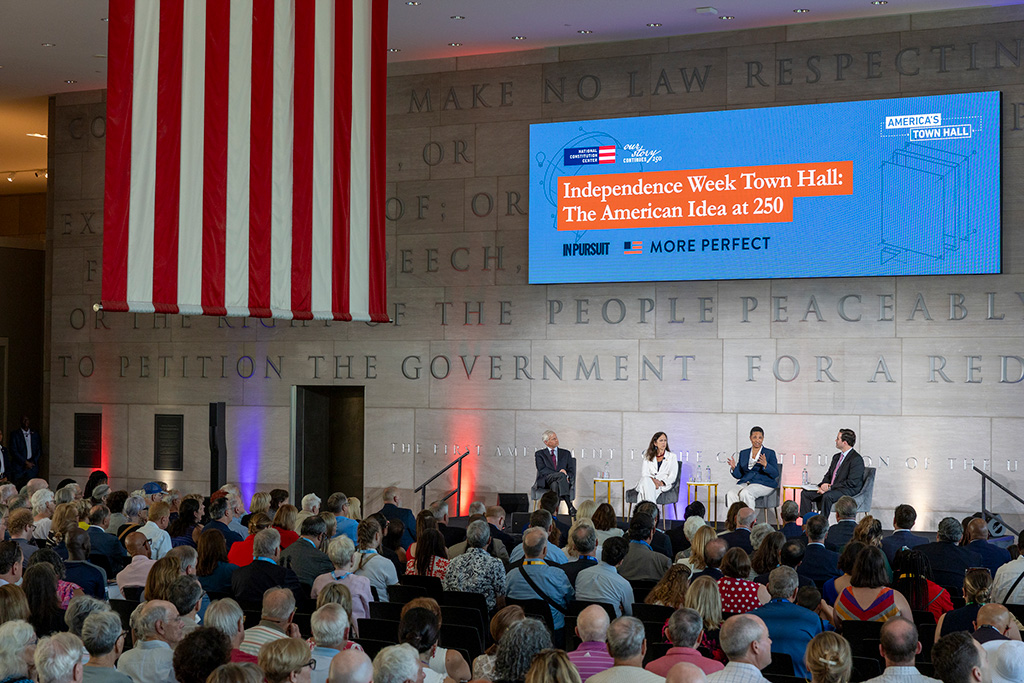


This week, we explore the life of an influential and yet, often overlooked founder, James Wilson, whose ideas and influence continue to shape current debates about popular sovereignty, constitutional structure, and democratic self-government. Legal scholar William Ewald of the University of Pennsylvania and Jesse Wegman of the Brennan Center for Justice join to discuss Wegman’s new book, The Lost Founder: James Wilson and the Forgotten Fight for a People’s Constitution, which explores the life and legacy of this founder and Supreme Court justice. Julie Silverbrook, vice president of civic education of the National Constitution Center, moderates.
Follow We the People, Live at the National Constitution Center, and Pursuit: The Founders’ Guide to Happiness on Apple Podcasts, Spotify, or your favorite podcast app.
This episode was produced and mixed by Bill Pollock. With production support from Scott Bomboy and Lisa Marie Patzer. Research was provided by Anna Salvatore, Trey Sullivan, and Tristan Worsham.
Participants
William Ewald is an internationally recognized scholar in comparative law, legal philosophy, and philosophy of mathematics. His influential, monograph-length article on the philosophical foundations of comparative law, “What Was it Like to Try a Rat?” has been translated into Chinese and Ukrainian. The broad strategy is to combine the historical study of legal systems with comparative law and with legal philosophy.
Jesse Wegman is a senior fellow in the Office of the President at the Brennan Center. He works with the Kohlberg Center on the U.S. Supreme Court, the Future of the Constitution Advisory Committee, and Brennan Center Ventures on electoral policy and democracy reform. From 2013 through 2025, Wegman was a member of the New York Times editorial board, where he wrote more than 1,000 editorials and signed pieces on law and politics, the Supreme Court, democracy, and the rule of law.
Julie Silverbrook is vice president of civic education at the National Constitution Center where she oversees the Center’s civic education strategy and the development and distribution of all educational products and programs.
Additional Resources
- Jesse Wegman, The Lost Founder: James Wilson and the Forgotten Fight for a People's Constitution
- Jesse Wegman, Let the People Pick the President: The Case for Abolishing the Electoral College
Excerpt from interview: Professor William Ewald details James Wilson’s claim to be one of the fathers of the U.S. Constitution.
William Ewald: Madison as the sole father of the Constitution, that's clearly mistaken. The primary authority for why it's mistaken is actually Madison himself, who was quite emphatic on the point, and rightly so, and for a couple of reasons. Importantly, Madison was very clear that this was a collaborative effort. You basically had 50 very strong willed people locked in a room for four months arguing with one another. And to try to pick out any single person as the architect of the Constitution, just makes no sense. It also makes no sense for Wilson, by the way. So I don't want to be claiming him as the father of the Constitution.
If you read through the convention notes slowly, there are two people who really emerge as the ones who are most in control of the ideas. They're in control of the arguments. They've got novel things to say on just about every point, extremely insightful, even when their ideas aren't picked up. And those two, I think are Madison and Wilson. There really isn't a third delegate who comes close to those two. Gouverneur Morris maybe, but he wasn't there through the entire summer. So for consistently interesting delegates at the convention, I would say it's Wilson and Madison.
The greatest contribution to the final document is probably the structure of the presidency. So this is something that Wilson led with at the very beginning of the summer. Almost nobody accepted his view of a single president elected for a short term of office and re-eligible and all the rest of what goes into Article 2. By the end of the summer, essentially the entire convention had come to the position that Wilson led with. So that's long been recognized. If you're looking for the architect of the American presidency, Wilson has a greater claim to that than anybody.
Excerpt from interview: Jesse Wegman describes the enduring significance of James Wilson’s vision of democratic governance.
Jesse Wegman: The story of James Wilson that I tell in the book and that I want to kind of, to weigh with... To sit with people here is, is a story of what America might have been and what it still could be. It's a lesson in, I think, how much we miss by erasing someone like him and his ideas. We are in this really, I think, difficult period where we're debating whether we are still or could ever be a democracy. And this idea that the people are the ultimate sovereign, that is at the heart of James Wilson's vision for America, a directly elected president, directly elected Senate, a Congress based on proportional representation. These are the things that I think he saw as essential to having a functional republic. And we have not really achieved many of them. So I think Wilson still holds out the promise of what we could be, and that is a democracy. To those who say, well, we're a republic, not a democracy, including members of Congress who should know better. Wilson's life story and his ideas are, to me, the answer. As I said, we're talking about the founding of the country and we're talking about the future of the country. And to me, Wilson ties those two things together in a way that none of the other founders is able to do.
Full Transcript
View Transcript (PDF)
This transcript may not be in its final form, accuracy may vary, and it may be updated or revised in the future.
Stay Connected and Learn More
- Questions or comments about the show? Email us at [email protected]
- Continue the conversation by following us on social media @ConstitutionCtr
- Explore the America at 250 Civic Toolkit
- Sign up to receive Constitution Weekly, our email roundup of constitutional news and debate
- Subscribe, rate, and review wherever you listen
- Join us for an upcoming live program or watch recordings on YouTube
- Support our important work