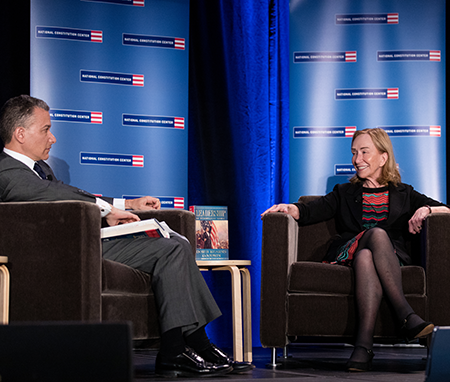



In this episode, Stephanie Barclay of the Georgetown University Law Center and Erwin Chemerinsky of the UC Berkeley School of Law join to recap the oral arguments from Chiles v. Salazar and discuss whether Colorado’s ban on conversion therapy violates the First Amendment. Jeffrey Rosen, president and CEO of the National Constitution Center, moderates.
Follow We the People, Live at the National Constitution Center, and Pursuit: The Founders’ Guide to Happiness on Apple Podcasts, Spotify, or your favorite podcast app.
Today’s episode was produced by Bill Pollock and Griffin Richie. It was engineered by Bill Pollock. Research was provided by Griffin Richie, Anna Salvatore, Trey Sullivan, and Tristan Worsham.
Participants
Stephanie Barclay is a Professor of Law at Georgetown Law School and the Faculty Co-Director of the Georgetown Center for the Constitution. Her research focuses on the role our different democratic institutions play in protecting minority rights, particularly at the intersection of free speech and religious exercise.
Erwin Chemerinsky is the Dean of UC Berkeley School of Law and the Jesse H. Chopper Distinguished Professor of Law. A leading First Amendment scholar, he is the author of 19 books, including preeminent casebooks and treatises about constitutional law, criminal procedure, and federal jurisdiction.
Jeffrey Rosen is the president and CEO of the National Constitution Center, a nonpartisan nonprofit organization devoted to educating the public about the U.S. Constitution. He is also professor of law at the George Washington University Law School and a contributing editor of The Atlantic. His newest book, Pursuit of Liberty: How Hamilton vs. Jefferson Ignited the Lasting Battle over Power in America, is out in October 2025.
Additional Resources
- United States v. Skrmetti (2025)
- Mahmoud v. Taylor (2025)
- NIFLA v. Becerra (2018)
- Tarasoff v. Regents of the University of California (Cal. 1976)
- Stephanie Barclay et al., “Brief amici curiae of First Amendment Scholars,” Chiles v. Salazar (6/13/2025)
- Erwin Chemerinsky et al., “Brief amici curiae of Constitutional Law Scholars,” Chiles v. Salazar (8/26/2025)
- Cass Report (2024)
Excerpt from interview: Stephanie Barclay discusses why Colorado's ban on conversion therapy is unconstitutional in Chiles v. Salazar: Colorado’s law is viewpoint discrimination against pure speech, plain and simple.
Stephanie Barclay: Why should it matter that we give lesser protection to speech if it is informed consent for a surgery or if it's bound up with providing a prescription? The easy answer to that question is because the Supreme Court has said so. The Supreme Court said in NIFLA that those are special categories of verbal or written communication that we will treat differently. Why has the Supreme Court said so? Because in larger bodies of its precedent about the First Amendment, we have long said that speech that is merely incidental to conduct just doesn't get the same sort of protection as pure speech. And here, what we have is pure speech. That's all that's being regulated. And in fact, to know whether or not the regulation applies, you have to know what words are coming out of Ms. Chiles's mouth. Is she encouraging a gender transition? That would be allowed. Is she helping a client who does not want to move forward with a gender transition and she's helping their goal of a detransition? That isn't allowed under the law. So a therapist can encourage this sort of behavior.
They can't discourage it. That's viewpoint discrimination. So, if we're dealing with pure speech, which we are, if it's not incidental to some other sort of conduct, which it's not, the Supreme Court's case law, including in situations like NIFLA, makes clear that we're dealing with strict scrutiny.
Excerpt from interview: Erwin Chemersinky discusses why Colorado's ban on conversion therapy is constitutional in Chiles v. Salazar: Colorado is simply prescribing standards of medical care, a function best left up to elected legislatures.
Erwin Chemerinsky: It doesn't violate the First Amendment because this is Colorado setting the standards for professional medical care. States have always been able to do this. I do think that the juxtaposition with Skrmetti is important because both this case and Skrmetti go to the question of who should be making the judgments with regard to the standard of medical care. Here, the state of Colorado has made the judgment that conversion therapy for gay, lesbian, and transgender individuals is harmful and ineffective. In Skrmetti, Tennessee made the judgment that providing gender-affirming care for transgender youth was harmful. The Supreme Court in Skrmetti stressed the need to defer to the judgment of the political process in the legislature. That's what's being urged here.
When you're talking about informed consent laws or the Tarasoff case that we were discussing, speech was at the core. So is speech here, what is being regulated, and the state should be able to do so in the same way that it regulates informed consent laws the same way that does with regard to Tarasoff. It's very frightening to think if the Supreme Court strikes this law down, how it will limit the ability of states to regulate medical care procedures that involve speech.
Full Transcript
View Transcript (PDF)
This transcript may not be in its final form, accuracy may vary, and it may be updated or revised in the future.
In our new podcast, Pursuit: The Founders’ to Guide to Happiness Jeffrey Rosen explores the founders’ lives with the historians who know them best. Plus, filmmaker Ken Burns shares his daily practice of self-reflection.
Listen to episodes of Pursuit on Apple Podcast and Spotify.
Stay Connected and Learn More
- Questions or comments about the show? Email us at [email protected]
- Continue the conversation by following us on social media @ConstitutionCtr.
- Explore the America at 250 Civic Toolkit
- Sign up to receive Constitution Weekly, our email roundup of constitutional news and debate
- Follow, rate, and review wherever you listen
- Join us for an upcoming live program or watch recordings on YouTube
- Support our important work: