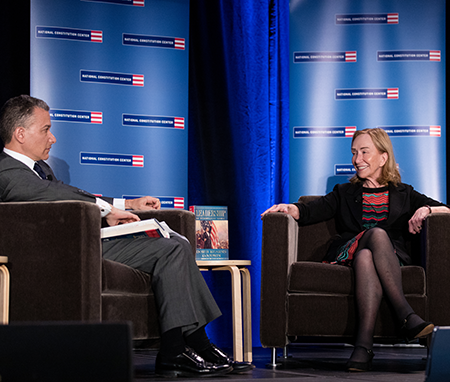


In this episode, Samuel Estreicher of the NYU School of Law and John Yoo of the UC Berkeley School of Law join to recap the oral arguments from the pair of challenges to President Trump’s tariffs and discuss whether International Emergency Economic Powers Act (IEEPA) authorizes the president to impose extensive tariffs on nearly all goods imported into the United States. Jeffrey Rosen, president and CEO of the National Constitution Center, moderates.
Follow We the People, Live at the National Constitution Center, and Pursuit: The Founders’ Guide to Happiness on Apple Podcasts, Spotify, or your favorite podcast app.
Today’s episode was produced by Bill Pollock and Griffin Richie. It was engineered by Bill Pollock. Research was provided by Griffin Richie, Anna Salvatore, Trey Sullivan, and Tristan Worsham.
Participants
Samuel Estreicher is the Dwight D. Opperman Professor of Public Law, the Director of the Center for Labor and Employment Law, and the Director of the Institute of Judicial Administration at the NYU School of Law. A nationally preeminent scholar in labor and employment law, he has authored more than a dozen books, including Beyond Elite Law: Access to Civil Justice in America.
John Yoo is the Emanuel Heller Chair in Law at the UC Berkeley School of Law and the Distinguished Visiting Professor in the School of Civic Leadership at the University of Texas at Austin. His most recent book, The Politically Incorrect Guide to the Supreme Court, was published in 2023.
Jeffrey Rosen is the president and CEO of the National Constitution Center, a nonpartisan nonprofit organization devoted to educating the public about the U.S. Constitution. He is also professor of law at the George Washington University Law School and a contributing editor of The Atlantic. His newest book, Pursuit of Liberty: How Hamilton vs. Jefferson Ignited the Lasting Battle over Power in America, is out in October 2025.
Additional Resources
- Samuel Estreicher et al., “Brief of Professors of Administrative Law, Separation of Powers, Foreign Relations Law, Legislation and the Regulatory State, and Trade Law” (10/24/2025)
- Sam Estreicher and Andrew Babbit, “The Case Against Unbounded Delegation in Trump v. VOS Selections,” Lawfare (10/30/2025)
- John Yoo, “What Could the Supreme Court Rule About Trump’s Tariffs,” Civitas Institute (9/8/2025)
- Biden v. Nebraska (2023)
- Whitman v. American Trucking Associations, Inc. (2001)
- Dames & Moore v. Regan (1981)
- Youngstown Sheet & Tube Co. v. Sawyer (1953)
- United States v. Yoshida International, Inc. (CCPA, 1975)
- United States v. Curtiss-Wright Export Corp. (1936)
- Schechter Poultry Corp. v. United States (1935)
Excerpt from interview: John Yoo questions the Trump administration’s trade deficit reasoning for the IEEPA tariffs and the Court’s reticence to scrutinize that reasoning in Learning Resources v. Trump.
John Yoo: I think it breaks down into two straightforward issues. One is, is there in fact an unusual and extraordinary threat to the national security and foreign policy and the economy of the United States? The only one that exists. Do you then get to the second question, which is what can the president do under the IEEPA statute? All this is, of course, about power granted to the president by Congress. The president doesn't have any inherent constitutional authority as Sam has observed, to impose tariffs or taxes or regulate international commerce at all. That's all explicitly given by the Constitution to Congress. So on the first question, I heard some Justices, I think, most notably Justice Gorsuch, question whether this is in fact a national emergency. I too have raised doubts about that because the trade deficit has been with us for 50 years now. And if you look at its size as a percentage of GDP, it's the same size now as it was 20 years ago. So it doesn't seem to be something that's happened all of a sudden.
How much deference will the courts give to a president in his findings of the facts of an emergency? The Supreme Court has never, as far as I know, overturned a president's finding of a national emergency. But if they were ever going to, I think it would be this case.
Excerpt from interview: Sam Estreicher describes the importance of the non delegation doctrine in Learning Resources v. Trump, and its broader impact on how the Court interprets statutes as part of the major questions doctrine.
Sam Estreicher: I think the statute is very problematic because I think it raises very serious non delegation problems and we can see in the way in which the Justices are struggling to come up with some statutory argument for withholding the authorization for reading IEEPA as not authorizing the tariffs. So my sense is... Again, I don't usually like to make short term predictions. I'm very good at predicting what's going to happen 30 years from now. But my sense is there is a court for doing something to block these tariffs.
I think this case is really driven by the non delegation concerns across the board. So I think that's the principle argument. You can block importation, you can have a quota on importation, but what you can't do is use any of these means that would be revenue enhancing because of the special solicitude about easy delegation of taxing authority outside of Congress.
Well, two aspects of the non delegation doctrine. One as a basis for outright invalidation of IEEPA, and the other is, and I agree with John, that it influences how we're reading this statute and whether we're going to adopt the major questions doctrine. And I think both the way that this statute is being read by the Justices that I think that are inclined to rule against the president and the interest in the major questions doctrine stem from the non delegation concern. I have no problem with using these other doctrines to avoid an outright invalidation of IEEPA. Historically, we've not had a very vigorous application of the non delegation doctrine.
Full Transcript
View Transcript (PDF)
This transcript may not be in its final form, accuracy may vary, and it may be updated or revised in the future.
Stay Connected and Learn More
- Questions or comments about the show? Email us at [email protected]
- Continue the conversation by following us on social media @ConstitutionCtr
- Explore the America at 250 Civic Toolkit
- Sign up to receive Constitution Weekly, our email roundup of constitutional news and debate
- Follow, rate, and review wherever you listen
- Join us for an upcoming live program or watch recordings on YouTube
- Support our important work: