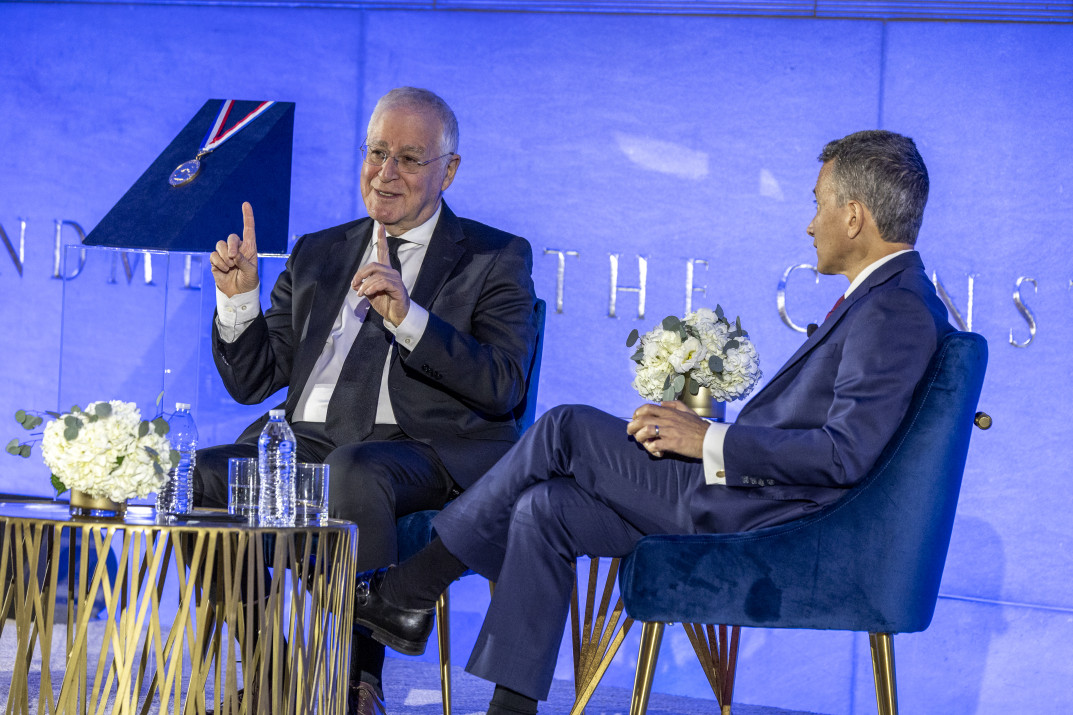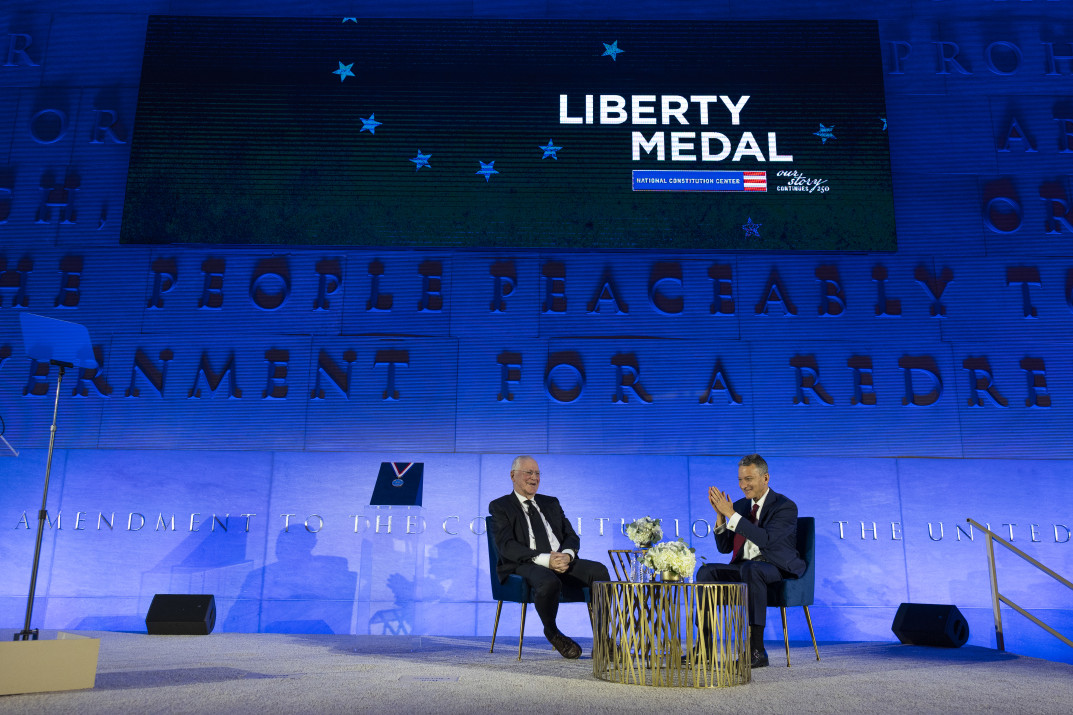


The Liberty Medal

2018 Liberty Medal Recipient: President George W. Bush and Mrs. Laura Bush

African American History Month

The Liberty Medal

2018 Liberty Medal Recipient: President George W. Bush and Mrs. Laura Bush

On this day, Theodore Roosevelt dies unexpectedly

The Liberty Medal

2018 Liberty Medal Recipient: President George W. Bush and Mrs. Laura Bush

Religious Liberty and LGBTQ Rights

The Liberty Medal

2018 Liberty Medal Recipient: President George W. Bush and Mrs. Laura Bush

Supreme Court reopens partisan gerrymander issue

The Liberty Medal

2018 Liberty Medal Recipient: President George W. Bush and Mrs. Laura Bush

House-Trump constitutional fight over Obamacare looms

The Liberty Medal

2018 Liberty Medal Recipient: President George W. Bush and Mrs. Laura Bush

For National Trivia Day: 10 Founding Fathers tidbits

The Liberty Medal

2018 Liberty Medal Recipient: President George W. Bush and Mrs. Laura Bush

Michael Tomasky: How to Fix Political Polarization in America

The Liberty Medal

2018 Liberty Medal Recipient: President George W. Bush and Mrs. Laura Bush

Donate

The Liberty Medal

2018 Liberty Medal Recipient: President George W. Bush and Mrs. Laura Bush

Best of 2018: ‘Madison, the Media, and the Mob’ Live at America’s Town Hall

The Liberty Medal

2018 Liberty Medal Recipient: President George W. Bush and Mrs. Laura Bush

General Stanley McChrystal: History’s Greatest Leaders

The Liberty Medal

2018 Liberty Medal Recipient: President George W. Bush and Mrs. Laura Bush

New Member Open House and Tour of Signers’ Hall

The Liberty Medal

2018 Liberty Medal Recipient: President George W. Bush and Mrs. Laura Bush

Hamilton: The Constitutional Clashes that Shaped a Nation Gallery Talk

The Liberty Medal

2018 Liberty Medal Recipient: President George W. Bush and Mrs. Laura Bush

Happy statehood birthday, Alaska!

The Liberty Medal

2018 Liberty Medal Recipient: President George W. Bush and Mrs. Laura Bush

MetroKids: National Constitution Center Launches Sensory-Friendly Sundays

The Liberty Medal

2018 Liberty Medal Recipient: President George W. Bush and Mrs. Laura Bush

Exhibit Sneak Peek: Civil War and Reconstruction Exhibit

The Liberty Medal

2018 Liberty Medal Recipient: President George W. Bush and Mrs. Laura Bush

KYW: Constitution Center Introduces Sensory-Friendly Sundays to Provide More Accessible Museum Experience

The Liberty Medal

2018 Liberty Medal Recipient: President George W. Bush and Mrs. Laura Bush

After Hours Gallery Talk- Hamilton: the Constitutional Clashes that Shaped a Nation

The Liberty Medal

2018 Liberty Medal Recipient: President George W. Bush and Mrs. Laura Bush

Members-Only Film Screening: On the Basis of Sex

The Liberty Medal

2018 Liberty Medal Recipient: President George W. Bush and Mrs. Laura Bush

2019 Winter Warm Up Sale

The Liberty Medal

2018 Liberty Medal Recipient: President George W. Bush and Mrs. Laura Bush

Sensory-Friendly Sundays Begin at the National Constitution Center in 2019

The Liberty Medal

2018 Liberty Medal Recipient: President George W. Bush and Mrs. Laura Bush

2019 Winter Warm Up

The Liberty Medal

2018 Liberty Medal Recipient: President George W. Bush and Mrs. Laura Bush

On this day, massive raids during the Red Scare

The Liberty Medal

2018 Liberty Medal Recipient: President George W. Bush and Mrs. Laura Bush

On this day, the Emancipation Proclamation changes history

The Liberty Medal

2018 Liberty Medal Recipient: President George W. Bush and Mrs. Laura Bush

Obamacare to remain in effect for months

The Liberty Medal

2018 Liberty Medal Recipient: President George W. Bush and Mrs. Laura Bush

On this day: Panama regains the Panama Canal

The Liberty Medal

2018 Liberty Medal Recipient: President George W. Bush and Mrs. Laura Bush

The Gadsden Purchase and a failed attempt at a southern railroad

The Liberty Medal

2018 Liberty Medal Recipient: President George W. Bush and Mrs. Laura Bush

Is Andrew Johnson the worst president in American history?

The Liberty Medal

2018 Liberty Medal Recipient: President George W. Bush and Mrs. Laura Bush

The Supreme Court Year in Review

The Liberty Medal

2018 Liberty Medal Recipient: President George W. Bush and Mrs. Laura Bush

10 fascinating facts about Woodrow Wilson

The Liberty Medal

2018 Liberty Medal Recipient: President George W. Bush and Mrs. Laura Bush

Best of 2018: Doris Kearns Goodwin, Live at America’s Town Hall

The Liberty Medal

2018 Liberty Medal Recipient: President George W. Bush and Mrs. Laura Bush

Remembering the Supreme Court’s first dissenter

The Liberty Medal

2018 Liberty Medal Recipient: President George W. Bush and Mrs. Laura Bush

Forbes: 12 Days Of Charitable Giving 2018: National Constitution Center

The Liberty Medal

2018 Liberty Medal Recipient: President George W. Bush and Mrs. Laura Bush

On this day, Woodrow Wilson seizes the nation’s railroads

The Liberty Medal

2018 Liberty Medal Recipient: President George W. Bush and Mrs. Laura Bush

Three other big historical events that happened on Christmas Day

The Liberty Medal

2018 Liberty Medal Recipient: President George W. Bush and Mrs. Laura Bush

America’s “forgotten war” ended on this day, and few people knew

The Liberty Medal

2018 Liberty Medal Recipient: President George W. Bush and Mrs. Laura Bush

When Festivus was recognized as a religion for several months

The Liberty Medal

2018 Liberty Medal Recipient: President George W. Bush and Mrs. Laura Bush

Is Supreme Court weighing Mueller’s powers?

The Liberty Medal

2018 Liberty Medal Recipient: President George W. Bush and Mrs. Laura Bush

All sides agree that Obamacare is safe – for now

The Liberty Medal

2018 Liberty Medal Recipient: President George W. Bush and Mrs. Laura Bush

Supreme Court keeps asylum limits on hold

The Liberty Medal

2018 Liberty Medal Recipient: President George W. Bush and Mrs. Laura Bush

Sensory-Friendly Sunday

The Liberty Medal

2018 Liberty Medal Recipient: President George W. Bush and Mrs. Laura Bush

Sensory-Friendly Sunday

The Liberty Medal

2018 Liberty Medal Recipient: President George W. Bush and Mrs. Laura Bush

Sensory-Friendly Sunday

The Liberty Medal

2018 Liberty Medal Recipient: President George W. Bush and Mrs. Laura Bush

Sensory-Friendly Sunday

The Liberty Medal

2018 Liberty Medal Recipient: President George W. Bush and Mrs. Laura Bush

The story behind the oddest White House summit ever

The Liberty Medal

2018 Liberty Medal Recipient: President George W. Bush and Mrs. Laura Bush

Podcast: 2018: A Constitutional Year in Review

Jeffrey Rosen: [00:00:02] I'm Jeffrey Rosen, president and CEO of the National Constitution Center, and welcome to We the People, a weekly show of constitutional debate. The National Constitution Center is a nonpartisan nonprofit chartered by Congress to increase awareness and understanding of the constitution among the American people. It's been such an extraordinary year for constitutional learning and such a privilege to learn with all of you, dear We the People listeners, and to round up the year, I'm so honored to be joined by two of America's greatest constitutional commentators, friends of the podcast who will discuss with me the constitutional highlights of the year and help us distill some of the learning that we've done together. Emily Bazelon is a staff writer at The New York Times Magazine and Truman Capote Fellow for creative writing and law at Yale Law School. She is co-host of Slate's weekly podcast Political Gabfest. Emily thank you so much for joining. And Josh Blackman is Professor of Law at the South Texas College of Law in Houston and an adjunct scholar at the Cato Institute. He is founder and president of the Harlan Institute and blogs at Josh Blackman dot com. Josh It is wonderful to have you back. Let us jump right in with the Affordable Care Act. Recently a federal judge in Texas ruled that the entire Affordable Care Act is unconstitutional. And Josh you have written extensively about the case. Explain to us on what grounds Judge O'Connor ruled that the mandate in the Affordable Care Act could no longer be defended as a tax, why he thought that that provision was not severable, in other words that it couldn't be cut out of the law while saving the rest of it, why he thought that there were standing to bring the objection and whether or not you think his decision was correct?

Josh Blackman: [00:01:57] Well Jeff thanks for having me again. I've been writing about Obamacare now for nearly eight years. At times I feel like it's Groundhog Day the movie where the same script keeps repeating in slightly different contexts. So this most recent case picks up where the 2012 Obamacare decision left off. As I'm sure your listeners know, the Obama administration defended the Affordable Care Act. They said that this law, if it can't be upheld as regulation in interstate commerce, the court should treat the individual mandate to buy insurance as merely a tax on those uninsured. In other words there is no mandate. Chief Justice Roberts thought that that was not the best reading of the statute. But he was willing to read the statute that way because of a few factors, one of which is that the mandate, I'm sorry the penalty, that enforces the mandate, was in many regards similar to a tax. It raised revenue, you put it on your tax return, et cetera. That was the basis of the so-called saving construction. So in other words, as long as the penalty raised revenue, the Court said this can be saved. Fast forward now till 2017 and Republicans passed their tax cut bill. That bill reduced the penalty to zero dollars. It didn't touch any other aspect of the ACA. It merely dropped the penalty down to zero dollars. While this was going on I thought to myself huh, who's going to challenge Obamacare as unconstitutional? And it turned out to be the Texas attorney general and several other states. They argue that because the mandate has now dropped down to absorb the penalty, it dropped down to zero, the mandate can only be challenged. So they brought a suit on behalf of a number of states as well as several individuals. They claim that the mandate can no longer be saved because the mandate is unconstitutional.We get into what's called severability. What other parts have to be chopped out? In 2012 the Obama administration took the position that if the mandate falls, then what also must fall what are called guaranteed issue and community rating. I'll just say GI and CR to make it easier. G.I. and C.R. are provisions that protect people with pre-existing conditions. These are very important provisions that are part of the law. So the Obama administration argued that a mandate goes, the pre-existing condition protections also must go. OK so now Attorney General Sessions said, I have the same position that the mandate goes, you must also set aside the G.I. and C.R. OK that's the setup. Texas brought this lawsuit last week. Judge Reed O'Connor and the Northern District of Texas issued a partial decision that's not a final decision, but a partial decision, that the mandate is no longer constitutional. He agreed with Sessions; the guaranteed issue community rating provisions must go. But then he went a step further and said that the entire ACA must be set aside. And he relied heavily on the joint dissent from NFIB by Justices Scalia, Kennedy, Thomas, Alito who argue that the mandate goes, the entire law goes. So this decision although preliminary found that the entire Obamacare law had to go. Now Jeff you asked about standing. Standing is always the question right. People can't just go to court because they're unhappy; they need to have what's called an injury for purposes of Article III of the Constitution. Judge O'Connor didn't consider the injury to the states; it wasn't part of its opinion. He focused entirely on the injury of the individual plaintiffs and the plaintiffs argue that they are now subject to a legal mandate and they do not want to be bound by that mandate. And on that basis Judge O'Connor found standing. Now, I am probably one of the few people, the only people, who think that the decision was mostly correct. Not entirely but mostly correct. I do think that the individual mandate survived the tax cut bill. I do think that if the mandate goes then the guaranteed issue community rating provisions must fall, although where I part company is I think you can save other parts of the law. I don't think the remedy has to be quite so sweeping. But to always give fair and balance, the other side argues that because you now have a mandate that's not enforced, it's toothless, and because here's a toothless mandate there's nothing to challenge. And because there's nothing to challenge there's no injury and nothing that the court can remedy. The other side argues, which I think is mostly correct, that the intent that matters is the intent of Congress in 2017, not the intent of Congress in 2010. I think it's more complicated but the argument goes that in 2017 Congress didn't want to kill the rest of Obamacare, so therefore the decision is completely out of whack. My one note before I hand it off to Emily is I would encourage people to not underestimate these sorts of cases. There's a long history of people laughing at Obamacare challenges that gain legs as they go up the ladder. So I think it's important to, as we are now, talk about these things and keeping them in mind.

Rosen: [00:06:47] Thank you very much for that helpful summary, for presenting both sides, for making clear that you believe that indeed the mandate is now unconstitutional because it can't be defended as a tax, and that some but not all of the law is severable. Emily, Josh noted that many people, indeed most commentators, think that there's no standing to challenge the alleged injury because there's no longer any penalty for not paying the mandate, and also that Congress intended this mandate to be severable when it wanted re passed the law in 2017. What do you think on both of those points? And then you can take us ahead to imagine what might happen at the 5th Circuit and might the Supreme Court pick the case and if it did, what might the Supreme Court do with it?

Emily Bazelon: [00:07:31] I think the reason that commentators all over the political spectrum are skeptical about Judge O'Connor's position is that it seems to fly in the face of some of the rulings that the Supreme Court made in the previous, or I guess we should say maybe the first Supreme Court Obamacare ruling. So now we're talking about Chief Justice Roberts' opinion for the majority and you know this- the thing about standing as Josh of course explained is that you have to have injury, something that courts can remedy. And so it's hard to see if there is no penalty, what the injury is, like why anyone would have standing to challenge having to pay something that has been zeroed out. I think that is like a place where a lot of commentators have started parting company with Judge O'Connor. And then this question of severability has been the one that I think has really made people feel like this is kind of a wildly off base judicial decision. And again I'm not just talking about fans of Obamacare as a policy matter. I'm also talking about law professors like Jonathan Adler and political commentators like Philip Klein at the Washington Examiner who don't like Obamacare and Adler is an architect of some of the earlier challenges that Josh referred to, that seemed to be kind of wild or people laughed off and then turned out to have four votes at the Supreme Court or at least three votes. So when you look at the severability question, O'Connor's analysis was all about Congress's understanding in 2010. But of course we have this amended statute and so it seems very odd that O'Connor is effectively looking at the 2010 Congress instead of the amended statute in 2017 as its baseline. You would expect that it would be the most recent version of Obamacare that he was grappling with and he really just sort of failed to do that. And so you know that makes it really hard to understand why this mandate which is now zero can't be severed from the rest of the law. And I guess the final thing I'll say here is I feel like there's this weird irony in this which is that it was sort of conservative and liberal conventional wonk wisdom that the individual mandate was really crucial to Obamacare functioning, right? This was supposed to be the thing that forced people to sign up for health insurance and pay for it it was going to keep the health care exchanges on track. It has turned out to be much less important than everybody thought or at least thus it seems so far. And so we have this funny kind of switch here where challengers who previously were railing against the individual mandate, now it's zero but like somehow it's the keystone of the law at least in the view of Judge O'Connor and the plaintiffs here, all these states attorney general and then the Justice Department itself.

Rosen: [00:10:29] Many thanks for that. Josh, respond to those points and also to the ironies. Conservatives have been among the most passionate opponents of standing for symbolic injuries. There are a series of environmental cases that law students learn from the 70s where the Court says no you can't object to environmental injuries just because you don't like it in theory, you have to have a practical effect on yourself, and conservatives led by Justice Thomas have also been much in favor of increasing severability and if a law is constitutionally flawed, chopping out that part and leaving the rest. So what should conservatives think of O'Connor's ruling?

Blackman: [00:11:12] Well let me answer the question in a few parts. First, Chief Justice Roberts' opinion I think is being wildly misread. The challengers in NFIB vs. Sebelius were challenging the mandate and not the penalty. And they argued strenuously that it was the mandate that was unconstitutional standing by itself. These were separate provisions. The Supreme Court was only willing to consider the penalty as part of the situation because of the saving construction. So I think what the position I'm advocating follows from a careful reading of Chief Justice Roberts' opinion, I think most of the people who argue to the contrary are simply assuming that Roberts thought that the mandate and the penalty were one. Roberts only got there because of the saving construction. On the issue of standing, this is always I think an open ended issue. I agree. There is not a lot of precedent on this point of how a legal mandate that's not enforced can give rise to standing. I wrote about this on the Volokh conspiracy. I think likewise there aren't many federal laws that command you to do something and if you disobey they don't do anything about it. It's somewhat of a strange provision but that's the sort of strange provision we have from the Affordable Care Act where this legal obligation was imposed and the Obama administration said, we have this obligation, if you don't comply you know nothing happens to you. So I think it's a fairly strange statute the way it was crafted and it goes back to the history of the ACA. Now with respect to severability. This is a very tough topic. Justice Thomas wrote a concurring opinion in a case called Murphy vs. NCAA. This was about sports gambling. And Justice Thomas suggested that the court should use a severability doctrine more narrowly. Specifically the court would only be able to declare unconstitutional portions of a statute that the plaintiffs would have standing to challenge. So let's say a statute has five parts. The plaintiff can challenge Part 1, have standing to challenge Part 1. The court would not have jurisdiction to set aside parts 2 through 5 because there's no standing. So here the plaintiffs haven't even shown that they would have standing to set aside the guaranteed issue community rating because they don't have standing to get there. I think this issue will percolate above. I can see in the end, and this would not be bad from my perspective, where the Supreme Court finds that they declare the mandate unconstitutional and nothing else and stops there, and I think that will still be a victory for the separation powers because it would mean that John Roberts' saving construction was an actual construction of law and not an ad hoc exception of judicial statesmanship.

Rosen: [00:14:01] Thank you for that. Emily last word on the ACA case. Channel Chief Justice Roberts if you will and take us through his thoughts. Would he likely believe that the mandate which he held as a tax is now an unconstitutional exceeding of Congress's commerce power now that the penalty has been removed or not, and then what does he do about avoiding entangling the Supreme Court in this political morass? Does he find no standing, does he sever? How does he try to persuade his other justices? And most importantly how does he preserve something he's very concerned about which is the institutional legitimacy of the Supreme Court?

Bazelon: [00:14:43] I mean to me it's very challenging to see why eliminating the tax makes the mandate unconstitutional. It would seem to me to work in the other way, right? Like if the problem is that this is a penalty then removing it would not accomplish what the plaintiffs want. I mean I suppose the idea here is that if it's zeroed out then it's not a tax anymore. And so that you know Roberts opinion depends on Congress's powers to tax but it just feels to me like this is the kind of legalistic debate that is not at all going to be satisfying to the public. If Chief Justice Roberts, in the very unlikely event in my view that he were to be seen as switching sides here, it's going to seem like a real head scratcher politically speaking: wait a second. When Obamacare seemed more vulnerable, when it was less popular also, you were willing to uphold it. But now this individual mandate, like the bad part that people objected to, is gone, but suddenly it's unconstitutional. I think that is going to be a tough row to hoe and the distinction between a penalty and a mandate just seems like more semantic than real, in a way that I think would would probably give Chief Justice Roberts pause and saying that, I don't mean to suggest that I think he's cynically just thinking about this in political terms. But you're right of course Jeff, he cares a great deal about the institutional legitimacy of the Supreme Court and it would seem like a strange choice to squander it going in a direction that has really attracted scorn across the ideological spectrum among legal observers, in favor of striking down a law that has gotten garnered much more public support in the time that it's been on the books. It just seems like a total no win for him. I cannot imagine why he would want to go out on that limb.

Rosen: [00:16:37] Thank you so much for that to both of you, and for a thoughtful airing of the Affordable Care Act case. Let us turn now to the Emoluments Clause lawsuits and dear We the People listeners please read both the foreign Emoluments Clause, Article I Section 9, and the domestic Emoluments Clause Article II Section 1. There are two Emoluments Clause lawsuits working through the courts, one filed by the state attorneys general of D.C. and Maryland and the other by Democrats in Congress. The state AGs lawsuits was filed in June 2017 and alleges that the president has violated both the foreign and domestic emoluments clauses and the congressional Democrats lawsuit was filed in late September 2018, and U.S. District Judge Emmet Sullivan has said lawmakers do have standing to sue the president. They allege he violated the Foreign Emoluments Clause as his hotels and other establishments around the world profit from spending and favors by foreign governments including the Saudi government. Josh lots to say here, once again, in the Professor Kingsfield spirit, give us the broad, most salient facts of both cases. What are the allegations? And then you've written a really long and interesting explainer at Reason: Who is right about the Emoluments Clause lawsuits? You wrote it with Seth Barrett Tillman who co-wrote the Emoluments Clause explainer on the interactive constitution with Zephyr Teachout, and you argue there that President Washington's land purchases are precedents suggesting that President Trump has not violated the emoluments clauses, so help us understand what we should be looking for in these lawsuits.

Blackman: [00:18:20] Well thanks Jeff and for disclosure I have filed several amicus briefs on behalf of Professor Tillman throughout the course this litigation. Almost immediately after President Trump took the oath of office he was sued in different courts by groups alleging violations of the foreign and domestic emoluments clauses. The foreign Emoluments Clause prevents certain officials from receiving what are called emoluments from foreign nations. So of course the question is who does it apply to and what is an emolument? The other clause, the domestic Emoluments Clause, applies only to the president and says he can't receive additional emoluments, whatever that is, from states. Now this litigation has been proceeding pretty slowly actually. It's been almost two years and we're still not at any sort of final decision from a district court. One litigation was brought in the Southern District of New York by a number of businesses who claim that they were injured by President Trump's- they were injured because President Trump's businesses had unlawfully competed. That is, they were getting an advantage because foreign dignitaries want to stay at his hotels rather than their properties. So the Southern District of New York threw the case out. Another case was brought in the district court of Maryland by the Maryland and D.C. attorneys general, and they argued that properties they owned, hotels in Maryland and in D.C., were again being injured by Trump businesses. The judge in that case allowed the case to go forward. The third case was brought by I think almost 200 members of Congress in the House and Senate all democratic and they argue that they were injured because President Trump failed to submit any foreign gifts he received for approval before taking them. The judge in that case also held that there was standing to go forward. We have some late breaking news this week that DOJ finally filed what's called a mandamus petition to the 4th Circuit where they asked a court of appeals in Richmond, Virginia to put on hold any discovery in the Maryland case. So these cases are proceeding pretty slowly but they will be up to the court of appeals by now. We're just getting there for the first instance in the 4th Circuit. Now again there's a couple of big legal issues right? What is an emolument? There's a broad and a narrow definition. The broader definition is basically anything of value. So the president receives any gift, from a state or otherwise, he is then violating the domestic emoluments clause. We argue in our brief, that's me and Professor Seth Barrett Tillman in Ireland, that the definition is more narrow; it refers to a payments made in relation to some sort of a ploy or some sort of relationship. So far the judge in Maryland rejected our reading. We think our reading is buttressed by the practices of President Washington, President Jefferson and other early presidents in our founding. But Judge Messitte addressed our evidence and he rejected it. I think there is a lot to be lacking in his in his evidence; he missed some stuff we wrote about it. I won't argue that in a podcast. The other issue is one of, who does the clause apply to? Now suddenly it's very important whether the foreign emoluments clause applies to the president but Professor Seth Barrett Tillman has taken a position for more than a decade I think, that the language in the clause, those who hold office under the United States, does not apply to the president. And we think, again, this is supported by the practices of Washington, Jefferson, other early presidents, supported by British parliamentary practice, and supported by docuements from Alexander Hamilton and others. I suppose like with the Obamacare case I'm somewhat on a limb here where people don't agree with me. But I'm used to it. I think we have a lot of good evidence on our side. And the third question with the Emoluments Clause is who has standing? So the judge in Maryland found that the states have standing to challenge it because their businesses are affected. The judge in DC found that members of Congress have standing to challenge it. Neither judge accepted the argument is this a political question that's up to the Senate to either accept or reject foreign emoluments so the court should stay out. I think this issue may actually reach the Supreme Court in a fairly hasty manner in the event that the 4th Circuit doesn't put discovery on hold. We've seen lots of discovery disputes about Cabinet officials. Here we might actually discover disputes about the president himself. I think that might be a bridge too far and I think the 4th Circuit should intervene; if they don't, SCOTUS will.

Rosen: [00:22:49] Thank you so much for that. And again for so clearly setting out the issues. Emily tell our listeners, how the Supreme Court might approach these lawsuits and maybe begin with this question of whether or not the clause applies to the president. On our joint explainer, Zephyr Teachout and Seth Barrett Tillman acknowledge that most recent presidents have assumed that the Emoluments Clause applies to them. President Obama's Office of Legal Counsel assumed as much when he accepted the Nobel Peace Prize but said that that wasn't an emolument. But Josh and Seth Barrett Tillman are now saying that the text, President Washington's practice, statements by Alexander Hamilton all suggest the clause doesn't apply to the president. So what's the weight of the evidence in your view and more broadly how do you think these suits will fare as they wind their way up?

Bazelon: [00:23:40] Well I think it's important to take a moment to think about what the framers were up to when they put this clause into the Constitution and I would argue that their concern was protecting against corruption, especially corruption from foreign governments and foreign agents. And so what you've seen historically are presidents being eager to get far far away from violating the Emoluments Clause right? I mean one of the reasons this is a fairly novel area of law is that modern day and even 19th century presidents for the most part were trying really hard to make sure there was no appearance of corruption, no whiff of accepting large gifts or benefits from foreigners. And so you know you invoked the precedent from Obama's Nobel Peace Prize. What you're seeing there is Obama being really clear. I assume this applies to me and I want to show that I'm not getting anywhere near violating this clause. And I think one reason we haven't needed a whole lot of legal rulings on this issue is that it would seem to be politically expedient and important for presidents to show that they're not corrupt that they're not being influenced. I think this is a norm that President Trump has really eroded or just outright broken. And so what we're seeing are these local businesses and also members of Congress concerned about the profits his hotels are making. And we have lots of reports of foreigners choosing to stay in the Trump hotels because they think they're currying favor, paying very high rates because of that, it would seem to be exactly the kind of corruption that the framers would have been concerned about. And so I think this very narrow reading of the emoluments clause that Josh is advocating for and what he correctly says is the kind of minority position isn't such a good idea, just from the point of view of protecting the country against a president who is willing to dabble in something that looks like corruption. And I think that's why you're seeing from these district court judges a sense that these lawsuits need to proceed. The Trump Organization has said that they're going to donate the proceeds of any profits that they make, but there's no transparency into that process. We have no idea how they're doing that if they are at all. And so I think again we just have this problem of influence that may be being exercised in a way that could affect Trump's decisions. And we just don't really know what's happening you know and to state the obvious, Trump could have prevented all of this by setting up a blind trust, truly divesting himself from his own businesses. But he's chosen not to do that. In terms of what will happen when the case goes to the Supreme Court. I mean because there is so little legal precedent, I don't think it's entirely clear. It's one of those rare areas of constitutional law where the court would be writing on a relatively blank slate and so we would be able to see kind of in real time this analysis takes shape, and there would be all kinds of great stuff, historical references in the opinion to you know some Arabian horses that a 19th century president got in trouble for accepting, these kind of arcane precedents because as we are saying, this just isn't a question that's come up in the modern day presidency in a clear way.

Rosen: [00:27:10] Many thanks for that. Josh this is such an interesting case and we're so lucky to have both of you. Why don't we take one more beat on it? As Emily has said it's a pretty open question and there's not a lot of case law. And regardless of the original understanding, whether you and Seth Tillman are correct about it, Professor Tillman acknowledges with Zephyr Teachout that subsequent presidents from Andrew Jackson onward in similar circumstances have sought congressional consent to accept an emolument. So why don't you just give us your arguments about why you believe that the president's practices at his hotels do not constitute the kind of corruption that the framers were concerned about preventing and give it your best shot for why you think that the narrow ruling should be accepted.

Blackman: [00:27:57] Well Jeff the premise of your question is I think a misnomer. I think President Trump's business practices are awful. I do think they do give rise to corruption and we've actually said as much in our brief; if the Senate wants to impeach him for it, they can if they think it's bribery. But the question for us is do the courts have a license to use a clause of the constitution to stop it from doing this? And there I think the weight of historical evidence is not. We're not only talking here about original public meaning, the phrase an officer of the United States. We have practice from the earliest of presidents. George Washington who was an icon, who helped define our Constitution, from Hamilton, from Madison, Jefferson other people. We have two streams of authority, those from the earlier founding and people from Jackson later. I think given those two streams of authority, the earlier precedents trump. And let me just add one more point. If we had instances where presidents were actually submitting emoluments to Congress for approval I might change my opinion, but Jackson never sought approval to accept emoluments. He basically declined the gifts and lots of presidents did as well. That's only one incident where a president submitted an emolument to Congress was a former president. So we didn't even have this separation of powers clash where the branches interact. This is all basically a series of declining gifts and a few executive branch memorandum. I will take my evidence from Washington and his contemporaries over some statements from Andrew Jackson any day.

Rosen: [00:29:23] Thank you for that and Emily if you were making the argument on the other side, which corrupt practices in particular do you think most trigger the foreign and domestic clauses? There's a good explainer in the New York Times on December 17th which lists a series of alleged violations from Kuwait spending thousands of dollars at the Trump International Hotel to the kingdom of Saudi Arabia's participation in Trump towers around the world so what- which facts most trouble you and do you think are most constitutionally problematic?

Bazelon: [00:29:55] I mean why do I have to choose? I guess what bothers me broadly speaking is the idea that foreigners are choosing to pad the coffers of the Trump Organization in hopes of creating favor with the president and that we have no idea whether there is influence over our foreign policy as a result of the choices they're making. So I don't really care whether they're staying in the Trump Organization's hotels or what exactly they're buying. I think that's the dynamic that is a problem here.

Rosen: [00:31:03] We turn now to the census. And in November a trial began in lower Manhattan charging commerce secretary Wilbur Ross who is the head of the Census Bureau with fatally undermining the accuracy of the 2020 count by inserting an eleventh question into the census: Is this person a citizen of the United States? There is a constitutional mandate of an actual enumeration every ten years. And there is a constitutional challenge to the secretary's decision to include this question. Josh can you explain for us what the facts of this case are and what is the nature of the constitutional challenges?

Blackman: [00:31:46] Well thanks Jeff. So for a number of years the Commerce Department has been operating the census and at times they've asked certain sections of the respondents whether they are a citizen but that's never been asked of all citizens for some time. The Trump administration moved to add a question a single question: Are you a U.S. citizen? The reason why the government said they did this at least in court is that it's necessary to help comply with the Voting Rights Act. That is, the government needs to know who's a citizen and who's not to help administer various voting laws. A number of states have challenged the legality of this decision. They argue that the true intent is to actually deter immigrants who are not citizens from filling out the census and doing so would actually decrease the representation of mostly urban, high immigrant populations. Now were this a routine and mundane administrative law challenge it probably wouldn't go anywhere. But the plaintiffs and the states advance evidence that people in the White House, think Steve Bannon and others, may have been nudging, if I may, the executive branch to include this citizenship question and a district court actually found that the motivation given about the Voting Rights Act was not the true motivation; that was merely what's called a pretext; it's basically a cover or a smokescreen. And therefore the case will go forward. The reason why the census case got very hot is that the plaintiffs, the states wanted to put under an oath for depositions high ranking people in the government. This included basically senior officials in the census department as well as the secretary of commerce Ross. And this process triggered a never ending volley with the Supreme Court where the U.S. solicitor general, the top lawyer in the U.S. government, filed a petition to petition the Supreme Court, asking it to stop the discovery. And when all was said and done the court allowed the deposition of the high ranking census official to go forward. But the Court blocked the deposition of the commerce secretary and then the Court did something strange where they actually granted certiorari, granted review before the case was decided. So the judge in New York hasn't issued a decision yet; it's basically waiting and the Supreme Court put the case on the docket for the spring. So we're in a weird place where we're actually going to have a SCOTUS argument before the trial court has made a decision on this discovery matter, which is all very unorthodox, but I would also add it's unorthodox to issue a deposition of a senior cabinet official. Usually they can get a lower level subordinate. But here the states say we need the top gun, right, the head cheese to figure out if this intent was accurate about depriving aliens of the rights under the census. So this is a very unorthodox case but most cases we're talking about this year seem to be quite unorthodox.

Rosen: [00:34:52] Thank you very much for that. Emily you wrote an absolutely superb piece in The New York Times on November 28: In Donald Trump's census, who counts? We the People listeners I urge you to read it because it's both a great history of the inclusion of citizenship or not on the census as well as a discussion of the legal merits of this case but distill for us some of that wisdom, Emily, if you will, and tell us both what the debate is about whether or not external evidence of alleged bias should be; in the travel ban case the Supreme Court said the president's tweets didn't count and we should evaluate an action on its face. Here there are some e-mails that were released between Ross and Steve Bannon that challengers argue show an illicit motive. So how is the Supreme Court evaluating whether or not we should look to the tweets and e-mails and then more broadly, how does this case fit into the history of citizenship in the census?

Bazelon: [00:35:54] Well thank you for plugging my piece. I appreciate that especially because I didn't really know very much at all about the census before I started working on this and I am now passionately devoted to the proposition that it is a pillar of American democracy. And we take it for granted at our peril. And I say that because we have had an actual enumeration, an actual counting of the people in the United States since 1790. We do it every ten years and it's the basis for allocating all of the federal tax money that the government collects. And then it also is the basis for apportionment, for how we decide how to allocate political representation in the House of Representatives and also in most state legislatures. So it's just really important and really easy to take for granted at the same time. This lawsuit, as Josh was saying, it is unorthodox and I would argue that it's unorthodox in ways that show how the Trump administration is kind of pushing the courts into these uneasy positions. One example of that are these multiple petitions the Justice Department has filed to try to stay and just prevent the litigation from going forward, where at this point, this kind of latest few rounds, were just about preventing a district court ruling before the Supreme Court hears one part of the case involving the evidentiary record in February, and also this goes back to the Emoluments Clause you know we were talking about this writ of mandamus, this kind of extraordinary relief that the Justice Department is asking to prevent the plaintiffs in the emoluments cases from learning anything about Trump's- the Trump Organization's profits. And again we just see the Justice Department going to extraordinary lengths procedurally as well as substantively to kind of try to stop these lawsuits from playing out as they normally would. So here the reason that Judge Furman, the district court judge, ordered these depositions of the former chief of the Civil Rights Division of the Justice Department John Gore and Wilbur Ross the commerce secretary is that the intent, the reason that Wilbur Ross gave for adding the citizenship question, is at the heart of the lawsuit. There is both a claim under the Administrative Procedures Act and the standard there is well was the government's action arbitrary and capricious? And usually it's easy for the government to get across this bar right because the government has some rationale for what it's doing that just makes sense in a basic way; you can agree or disagree but they have a bunch of reasons they give that check out; in this case what Wilbur Ross testified to Congress last March was that he went ahead with the citizenship question solely because the Justice Department initiated a request for the purposes of enforcing the Voting Rights Act. And all of that has just unraveled in the course of this litigation. It turned out that Ross was repeatedly bugging the Justice Department to make this request. Ross did that after meeting with Steve Bannon while he was consulting with Kris Kobach who was the secretary of state in Kansas at the time, someone who has been very instrumental in kind of promoting the myth that voter fraud is widespread. And so we have this sort of opposite dynamic here in terms of Ross actually initiating the request and then the idea that this data was necessary to enforce the Voting Rights Act. That was hard to swallow from the start. In 53 years the Justice Department had never bade a request for this kind of data from the Census Bureau. And the government couldn't identify a single voting rights case that it needed the data for. But the real problem is that when John Gore gave a deposition he was asked, is this data necessary to enforce the Voting Rights Act? And he said no. So when the Supreme Court blocked Ross's deposition he made it impossible to understand what exactly Wilbur Ross was thinking. We know that his proffered rationale has- wasn't true but we don't know what his real reason was. And so to me the kind of big question in this litigation, whenever it gets the Supreme Court, is can the government make a huge change to a vital government institution that goes against the advice of like all the career professionals who work at the Census Bureau? In this case there are lots of reasons to suspect that adding the citizenship question will reduce the rate of response, make it much harder to get an accurate count. Can the government do all that damage without ever giving a legitimate reason that holds up in court to explain why? And if the government is allowed to go forward in that context what does that say about the naked exercise of government power? Often we see conservatives objecting to administrative agencies doing things that seem like you know they're kind of making up law or they're making up reasons for doing- from taking big steps. And it would seem that that's exactly what was going on here although it's really hard to tell because Ross' decision making remains a black box.

Rosen: [00:41:05] Thank you for that extremely illuminating intervention. We can hear how engaged you are by this crucial question and I do urge We the People listeners to read Emily's piece. Josh in the same spirit you're arguing before the Supreme Court, what is the essential legal issue that the census case is likely to raise and given the back and forth we already saw about the stay, is it the question of whether we should look at tweets and e-mails that's likely to be most salient and how might the Supreme Court decide it?

Blackman: [00:41:38] Well I don't have a dog in this fight unlike all the usual topics I talk about. So I don't have quite as much passion as my friend Emily does. But if I were the government lawyer for this case I'd argue that courts should not be in the business of second guessing and scrutinizing the intentions of administration officials based on external sources. We saw this a little in the travel ban although I think that really is largely limited to the president. But the court seemed to suggest that you have some sort of presumption of regularity for government officials. Now the Census might be one of these cases where that presumption is rebutted by record evidence in which case a deposition may be the only way to get the true state of mind of the executive branch official. I think there are some justiciable problems of whether this case can go forward under the administrative procedure act. But I think the court is really, the fact that they took this case at an early juncture tells me that there are at least four maybe five people who think that lower courts screwed up. If a majority of the court thought that you know the lower court was doing just fine they could've denied the petition and moved on with their lives. So it takes four votes for certiorari. They also granted a partial stay with respect to the Commerce Director. So it's possible that we may see a decision saying district courts you guys need to back off and let the government do its job and don't scrutinize every little thing they do.

Rosen: [00:43:08] Emily your response to Josh's claim of four or five justices may think the lower court's erred, and if the court were to hear it how might they come down on the question of whether the tweets and emails show discriminatory intent?

Bazelon: [00:43:23] So I don't think we're actually talking about tweets and emails this time because we have Ross's emails in the administrative record and I don't think anyone argues that that isn't part of the body of evidence the district court should be looking at; the question the Supreme Court granted cert about was Judge Furman's order for Ross and John Gore to be deposed. And when- so far what we know about the court's thinking here which is quite partial is that there is a split on the conservative wing of the court. So we've seen justice Gorsuch and Justice Thomas argue that Gore should not have been deposed in the case. And we've seen Gorsuch and Thomas and Alito argue that the trial should have been stayed, should have not happened. That trial was scheduled for the day before the November election. And so Kavanaugh and Roberts did not join with their fellow conservatives in preventing the trial from happening at all or from blocking Gore's deposition. I wonder if the Supreme Court granted cert when there was a lot of concern about these depositions and whether Judge Furman's opinion which may not really rely on the depositions very much at all will reassure the court. And if it's possible that this particular grant of certiorari will actually be taken back, that move the court can make where they decide that cert was improvidently granted; I'm sure the Supreme Court will want to weigh in about the census in the longer run. But as Josh was suggesting it's just a really strange idea that the court is already prepared to look at this question of what evidence the district should consider before the district court even rules. And if Judge Furman doesn't heavily rely on these depositions then what's the point of reviewing that question. Why wouldn't the court wait until the district court has ruled and the second circuit, the federal court of appeals that's relevant here, also makes that ruling. I think the Justice Department has been very eager to head off those lower court rulings; from the Trump administration's point of view would be much better to have the Supreme Court without any fact finding by the district court without opinions that could go against the Trump administration just decide the case sort of out of thin air. But that's not how American civil procedure in the federal courts normally works. And so I wonder if the Supreme Court will back off and wait a little longer to review this case in the end; I'm not sure about that but that's one possibility.

Rosen: [00:45:56] Thank you very much for that. Josh our next topic is Justice Kavanaugh's early rulings; recently he joined Chief Justice Roberts and the liberals on the court in deciding that the court would stay out of a legal fight over efforts to block Medicaid funding to Planned Parenthood. Many observers said that this was evidence that he might be inclined to join Chief Justice Roberts and the liberals in keeping the court out of fights that might threaten its institutional legitimacy. What do you make of the Planned Parenthood ruling and of any other tea leaves that you can read from Justice Kavanaugh's first months on the Supreme Court?

Blackman: [00:46:38] Well thanks Jeff. At the threshold let's say that it's really early. I don't think Justice Kavanaugh's written an opinion yet; he's only made a few preliminary decisions on cert grants and I really caution people not to read too much into it. But that's what we do for a living so I'll do it. We do have some tea leaves. And Jeff I think that were I to peg who Kavanaugh's most similar to it's not Alito it's not Gorsuch it's not Thomas but it's your favorite, your your BFF, John Roberts, and I think that Justice Kavanaugh may have a similar streak of institutionalism if I can say it, to the Supreme Court and why it's important to think about its legacy, as does Chief Justice Roberts. During his confirmation hearing before the other stuff started, he was very consistent on discussing but stare decisis. And In fact in a recent case he said that stare decisis is part of the original meaning of the Constitution. I can argue about that. What exactly that means. But I think he has a strong reticence which is why the Democrats opposition to Kavanaugh before the other stuff arose always struck me as bizarre. He was the most moderate member and the least dangerous person on the trump list by far in terms what the progressives care about. But you know he's here and I think that we'll have to wait and see. The significance the Planned Parenthood decision you referenced is that Thomas, Alito and Gorsuch were willing to call out their new colleague and say hey Brett you're confirmed now. Get on with the program. You know that could have been handled internally; they could have granted cert; they only needed one more vote for certiorari. But by putting their name on that, three names, it was publically signaling that they are not happy with their new colleague and like it or not they're not stuck with him for many many years to come.

Rosen: [00:48:38] Thank you for that. Emily, your thoughts on Justice Kavanaugh's joining of Chief Justice Roberts in the Planned Parenthood case, whether he's more likely to be like the chief or not, and on his early months on the Supreme Court.

Bazelon: [00:48:51] I mean I agree with Joshua that it's too soon to tell. I would not call him a moderate based on his past record in any way shape or form and I think that it's an interesting question whether the more kind of extreme right wing rhetoric and positions that we've seen Alito and Thomas and to some extent Gorsuch take are worse for progressives or whether that kind of more reasonable seeming rhetoric that Chief Justice Roberts has deployed is worse for progressive causes. I just don't think we know the answer to that yet but I think we're going to find out because now we have these five solid Supreme Court conservative votes. And so we may have a long period of watching exactly these tensions play out and these questions of whether you're better off mounting a kind of nice sounding stealth attack on causes that progressives care about and I'm thinking now Chief Justice Roberts opinion in the Shelby County Voting Rights Act case, or whether you know someone like Thomas or Alito, you know Alito in that opinion this last term overturning really important precedents that protected unions for example, whether that's quote worse for progressives. It sort of depends on this question of institutional legitimacy, you know over the last 50 years progressives have cared a lot about the Supreme Court's legitimacy and about the idea that the court is a bulwark that protects the rights of vulnerable minorities. And it's been conservatives who've been much more critical of the court because of abortion but on other fronts too. And now I think we're seeing a potential kind of shift going on where progressives may be much more skeptical of the court's role going forward especially if the Court becomes seriously out of step with Americans' political preferences and that is a real possibility because we're looking at this deeply conservative court that will be entrenched long after President Trump is out of office versus a country that demographically looks like it is moving in a more progressive direction. And so as that gap grows it will be interesting to see how the politics about the court shifts.

Rosen: [00:51:10] Thank you so much for that. Our last topic is the Mueller investigation and the Constitution. Wired magazine on December 17th published a complete guide to all 17 known Trump and Russia investigations which is a good explainer for listeners who want to disaggregate the various investigations. But my question to you Josh and Emily is the constitutional one: out of all of the twists and turns that may come out of the Mueller investigation over the coming year, what constitutional issues do you think is likely to be most salient?

Blackman: [00:51:48] I'll start, I'll try to disaggregate the explainer. I like those buzzwords. You know the Mueller investigation is multifaceted. There are many aspects to think about so far. As far as we know, all of Mueller's prosecutions and investigations have concerned people who are not named Donald Trump or at least Donald Trump senior. There might be other people being subpoenaed. We have no doubt there are a number of challengers to Mueller's authority arguing that he is either a principal officer or alternatively he is an inferior officer exercising too much power. And so far the courts have rejected those arguments. I think Mueller is probably appointed correctly but there might be some wrinkle in the fact that his position is of a limited duration. Last year in the Lucia case, the court said that a person who has an office that's of limited duration that doesn't extend beyond a given project is not an officer at all but merely an employee of the United States. An employee of the United States per Buckley can't exercise his power. Actually Seth Barrett Tillman and I, we wrote a thing on Lawfare about this. So I think there is an actual problem with Mueller not being an officer at all. But the courts haven't bitten on that yet. We'll see what happens when it goes upstairs. The big question that will happen is what happens if Mueller tries to subpoena Trump? Not indict him but subpoena the president separate interview. So far that hasn't happened. I don't know that he could do that without the permission of DOJ. But you don't really know what the supervision is like there. And the president may try and fight the subpoena. Of course we have the precedent of US versus Nixon. People forget about that case: the subpoena was actually issued in the context of a criminal prosecution where defendants have right to compulsory process. The evidence was not subpoenaed, the tapes were not subpoenaed as part of a investigation just in Whitewater. So I don't think  US v. Nixon goes quite as far as Mueller would need. The other big question about the Muller investigation: who's his boss? He was appointed by Rod Rosenstein who was acting as attorney general; can the acting AG even make that appointment? Moreover we now have a new A.G. Whitaker whose appointment himself as a huge constitutional puzzle. And what if Whitaker takes an action to limit Mueller? Would those limitations be set aside if Whitaker was not the correct A.G.? So I often feel like President Trump tries to make a law school final exam fact pattern by just stacking these issues one of top of the other, making it much harder to decide. And then we have to disaggregate, and then we have to do an explainer, which is where we are.

Rosen: [00:54:19] Thank you for that excellent disaggregation and explainer. Emily, same question to you: out of the many issues that may arise out of the Mueller investigation in the coming year, what constitutional issue or issues do you think will be most important?

Bazelon: [00:54:34] What matters to me here is the rule of law which isn't written anywhere in the Constitution but is the underpinning for all of it. And I think separation of powers is crucial here. You know the country needs to have some way to address wrongdoing by the president of the United States apart simply from the next election because we need to be able to understand what a president who's credibly accused of wrongdoing has actually done. And so what I think we're seeing so far in the Mueller investigation and the apparatus for a kind of quasi special counsel that was set up after Bill Clinton's administration, we're seeing that hold up kind of remarkably well despite Trump's many attacks on it, despite the installation of you know Matt Whitaker as acting attorney general, someone who normally would not be considered for that position based on his qualifications. It's all kind of continuing to unfold and I think it's because of the momentum the investigation had gathered before Whitaker was installed, you know when you have a lot of credible evidence and indictments and guilty pleas and sentencing hearings that's a pretty hard train to stop. I think so far we are kind of passing the test of what we can think of as like the Watergate test right? I mean when Nixon was the president he was called an unindicted co conspirator by the special counsel of his time and the country wrestled with that and eventually his popularity ratings fell including among fellow Republicans and he was impeached. I'm not saying that's the right outcome here. I think there is lots we still don't know about. But Mueller and other prosecutors in the Southern District of New York have uncovered a lot about Trump's behavior. What's important is that we see it through, that we the public find out what the FBI and the Justice Department knows and then that we hold our politicians accountable for assessing whether these are grounds for impeachment or whether this is reason for the country to choose not to re-elect Donald Trump or whether eventually he could be indicted. I mean I think because there is an internal Justice Department memorandum that suggests the president cannot be tried for crimes, it's likely that he will also not be indicted in office. But you know there's also starting to be some pushback on that question and wondering whether an indictment but not a trial could be possible. That's a position that Walter Dellinger has taken, that Neal Katyal has been talking about lately. You know again President Trump is really testing the kind of norms of our democracy and putting us to a test and we just don't know yet how well we passed, constitutionally or otherwise.

Rosen: [00:57:21] Thank you so much for that. Well it is time for closing arguments in this wonderful end of year discussion and we've just looked forward to 2019, I'll ask you now to look backward to 2018 and the question is the obvious one. What was the most important constitutional issue of 2018 and what should our listeners think about it? Josh the first word is to you.

Blackman: [00:58:09] The most important- the most important decision from 2018 I think was Trump against Hawaii the travel ban case. This was a challenge to president Trump's authority to exclude people from the country. And every single district court that heard the case rejected the challenge. In fact I was I think on your program some time ago defending the travel ban. People said I was wrong about that. And Trump won in court five to four and the court upheld his authority to exclude these aliens which is why I would not put forward lower court decisions as a good predictor of how the Supreme Court will rule. I think most cases like any good boy are chosen forums that are friendly. The reason why the judge O'Connor opinion in Obamacare is so shocking is that Texas got to choose its forum and they picked a forum where they were likely to get a better result. So I would use the travel ban case as a, perhaps a warning that the court should not- I'm sorry, analysts, should be a little bit more skeptical about the likely success in the lower courts versus the Supreme Court. And why couple the cases I mentioned with emoluments, Obamacare, and otherwise, people may be surprised what happens upstairs.

Bazelon: [00:59:34] I'm continuing to watch with great interest the expansive interpretations of the first amendment by the Supreme Court. I mean the first amendment has emerged as such a crucial issue this year as we think about online speech disinformation campaigns related to the election. But it has all these other dimensions I mean as our Supreme Court has interpreted it, it's why we have so much undisclosed and just so much money pouring into politics that sort of all or much of it is in the wake of the ruling in Citizens United. Even if it can't be directly attributed to that ruling and then this past term we have this ruling that I mentioned earlier Janus, in the case known as Janus, in which the conservative members of the Supreme Court made it harder for unions to establish branches in different parts of government. And that also was based on a first amendment interpretation. And so I think Americans are used to thinking of the first amendment as this incredibly important pillar of American democracy. And that's for good reason, it is all of that, but it's also really grown in ways that I think we should be thinking about whether they're just as necessary and important or whether the First Amendment becomes a kind of smokescreen itself for doing things that the conservative wing of the court is eager to do under a cloak that seems to have this kind of positive and cheery connotation for a lot of the public.

Rosen: [01:01:08] Thank you so much Josh Blackman and Emily Bazelon for a deep, illuminating, and meaningful review of the constitutional issues of 2018. And a preview of 2019. And dear We the People listeners thank you for joining with me every week to learn from the greatest constitutional minds on all sides of the issues at the center of national life. I have to tell you what a privilege it is every day for my colleagues and I to come to work to learn and teach. And for me one of the greatest privileges is to come and learn with you We the People listeners every week. You know how moved I am by the exhortation from Isaiah that Justice Brandeis loved so much: come, let us reason together. And every week we come together, we gather thought leaders like Emily and Josh and together we engage in the practice of public reason and we all learn in the process. So thank you for being part of this journey of lifelong learners with me and Josh and Emily, thank you once again for having educated and enlighten us. Thank you and happy holidays.

The Liberty Medal

2018 Liberty Medal Recipient: President George W. Bush and Mrs. Laura Bush

2018: A Constitutional Year in Review

The Liberty Medal

2018 Liberty Medal Recipient: President George W. Bush and Mrs. Laura Bush

On this day, the Louisiana Purchase is completed

The Liberty Medal

2018 Liberty Medal Recipient: President George W. Bush and Mrs. Laura Bush

How Thomas Paine’s other pamphlet saved the Revolution

The Liberty Medal

2018 Liberty Medal Recipient: President George W. Bush and Mrs. Laura Bush

Rule of Law: High School Level

The Liberty Medal

2018 Liberty Medal Recipient: President George W. Bush and Mrs. Laura Bush

Teacher Seminar Series: Separation of Powers

The Liberty Medal

2018 Liberty Medal Recipient: President George W. Bush and Mrs. Laura Bush

National Constitution Center Hosts Special Winter Break Programming

The Liberty Medal

2018 Liberty Medal Recipient: President George W. Bush and Mrs. Laura Bush

On this day, the Supreme Court issues the Korematsu decision

The Liberty Medal

2018 Liberty Medal Recipient: President George W. Bush and Mrs. Laura Bush

A guide to a potential partial federal government shutdown

The Liberty Medal

2018 Liberty Medal Recipient: President George W. Bush and Mrs. Laura Bush

Katz v. United States: The Fourth Amendment adapts to new technology

The Liberty Medal

2018 Liberty Medal Recipient: President George W. Bush and Mrs. Laura Bush

Museum Closing at 3 pm New Year’s Eve

The Liberty Medal

2018 Liberty Medal Recipient: President George W. Bush and Mrs. Laura Bush

Museum Closing at 3 pm Christmas Eve

The Liberty Medal

2018 Liberty Medal Recipient: President George W. Bush and Mrs. Laura Bush

Is Obamacare about to collapse?

The Liberty Medal

2018 Liberty Medal Recipient: President George W. Bush and Mrs. Laura Bush

On this day, The Boston Tea Party lights a fuse

The Liberty Medal

2018 Liberty Medal Recipient: President George W. Bush and Mrs. Laura Bush

Happy birthday, Bill of Rights!

The Liberty Medal

2018 Liberty Medal Recipient: President George W. Bush and Mrs. Laura Bush

Five items Congress deleted from Madison’s original Bill of Rights

The Liberty Medal

2018 Liberty Medal Recipient: President George W. Bush and Mrs. Laura Bush

Eight basic facts about the Bill of Rights

The Liberty Medal

2018 Liberty Medal Recipient: President George W. Bush and Mrs. Laura Bush

Texas federal judge strikes down entire Obamacare law

The Liberty Medal

2018 Liberty Medal Recipient: President George W. Bush and Mrs. Laura Bush

A new government challenge to transgender in the military

The Liberty Medal

2018 Liberty Medal Recipient: President George W. Bush and Mrs. Laura Bush

The mysterious death of George Washington

The Liberty Medal

2018 Liberty Medal Recipient: President George W. Bush and Mrs. Laura Bush

Podcast: Cohen, Trump, and Campaign Finance Law

Jeffrey Rosen: [00:00:07] I'm Jeffrey Rosen president and CEO of the National Constitution Center. Welcome to We The People, a weekly show of constitutional debate. The National Constitution Center is a nonpartisan nonprofit chartered by Congress to increase awareness and understanding of the constitution among the American people. Recently President Trump's former attorney Michael Cohen was sentenced to three years in prison for pleading guilty to several crimes including violations of campaign finance laws. On today's podcast we're going to discuss those campaign finance violations and their possible implications for President Trump. Joining us are two of America's leading election law and campaign finance experts, great friends of the We The People podcast, and I'm so honored to welcome both of you back. Rick Hasen is Chancellor's Professor of Law and Political Science at the University of California Irvine. He was the founding co-editor of the Election Law Journal and blogs at the Election Law Blog. Rick thank you so much for joining.

Rick Hasen: [00:01:08] Great to be with you.

Rosen: [00:01:09] Bradley Smith is chairman and founder of the Institute for free speech. The Josiah H. Blackmore II/Shirley M. Nault designated Professor of Law at Capital University Law School and chairman of the Center for Competitive Politics. He served on the Federal Election Commission from 2000 to 2005. Brad welcome back.

Brad Smith: [00:01:30] Thanks Jeff. Pleasure.

Rosen: [00:01:31] OK. Let's jump right in. Rick, Cohen recently pled guilty to violating the Federal Election Campaign Act of 1971. Tell us what he pled guilty to and what the implications are for President Trump's liability for similar charges.

Hasen: [00:01:51] Sure. Well first it's important to note that he pled guilty to a number of different crimes. Only a couple of them related to campaign finance and so he was sentenced to 36 months for the sum total of the criminal activity that he engaged in. In relation to campaign finance, according to the documents that had been filed including a sentencing memo from the prosecutors in the Southern District of New York. And I should say parenthetically here that Cohen was sentenced for charges brought by the Muller team, the special counsel, related to information- related to covering up information related to contacts between the Trump Organization and Russia, but the campaign finance charges came from the Southern District of New York; they were not part of the special counsel. And basically, the Cohen campaign finance problems involved paying off two women who allegedly had sexual encounters with Donald Trump. One of the payments was facilitated through the National Enquirer, a tabloid magazine which made a payment to a woman named Karen McDougal to get her to sell her story exclusively to The National Enquirer and it was this idea of catch and kill. They would pay for the story and then never run it and she would have an exclusive and never be able to run it again. Cohen had assured the editor at The National Enquirer that they would be reimbursed for these payments. Then there was a separate payment to Stormy Daniels. This is the one that's probably gotten more attention for a long time. Daniels had been seeking payment to keep quiet. Cohen didn't agree to make any payments. But then October 25th, 2016, just days before the election, when Stormy Daniels' lawyer indicated that she was about to give an exclusive interview to a media outlet, Cohen agreed to a payment, took out a loan against the against his home, created a Limited Liability Corporation which paid about one hundred thirty thousand dollars to Daniels for her silence, and then billed the Trump Organization eventually to get this money back along with a commission for legal and technical services in payment structured - monthly payments of I think thirty five thousand dollars a month. Now both of these were found to be campaign related payments, that is, payments that would not have been made but for the campaign. Under those circumstances when you have someone making a payment for a campaign, in coordination with the campaign, and the sentencing documents say that this was done at the direction of and cooperation with Donald Trump and with the campaign, that would be an illegal in kind contribution from Cohen. You could only give twenty seven hundred dollars to a campaign. This was much more than that, just looking at the Stormy Daniels payment, that was a hundred thirty thousand dollars. Then you look at the fact that it was not a reported contribution. You look at the fact that a corporation may have been making the payments which would be an illegal corporate contribution. You've got both excessive in kind contributions, corporate contributions as well as unreported contributions and expenditures. These were never reported by the campaign in any sense, I think even through today. And so that's the basis for the violations. When they're willful violations, when you willfully violate the campaign laws rather than simply inadvertently doing it as campaigns do all the time, by forgetting to file something on time or making a slight paperwork error, those are handled civilly. But when you willfully evade the campaign finance laws that can subject to criminal liability and that's the- part of the reason that Cohen was sentenced to serve prison time for his activities.

Rosen: [00:06:21] Thank you very much for that clear and very helpful introduction. So Brad, Rick has said that potential crimes to which Cohen has pled guilty include unlawful contributions, failure to report transactions, and unlawful corporate contributions. To what extent might the president be liable for similar offenses? He has tweeted that it was a simple private transaction, lawyer's liability if he made a mistake, not me. Rick suggests that if the violations were willful they might raise criminal liability. Walk us through the arguments for and against liability for President Trump on any of these issues.

Smith: [00:07:02] Sure. I mean the basic simple argument is that if Cohen did these things with Trump's knowledge and at his direction which is what he's pled to, then Trump would be involved in the same knowing and willful violations of the law potentially subject to criminal penalties. You have got a whole [other] issue: whether you can indict a sitting president, so I'd just talk about campaign finance violations. However I will say that my view is that none of these things are in fact campaign finance violations and there's a fairly simple reason for that. They're not campaign expenses. I think intuitively you know if we ask most people, do you think that paying hush money to a former mistress is a campaign expense? They would say no but there's actually a basis for this in the statute that is the correct basis of the statute. The prosecutor or the U.S. attorneys rely very heavily on language in the statute that says anything that's done for the purpose of influencing an election is an expenditure and therefore subject to all of these rules. But in fact we know that that language is not to be taken literally. That is, all kinds of things are done for the purpose of influencing elections that are not campaign expenditures, so they go down to the most mundane things. When the candidate gets up in the morning and puts on his suit so he looks good on the campaign trail, that suit is not a campaign expenditure. When he drives into his office, his gas is not a campaign expenditure. And we can get into more serious things, for example, if a business man has many lawsuits pending against his businesses or him personally and that's- that's not uncommon, or say a candidate is in divorce proceedings. And let's take the business example. He says, look I think these cases have no merit but I don't want them out there; I don't want the press jumping on them while I'm running for office and saying I'm a cold hearted tycoon. So he tells his lawyer, settle those cases. Those payments are not campaign finance expenditures. They are not campaign expenditures. If they were they'd have to be paid with campaign money. And that's exactly what we don't want happening which is somebody using campaign funds to pay for personal expenses that arise from things outside of the campaign. And that's the same thing with for example the payments to Daniels, and the dual obligations arise from outside of the campaign, not in the campaign. They both were for events occurring far in advance. Now people say, yeah but he only paid them because he was near the campaign. That really doesn't matter. First we don't know exactly why he paid them. But beyond that the lawsuit says that it has to be the obligation would exist irrespective of the campaign. And it's not a campaign expenditure. This is another part of the law that the U.S. attorney seems to want to ignore. So in this case you know to the extent Trump has an obligation to pay this, it arises from things that occurred long before the campaign. The definition the laws intended is to get at the things we think of as campaigning: buying television ads, paying for bumper stickers, office space, hiring a campaign manager, getting phones for your staff, and that sort of thing. So I don't think there's anything there. When the FEC considered this, implementing regulations for this part of the law, it specifically rejected language that would have held that an expenditure that was primarily for the campaign was a campaign expenditure. It said no it has to exist only because of the campaign. So again the underlying events here are not campaign related and thus I don't think there's any campaign liability here at all. I do stress I'm not talking about whether Michael Cohen had legal ethical duties as a lawyer, whether there's abuses of corporate trust but there might be ethical laws that are violated, and also disclosure laws for political candidates, but purely from a campaign finance standpoint, I don't see it. And I think that in the past the FEC has not interpreted this way. The John Edwards case some years ago; John Edwards had supporters who paid a mistress of his for her silence. He was not convicted in court although he was indicted but he was not convicted in court. And I know at that time two former- two other former FEC chairs Scott Thomas and Don Lenhard testified much with the understanding I'm offering today, that this is simply maybe unseemly but it's not an illegal campaign expenditure.

Rosen: [00:11:16] Thank you very much for that. Rick, your response to Brad's two points, first that the statute does not consider campaign expenses obligations that exist independently of the campaign, and secondly the relevance of the Edwards case.

Hasen: [00:11:32] Sure. So I do think that the Edwards case is an important precedent here because we do know that these same kinds of arguments were made before the trial in the Edwards case. And the court rejected them. The court said that in fact these payments were being made because of, think of kind of a but for test as we use in tort law; would you have made these payments but for the campaign? Then these should be treated as campaign related. So even though the jury hung on the question of whether or not that was the factual case in the Edwards case, whether or not these payments were made for campaign reasons rather than to protect Edwards' personal reputation, the court accepted the idea that in certain circumstances such payments can count in this way. And of course Cohen's lawyers and Cohen agreed to plead guilty to this, and we know that the federal district court accepted this. If this were an illegitimate theory then that the court presumably would not have accepted these kinds of arguments as a basis for a campaign violation. And we know that at least from what Cohen has pled guilty to, that if you look at the timing of the Stormy Daniels payment there was no interest in making payments to her until it was close to the election. The election was very, a very tight election at that point, October 25th, 2016, you know just days before the presidential election, Stormy Daniels threatens to go on TV and talk about this and now the payment's going to be made. And we know that not only had Donald Trump had extramarital affairs before and bragged about them and didn't seem to really care about his general reputation. All of a sudden these payments are being made at the time before the election. I'm not saying that if Trump were ever indicted that he would necessarily be found guilty. As Brad mentioned you need to prove a willful violation and just because Cohen agreed to plead guilty to this doesn't prove that Trump did it, but I certainly think there would be enough here to go to a jury on this question of whether or not these were payments that would have been made irrespective of the campaign. And I think there's pretty good evidence that that they would not have been. And so then the question is what do we do about that? Is Trump really an unindicted co-conspirator here? Is the Southern District of New York going to potentially bring charges against him? We don't know where this goes next. We do know that the National Enquirer which was involved in this and the- I think it's the owner or the publisher, David Pecker, was given immunity in relation to this, so it could be that there's going to be more that comes out and it could be that for reasons unrelated to campaign finance law, that a sitting president wouldn't be indicted. But certainly there seems to be enough here. And I just point to one other example of something that's just completely unrelated just to show you how this would be handled in the normal course of things. There is a person who was elected to Congress, a Republican from Florida by the name of Ross Spano, and he received one hundred and eighty thousand dollars in loans, personal loans from friends to help run his campaign. And now he is facing criminal liability for failing to report those loans. So we know that these things are taken very seriously by both the Federal Election Commission and by prosecutors. And so I think if this were not the president, this would not be a difficult case. There would certainly be enough here to move forward and then the question be what would a jury think about this?

Rosen: [00:15:31] Thanks so much for that. Brad, if you were to evaluate the Edwards and Trump cases, which is stronger? In the Edwards case, the payments to the mistress took place as he was ending his candidacy. The payments to Trump's alleged mistresses came ahead of the election. Prosecutors in Edwards had little corroboration; here Cohen's corroborated. Would a potential case against Trump be stronger or weaker? And also what are your thoughts about the Spano case which Rick mentioned as well?

Smith: [00:16:01] You know I really can't say which case is stronger. I mean there are some differences. For the most part though they're very similar cases in which there doesn't seem to be much denial of the basic fact that people were paying money in order to help a candidate be a stronger candidate in the future for the purpose of influencing the election. But I do think- I want to respond a little bit to- Rick made the point that obviously the district court here let Cohen plea to this, and the district court in the Edwards case let the case go to a jury. On the other hand what's very important to note is that we've never had an appellate ruling on this specific issue in interpreting the contribution to a campaign. But what we have had are a number of appellate rulings interpreting the 'for the purpose of influencing' language in other contexts under the law, and then the court has always struck down broad interpretations. It says no, 'for the purpose of influencing an election' cannot literally mean anything for the purpose of influencing an election. And it's taken a very narrow view. For example if you do expenditures to the public, for those to count they have to not only include express advocacy, words of 'vote for' 'vote against' 'support' 'defeat.' Very, very precise in order to get there, and the court has done that in- the Supreme Court has done that in a number of cases as have the appellate courts. So you know I keep going back here. I mean I think- to me one of the real problems here is a lot of people are very convinced that Donald Trump is a uniquely bad person and a unique threat to American democracy who needs to be removed from office however possible. But you know my basic view is that the real threat comes from stretching laws in ways they are not intended to be used to try to get somebody simply because we see that person as uniquely bad.

Rosen: [00:17:54] Thank you so much for that. Rick response to the argument that the interpretation of laws should be narrow rather than strict. Which way might the Supreme Court go on this hypothetically? In the McDougal case they argued for a rather strict definition of corruption and then, put on the table please the case of Donald Trump Jr. and what his potential liability to campaign finance violations might be.

Hasen: [00:18:20] Sure. So I do think that there are reasons under the First Amendment for example, for reading certain campaign finance provisions in a narrow way to make sure that we can have rigorous competitive elections. But I do think that given that we have the precedent of the Edwards prosecution which Trump himself had commented on at the time on Twitter and elsewhere, it was pretty well established that these kinds of payments could be campaign related in appropriate circumstances and I don't think it would require a huge stretch of the law to say that if these payments were made only but for the campaign, that they are expenses that would be reportable as campaign expenses and that you could not make an excessive contribution or illegal personal loan to pay for them. Now the Don Jr. situation which has been out of the news recently but may come back up to the extent that the Mueller investigation goes there. This relates to a meeting that took place during the campaign at the Trump Tower where, we don't know everything, but supposedly dirt was being offered, information was being offered from representatives of the Russian government to the campaign. And the question there would be whether the provision of this information would count as a thing of value being given by a foreign entity to a campaign. That would be an illegal foreign contribution to the campaign. It could potentially be an illegal foreign expenditure that Don Jr. and maybe Manafort and some others helped to facilitate there. I think we don't have all the facts there. I think there's a more serious First Amendment question as to whether treating information as a thing of value would run into First Amendment problems. And I think you know that's something that has not been fully tested. I remember when this issue hit back last summer I was looking at some old Federal Election Commission rulings and there was one involving the provision of polling data when one candidate was running against another candidate. That first candidate drops out has polling data and offers it to the Other Campaign and the court said well that information is a thing of value that needs to be subject to the reporting rules and the contribution rules. But I think this is going to be the next big issue to the extent that the special counsel or another federal prosecutor goes after Don Jr. I think it's going to be a big question as to whether or not the provision of this information could be considered a thing of value that a foreign government could not contribute to or expand its resources on in relation to the 2016 presidential election.

Rosen: [00:21:20] Thanks very much for that. Brad, your thoughts on the possibility that the provision of information from Russia could be considered a thing of value in violation of the campaign finance laws. Is that a strong or a weak argument?

Smith: [00:21:33] Well a thing of value of course is a broad term and can mean a great many things. Certainly polling data is something that goes stale quickly and we need to remember here- and Rick basically was saying yes I think it could be considered a thing of value. But it's going to depend on the circumstances. The other thing that needs to be remembered here though are there are a number of allegations swirling about did they solicit foreign contributions and so on. I think the first thing is you have to actually solicit, so just taking a meeting with someone to find out what they have, what they're offering, it's not a violation of the law. And note that for example it's not a violation to pay a foreign entity to obtain information. That, for example, remember the Clinton campaign paid a British citizen, the spy Steele to go out and gather dirt on Trump, so you can pay foreign citizens for information that they might give you. So at least that's where that case is really going to hinge is whether solicitations and were delivered that were of value and not really so much whether specific items such as polling data might be considered a thing of value. One of the problems here I do want to mention again. In referring to Cohen, Rick mentioned, he said, if these contributions were made solely for the campaign they could count. Yeah I think that's wrong. I think that's wrong as a matter of reading the statute. But I do think that even if we were to read the statute that way and say that it had to do with the intent of the spender or the donor rather than a more objective test. I should note that Cohen in his testimony, in his sentencing memo, he says that the reason he made the payments were to prevent the election narrative before the election, and, and he puts an emphasis on this in the original, and because they would cause personal embarrassment to client one and his family and that takes us back to this key point here that you know we're looking for things that exist because you're running for office. We're not- the campaign finance laws are not a catchall to pry into the lives of candidates and force them to reveal everything about their finances and what they spend money on. They're about people who are paying for campaigns, polling, ads, office space, staff; the kinds of things that if you ask the person why would you give that candidate money? He would say I gave them money to pay for those things. And so again I really dislike this notion that you know maybe we can make this fit and some person we feel is uniquely bad, we're going to go get him. I think we need to remember he the admonition from Thomas Moore; you don't want to do this because one day the law is going to be turned around and used against somebody who you don't think is quite such a bad person.

Rosen: [00:24:17] Thanks for that. Rick, thoughts on what we've understood from this excellent discussion that it might be a close case if it went to a jury but Brad said that the provision should be read narrowly rather than broadly. What's your thoughts about that and then let's put on the table if we can a related case but which brings us to a different topic. That is the challenge to the federal law that bans foreign involvement in U.S. elections. It's being challenged by Ravi Singh, an Illinois based political consultant who says that it's unconstitutional and Congress can't regulate the role played by non-citizens in state and local elections. And some say that that's a threat to a law seen as the backbone of Mueller's probe of Russian election interference.

Hasen: [00:25:03] Sure so I think I've made my points and I think Brad and I are not going to get any further on this question of whether or not the law can be read to cover these kind of payments in appropriate circumstances. And you know I certainly politically was much closer to John Edwards than to Donald Trump. But I thought that the prosecution made sense to the extent that they could actually make their case. The problem in that case was that one of the donors was dead and the other one was I think over 100 years old and wasn't available to testify. So you know there's a problem of proof in that case. here we don't know exactly what the proof is on the foreign question. I don't think that the case that the Ninth Circuit is now considering out of San Diego is one that would really threaten the Mueller probe which involves money that is being- the Mueller probe involves money that is being spent to influence or information being given to influence federal elections. In the other case that you just referenced, the question is whether or not federal prosecutors can go after someone for making- for illegal foreign contributions in state and local elections. That raises a federalism question. The argument's really under the 10th Amendment and whether the federal government has the power to make these things crimes. I think it probably does. But that's really a question of Congress's power to criminalize activity in state and local elections. I know that there is a Federal Election Commission ruling which construed the federal foreign spending ban not to apply to ballot measure elections out here in California. So there might be something to that. But I really do think that regardless of what the Ninth Circuit or what the Supreme Court might do in that case it would have no impact on the kinds of campaign finance questions that have come up in the Mueller probe and in the related probe that the Southern District of New York has brought against Michael Cohen.

Rosen: [00:27:14] Thanks for that. Brad, your thoughts on the Singh case, whether or not you think that the constitutional challenge to the law banning interference by non-state citizens in state and local elections has constitutional merit regardless of its relevance to the Mueller probe, and then if you want to put on the table any other constitutional challenges to campaign finance laws that might be relevant to the Trump investigations.

Smith: [00:27:40] I think that I would agree with Rick's analysis on the case in the 9th Circuit. I think that the court is likely to uphold the statute but even if it didn't, that decision would probably follow on federalism grounds which would not affect the Mueller probe or the Southern District action here. So they'll probably be able to make that- that probably won't affect this case. I think that generally speaking you know we're going to- what we're seeing here in essence is sort of a breakdown of, the kind of absurdity of some of the law. When we're trying to use campaign finance law so that we can learn about whether a candidate had prior affairs, which is something a candidate does not have a legal obligation to disclose, you know we're starting to get off the reservation, and we're doing it again in an area that has a lot of First Amendment implications, a lot of democracy implications, that people have, you know, they vote for candidates, and we don't want to be relitigating the elections by coming up with all kinds of campaign finance theories. There are serious issues in elections I think and we're seeing them in the aftermath of 2018 as we do almost every year, where we've got some very serious allegations of election fraud in North Carolina. We have issues around the country pertaining to the efficiency of election administration and so you know I continue to go back Jeff, I said to you earlier, as much as some people want to get Trump, and this seems to be the legal means to get him, everything else is kind of squeezed, but this year is the one legal thing you can tie into it. It's a dangerous business to start trying to use laws in that way and interpret them in ways that are outside of their ordinary normal interpretations.

Rosen: [00:29:47] Thank you for that. Well it is time for closing arguments in this excellent discussion. And Rick, the first one is to you. How serious are the allegations of campaign finance violations against President Trump and how seriously should We the People listeners be concerned about them?

Hasen: [00:30:08] Well I as I said earlier, I certainly think that if Trump were not the president and there weren't these complicating political and legal factors, that he would be subject to indictment for what he's done and the question would be one that would be left to a jury in terms of how significant it is. I think I would leave the last word to the Southern District of New York prosecutors. I just want to read very briefly what they wrote about Cohen's activities in their sentencing memo. They said: Cohen's commission of two campaign finance crimes on the eve of the 2016 election for president of the United States struck a blow to one of the core goals of the federal campaign finance laws: transparency. While many Americans who desired a particular outcome to the election knocked on doors, toiled at phone banks or found a number of other legal ways to make their voices heard, Cohen sought to influence the election from the shadows. He did so by orchestrating secret and illegal payments to silence two women who otherwise would not have made public their extramarital affairs with Individual-1 (that's Trump). In the process Cohen deceived the voting public by hiding alleged facts that he believed would have had a substantial effect on the election. And I think that's really what's at stake here and why this really does matter. And it's not just a witch hunt, as the president might say.

Rosen: [00:31:24] Thank you very much for that. Brad, last word to you. How serious are the campaign finance violation allegations against President Trump and how seriously should We the People listeners be concerned about them?

Smith: [00:31:37] First, I've indicated as a campaign finance matter, I think there's nothing there. It's worth noting here again that for example had President Trump paid these expenditures out of his campaign funds and as the Clinton's paid the British spy Steele, they just paid their legal company and called it legal fees, Trump probably could have done that, used campaign and paid it as legal fees. That to me would be what much worse. We don't want the president using his campaign funds to pay hush money for mistresses, and had he done so, many people who are now arguing he violated the campaign law and this is very serious, would be arguing that he had violated campaign finance law by diverting campaign funds to his personal use and that if he wanted to pay hush money to his mistresses he should have arranged to pay it with non campaign funds which wouldn't have been reportable and wouldn't have been subject to any limits. So I think that you know there's this little bit of a gotcha coming when we gotcha going but we're going to getcha attitude. And again I think that's very dangerous for the rule of law. Nothing in the law requires presidents to reveal their prior extramarital affairs. The press can dig them up. That's great. But that's not what these laws are for and not what we want to try to be doing in this particular case. So we have to say you know there may be lots of reasons to vote against Trump or maybe other things that he has done that would be impeachable offenses or violate the law. But I think we need to be very careful when we get really enthusiastic about getting somebody [when we've] decided that this person is particularly bad, that we start using them misusing the law in ways that it's not intended to be used.

Rosen: [00:33:14] Thank you so much, Rick Hasen and Brad Smith for an illuminating, subtle, and educational discussion of the technical but important campaign finance laws and their consequences for President Trump. Rick, Brad thank you so much for joining us.

Smith: [00:33:32] Thank you Jeff. Thank you Rick.

Hasen: [00:33:33] Always a pleasure.

Rosen: [00:33:35] Today's show was engineered by Kevin Kilbourne and produced by Jackie McDermott. Research was provided by Lana Ulrich and Jackie McDermott. Please remember to rate review and subscribe to We the People on Apple podcasts or wherever you listen, and check out our companion podcast, Live at America's Town Hall. That's the feed of all of our phenomenal town hall programs at the National Constitution Center and around the country that spread so much light about the constitutional issues at the center of national debate. And always dear We the People listeners remember, as you wake and as you sleep, that the National Constitution Center is a private nonprofit. We receive little government support and all of this incredible important work that we do spreading light about the Constitution, inspiring people to learn about it, and educating people to converge around this great document of human freedom is made possible only because of the support of people around the country who share our mission and are part of our common work, so go to the Web. Click the membership form and join the National Constitution Center. We're all so honored as the holiday seasons approach to work at the National Constitution Center. My colleagues and I are so excited about the really important work of constitutional education to be done in the year ahead and so grateful that you dear We the People listeners are a core part of our crucially important mission. So happy holidays and on behalf of the National Constitution Center, I'm Jeffrey Rosen.

The Liberty Medal

2018 Liberty Medal Recipient: President George W. Bush and Mrs. Laura Bush

Cohen, Trump, and Campaign Finance Law

The Liberty Medal

2018 Liberty Medal Recipient: President George W. Bush and Mrs. Laura Bush

Judicial Independence and the Federal Courts: A Historical Perspective

The Liberty Medal

2018 Liberty Medal Recipient: President George W. Bush and Mrs. Laura Bush

Once again, holiday displays face First Amendment questions

The Liberty Medal

2018 Liberty Medal Recipient: President George W. Bush and Mrs. Laura Bush

On this day, Bush v. Gore settles 2000 presidential race

The Liberty Medal

2018 Liberty Medal Recipient: President George W. Bush and Mrs. Laura Bush

Supreme Court drawn into asylum controversy

The Liberty Medal

2018 Liberty Medal Recipient: President George W. Bush and Mrs. Laura Bush

Broad review of partisan gerrymandering urged

The Liberty Medal

2018 Liberty Medal Recipient: President George W. Bush and Mrs. Laura Bush

National History Day: Citywide Competition 2019

The Liberty Medal

2018 Liberty Medal Recipient: President George W. Bush and Mrs. Laura Bush

January Classroom Exchanges

The Liberty Medal

2018 Liberty Medal Recipient: President George W. Bush and Mrs. Laura Bush

Teacher Seminar Series: Alexander Hamilton

The Liberty Medal

2018 Liberty Medal Recipient: President George W. Bush and Mrs. Laura Bush

Scout Day: Cub Scouts and Scouts BSA

The Liberty Medal

2018 Liberty Medal Recipient: President George W. Bush and Mrs. Laura Bush

Scout Day: Girl Scouts of the USA

The Liberty Medal

2018 Liberty Medal Recipient: President George W. Bush and Mrs. Laura Bush

On this day, the Constitution’s other George is born

The Liberty Medal

2018 Liberty Medal Recipient: President George W. Bush and Mrs. Laura Bush

African American History Month

The Liberty Medal

2018 Liberty Medal Recipient: President George W. Bush and Mrs. Laura Bush

Women’s History Month

The Liberty Medal

2018 Liberty Medal Recipient: President George W. Bush and Mrs. Laura Bush

Martin Luther King Jr. Day of Service with $5 Admission

The Liberty Medal

2018 Liberty Medal Recipient: President George W. Bush and Mrs. Laura Bush

Presidents Day Weekend

The Liberty Medal

2018 Liberty Medal Recipient: President George W. Bush and Mrs. Laura Bush

Presidents Day with FREE Admission

The Liberty Medal

2018 Liberty Medal Recipient: President George W. Bush and Mrs. Laura Bush

Supreme Court declines Planned Parenthood funding challenge

The Liberty Medal

2018 Liberty Medal Recipient: President George W. Bush and Mrs. Laura Bush

10 Americans who have won the Nobel Peace Prize

The Liberty Medal

2018 Liberty Medal Recipient: President George W. Bush and Mrs. Laura Bush

When Congress last used its powers to declare war

The Liberty Medal

2018 Liberty Medal Recipient: President George W. Bush and Mrs. Laura Bush

Pearl Harbor’s role in a historic Supreme Court decision

The Liberty Medal

2018 Liberty Medal Recipient: President George W. Bush and Mrs. Laura Bush

BONUS: Senator Chris Coons (D-DE) on the Senate and the Constitution

The Liberty Medal

2018 Liberty Medal Recipient: President George W. Bush and Mrs. Laura Bush

Is the Act Protecting the Special Counsel Unconstitutional?

The Liberty Medal

2018 Liberty Medal Recipient: President George W. Bush and Mrs. Laura Bush

National Constitution Center Hosts Special Thanksgiving Weekend Programming 2018

The Liberty Medal

2018 Liberty Medal Recipient: President George W. Bush and Mrs. Laura Bush

Survey: High school students, teachers differ on the First Amendment

The Liberty Medal

2018 Liberty Medal Recipient: President George W. Bush and Mrs. Laura Bush

On this day: The United States formally outlaws slavery

The Liberty Medal

2018 Liberty Medal Recipient: President George W. Bush and Mrs. Laura Bush

The Suffrage Movement: Revisiting the Final Campaign

The Liberty Medal

2018 Liberty Medal Recipient: President George W. Bush and Mrs. Laura Bush

Five interesting facts about Prohibition’s end in 1933

The Liberty Medal

2018 Liberty Medal Recipient: President George W. Bush and Mrs. Laura Bush

Podcast: The Bladensburg Peace Cross Case

Jeffrey Rosen: [00:00:02] I'm Jeffrey Rosen president and CEO of the National Constitution Center, and welcome to We the People, a weekly show of constitutional debate. The National Constitution Center is a nonpartisan nonprofit chartered by Congress to increase awareness and understanding of the Constitution among the American people. On this episode we'll dive into one of the most interesting Supreme Court cases of the year. American Legion versus American Humanist Association. The case centers around a constitutional challenge to a 40 foot cross that's part of a veterans memorial in Maryland. It was built by the American Legion after World War 1 and it's being challenged by the American Humanist Association and Maryland citizens who say that it unconstitutionally promotes Christianity. It's being defended by a cross partisan coalition of citizens and lawyers who say that it does not and it's just a wonderful opportunity to explore the current state of the Establishment Clause and the nature of religious freedom in America. We're so honored to be joined by advocates on both sides of this fascinating case and it's just great to have them both. Ken Klukowski is representing the American Legion on behalf of First Liberty where he's senior counsel and director of Strategic Affairs. He's also senior legal editor for Breitbart news network and previously served as team leader for the constitutional rights team on the presidential transition team of President Trump. Ken thank you so much for joining.

Ken Klukowski: [00:01:34] Jeff thanks so much for having us.

Rosen: [00:01:36] And Monica Miller is counsel of record in this case for the American Humanist Association where she is senior counsel. Since joining the American Humanist council in 2012, Monica Miller has litigated many establishment clause cases and is a frequent media commentator. Monica it's an honor to have you as well.

Monica Miller: [00:01:54] It's a pleasure to be here. Thank you very much.

Rosen: [00:01:56] Ken let's jump right in. You can briefly state the facts as Professor Kingsfield used to say but the most interesting thing about this case is it was built on private land but the land at some point was bought by the state of Maryland so it's now on public land and then tell us what the lower court says some of them applied this so-called Lemon Test which we're going to talk a lot about and others apply a test from a case called Van Orden. So tell us about how lower courts differed about whether or not this cross violates the Establishment Clause.

Klukowski: [00:02:27] Happy to. In the 1920s the American Legion worked with the families of 49 Maryland citizens from a county in Maryland who had made the ultimate sacrifice in World War 1, had actually lost their lives defending the country overseas. And so a memorial was erected in the shape and configuration of a battlefield memorial that you can find even now in World War 1 cemeteries on European soil. That being a cross-shaped memorial with words emblazoned around the base like courage and valor and a large bronze plaque that explains what this memorial is all about who it is commemorating and that was set up again by a private organization on private land in the 1920s. Decades later the state of Maryland was expanding a nearby highway exercising the power of eminent domain and in doing so actually acquired title to the parcel of land where this memorial was located. Even so the memorial went on for roughly another half century without anyone having any objections to it until our friends on the other side of this case filed a lawsuit saying that the mere presence of this war memorial, this long standing war memorial, on land that had since become public land was in and of itself a violation of the Establishment Clause of the Constitution. That's the provision of the First Amendment that says that Congress shall make no law respecting an establishment of religion. First Liberty Institute came in representing the American Legion who intervened in the case and then we defended the war memorial in U.S. District Court for the District of Maryland. The case was assigned to a federal district judge who happened to be appointed by President Bill Clinton. And on summary judgment that judge held that, the judge noted that there are some questions regarding exactly what the standard is required by the Establishment Clause, what test a court should apply as it's trying to determine whether the clause has been violated. But the judge determined that under any of the tests that the Supreme Court had used through the years this war memorial clearly passed constitutional muster under any of those tests, so much so that the judge did not even require oral argument, just decided on the briefs on summary judgment. That was the decision in the district court. It then went up to the U.S. Court of Appeals for the 4th Circuit where the plaintiffs in the case prevailed by a 2 to 1 divided decision. Then the full en banc court all the judges of the 4th Circuit declined to rehear the case by an 8 to 6 split decision with several vigorous dissents. And now the US Supreme Court has granted certiorari to hear the case possibly in February of 2019 regarding whether this war memorial is permitted under the Constitution's Establishment Clause.

Rosen: [00:05:52] Thank you for that wonderful and clear summary both of the facts and the lower court holdings. Monica, please add anything to the facts you think relevant and then tell us more about the 4th Circuit ruling. Writing for the majority Judge Thacker applied the so-called Lemon Test, which we're going to hear a lot about, and held that the cross satisfied the first prong of a Lemon Test as it was put up for secular purposes maintaining safety in the intersection and honoring World War 1, soldiers but that it failed the second and third prongs of the Lemon test because it endorsed Christianity in a manner that excluded other faiths. So disaggregate and tell us more about that decision and whether you think it was right.

Miller: [00:06:36] Sure. So I'll start with the facts and we actually see we have a different iteration of the facts. And one of those facts is that the cross actually commenced construction began on property that was owned by the town and we know this because ultimately the cross, after it had been erected but hadn't been completed, the town actually transferred the care of that land and the completion of the cross to the American Legion. And that was around was in the mid- you know I think it was 1923, about then. So the cross had actually already been put up and then the Legion just happened to finish it. So it did start on public land. This is again this is a 40 foot Christian cross. It's concrete. It has some slight arching at the, where the bars meet. It doesn't look like the white small crosses in foreign battlefields. It's a dominating cross. It towers over one of the county's busiest intersections. It's unavoidable to passersby. At the time that the reason one of the reasons why it couldn't be completed is because it competed for funding with a secular and non-religious war memorial that had just been put up at the county courthouse for World War One veterans of Prince George's County, the very same county the cross was in. And so many citizens didn't want to support the cross because they had just supported this other non-religious war memorial. And that's, that goes into the fact that most World War I memorials did not use the cross. They usually consist of the secular doughboy at that sort of a bronze statue and that's the vastly common display that's used for World War One. The cross, you know, is a religious symbol, it honors Christian veterans but no other war dead are honored by the cross other than Christians. And so when you have these federal cases that a challenge crosses you see a landscape of courts consistently recognizing that the cross doesn't recognize other individuals and so when it sees this as a war memorial it sends a sharp message of exclusion to those who served our country, died for a country, but are not honored and practically forgotten when a cross is used to symbolize the war dead. And so there are about 30 federal cases that have struck down crosses either if they were used as a memorial or just you know used for some other purpose. And there are really only three outliers. So that kind of gives you the way that the courts have ruled. So the district court in this case that ruled that upheld the cross was actually kind of in it was in the minority of the courts that have addressed cross displays. So when we appealed up to the 4th Circuit Court of Appeals we did prevail there and the judge, Judge Thacker who wrote the opinion for the majority, said that you know using a cross to commemorate the war dead is exactly what I just said: it just doesn't commemorate all of the war dead. And so it actually is it's it just because it's a war memorial just doesn't make it secular it actually just it's using a religious symbol to accomplish that end. And so for that reason it was violate of the Establishment Clause.

Rosen: [00:09:52] Thank you so much for that. Ken so let's delve into the Lemon Test, much criticized by some, defended by others, Justice Scalia once described it like the ghoul rising up from the end of a horror movie which keeps coming back to be invoked by the court even though often justices don't like to cite it. But it was a case decided in 1971 and it had three prongs. It said that in order not to violate the Establishment Clause a statute must have a secular legislative purpose. Second, its primary or principal effect must be one that neither promotes nor inhibits religion. And third, that it must not foster excessive government entanglement with religion. And in this case as Monica suggested, Judge Thacker said that although the cross was erected for a secular purpose, it represented excessive entanglement of the church and state for two reasons: because the commission spent money to maintain the cross and the cross overwhelmed its surrounding and contained no symbols of other religions. And Judge Thacker also noted that religious services have been held over the years at the side of the cross. So tell us about whether you think the cross fails the Lemon test and whether do you think the court should apply the Lemon test or not and if and if not what other tests did it apply.

Klukowski: [00:11:07] Great questions. Let me weigh in on both parts of that. I guess the only supplemental fact that I would add before we get there is also within the jurisdiction of the Fourth Circuit. You have Arlington National Cemetery and there you will find a large twenty four-foot standalone cross, the Canadian cross of sacrifice, and another large standalone 13-foot cross, the Argon Cross. Those have been highlighted by the amicus briefs filed on behalf of numerous and a bipartisan group of members of Congress who filed a brief in the case and also a separate brief filed by the Veterans of Foreign Wars, also making the point that we do have these large stand-alone, these towering crosses as part of war memorials in other parts of the jurisdiction of the 4th Circuit, which certainly the only difference or perhaps the most prominent difference between this cross and those crosses is that this this crosses a little over 10 feet higher than the twenty four foot cross, the Canadian Cross of Sacrifice. And so it's difficult to say how the Constitution would say that that a 40 foot cross is unconstitutional but a 24 foot cross is constitutional. How those additional feet somehow make a constitutional difference. And I think that perhaps the reason that now the constitutionality of Arlington is jeopardized by the 4th Circuit's decision might account for one of the reasons that the High Court has decided to review this case. But getting into the actual facts I would start out by saying that we would contend that Lemon is actually not the right test to be applied here. There are three tests that the court could look at. We would say that the test that the court recently articulated and reinforced in Town of Greece versus Galloway is actually the correct rule for decision. But let me directly speak to what you ask regarding Lemon. We believe that the memorial is constitutional under any of the three tests that the court could look at: Town of Greece, or a separate case, Van Orden v. Perry, or the Lemon test, either under its original iteration or under its modern revision called the endorsement test. Regarding Lemon, you have this three prong test. We agree with the reasoning of the district court and the dissenting judges in the in the 4th Circuit proceeding, both at the panel stage and before the before the court. That the principal effect of this is not to advance religion. That the principal effect, speaking of the second prong of Lemon here, is to commemorate those who made the ultimate sacrifice during war. We would also say for the for the same reason that any degree of entanglement between the government and faith in that regard is not excessive and that that's why the third prong of Lemon is not offended either. To put that in the modern context where the Supreme Court in 1989 in the case county of Allegheny versus ACLU Greater Pittsburgh Chapter, revised Lemon starting with the second prong but really expanding out over the years to get to purpose and entanglement as well, say that the essentially that the Establishment Clause is violated under Lemon whenever a hypothetical reasonable observer, a person who is aware of community traditions aware of history aware of contextualizing facts, whether such a reasonable observer would come to the conclusion that the government is endorsing religion. Now while it's possible that that a hyper-sensitive observer might get such an impression, we believe a reasonable observer, someone who understands how common of a symbol this is to commemorate war dead including people of other faiths by the way, and that's included in the record we have. There are record citations to people of other faiths, including for example the Jewish faith, some of whom have been commemorated for example with tombstones with the Star of David but others who have voluntarily chosen and embraced being represented by a symbol that was the same as all of their other comrades in arms. We would say that a reasonable observer who is aware of how common it is for soldiers of various faiths or even no faith at all, to be represented by this symbol that that resembles battlefield markers. Including, for example, soldiers of the Jewish faith some of whom are commemorated with tombstones that feature the Star of David but others as the record shows in the amicus brief show in this case who chose, even though it's not as a symbol of their faith, to be commemorated by the same war memorial symbol that their comrades in arms were also being represented by. Choosing as a matter of solidarity, for everyone to be represented under the same symbol that a reasonable observer would understand that this is a way to commemorate and honor those who have sacrificed for this country. Not to try to impress a specific sectarian religious message.

Rosen: [00:17:03] Thank you so much for that. And thank you for giving us so much great constitutional law doctrine. Dear We the People listeners you must understand there's not a whole lot of doctrine in constitutional law. And when I teach in New York I'll just give you the whole thing for free when you're studying the 14th amendment Equal Protection clause, here's all the doctrine really that you need to know--if a law implicates a suspect classification like race or national origin it's subject to strict scrutiny which means that the law has to be necessary to achieve a compelling governmental interest. If it's an ordinary economic legislation it's subject to what's called rational basis review which means it has to be rationally related to a legitimate governmental interest. And if it's intermediate scrutiny like gender then it's has to be substantially related to an important governmental interests. I did it from memory and I gave you that just as a I hope will be a delightful bonus because Ken ran through these three First Amendment tests which are so doctrinal in which lawyers love cause you can actually apply the prongs. So Monica with apologies for that commercial interruption, I would love it if you now could run through the three tests that Ken mentioned. We have the Lemon test with the three prongs, we have this Van Orden test which asks about the perspective of a reasonable observer and also asked whether a practice has been subject to challenge over a period of time or not. And then he mentioned the Town of Greece case which involved a legislative prayer and the question there was, has the practice in question been compatible with longstanding historical practice. So thanks for your thoughts on each of those steps.

Miller: [00:18:52] So the Lemon test, really it enshrines sort of fundamental precepts of the Establishment Clause. So what the court is saying when it when it enshrines that test in the Lemon case, it was actually going off of the decades of jurisprudence prior to Lemon where the court had looked to, you know purpose and said you know the Establishment Clause clearly prohibits the government from acting with a religious motive like a can't no intend to convert citizens to Christianity. So when the government acts with an unconstitutional, with a religious purpose or motivation, that violates sort of prong one of Lemon. Prong two of course is that the government can't sponsor religion or make it appear to citizens that it's favoring one religion over others. And that's again an unquestionable precept of the Establishment Clause that goes back to the court's earliest Establishment Clause cases that one religion can't be favored over others. And lastly you get into entanglement which sometimes overlaps with that second prong about effect but it does have its own precepts that that goes to the heart of what the Establishment Clause prevents, which is interference with it from the government with religion and vice versa. And here we have an instance where the government has spent already over a hundred thousand dollars on this cross through various restoration projects and ongoing maintenance and it's now set aside another hundred thousand dollars because the cross is in critical condition. There's cracks. It's crumbling. One of the commission's employees said it might just come down on its own during deposition. And so we know that we're looking at a lot more entanglement with the government and this massive Christian display. So that's sort of where the three prongs of Lemon kind of come into play. The so-called historical test is not a test at all. The court in the Town of Grace case look to whether a legislative prayer practice that was being done by a local town fit within the tradition that the court previously upheld in Marsh vs. Chambers -- that was a 1980s case. So it wasn't applying a test as much as it was saying can a can a town's prayer practice be consistent with something that we upheld for state and for the federal government and it held that it could. But there was no actual test that the court applied. It was a very unique analysis that hasn't been applicable outside of the legislative prayer context. And so here we're just saying I don't even know how you would apply that because it doesn't--the inquiry was very focused on who's delivering the prayers, what the audience is doing with respect to the you know the government giving the prayers, is who's the one giving the prayer. It's all very focused on prayer and can't really apply outside of that. And then lastly we get to the Van Orden case which again doesn't actually give us a test. You had a plurality decision so you had a splintered court and what ended up happening was Justice Breyer provided this concurring opinion which is considered the controlling opinion. But in it Justice Breyer says that Lemon is still very useful and we're going to continue to apply it in a religious display cases. Not only did he say that he did it the very same day Van Orden was decided the Supreme Court in a majority applied Lemon to strike down another Ten Commandments display which was in the McCreary case. And Justice Breyer was in that majority block. He just said that you know this was almost like a one off situation. Texas had a Ten Commandments that was in line with about 17 monuments and historical markers all which were the same size it had been added to the display. So unlike the cross here that was proposed and installed in isolation was until years later other structures were built around it. The Ten Commandments in that case was integrated and both the plurality the justices that said you know we were not sure if we like Lemon, and Justice Breyer agreed that the reason Ten Commandments are sort of different is because they have an undeniable historic meaning tied to our nation, our foundations of law and lawmaking. And so when the Ten Commandments are displayed in a legal historical context, which was the case there in Texas, it's less likely to be perceived as you know the government putting its hands on religion, unlike something that's you know, a quintessential and the preeminent symbol of Christianity, which is a cross. And to the point about Jewish soldiers using the cross it's- I'm not familiar with, that maybe it's an exception. But the Jewish Welfare Board was a staunch opposer of using crosses in overseas graves and actually testified before Congress saying it was very deeply offensive that some Jewish soldiers graves were being used with crosses and not Stars of David. And the Jewish War Veterans organization has been the plaintiff in many of these cross lawsuits seeking to remove federal crosses as war memorials on the basis that they don't represent them. So the general consensus amongst Jews and non-Christian groups is that the cross is not representative and does not honor or memorialize them in any way.

Rosen: [00:24:00] Thank you so much for that. Ken, help us understand how the Supreme Court may approach these conflicting tests. Justices Thomas and Gorsuch have noted the disagreement among the circuits on the question of whether a particular religious symbol would be perceived by a reasonable observer. Justice Thomas says it's entirely unpredictable whether given the court's hypothetical observer would be any beholder or the average beholder. And the circuits have disagreed as well. The 10th and fourth circuits have understood the reasonable observers and ordinary passerby, but the third, sixth, and 11th Circuit have rejected this definition and said that the reasonable observer as a person is presumed to have an understanding of the general history of the display. So given Justice Thomas and Gorsuch's preference for examining the text and original understanding of the clause, rather than precedents they think are inconsistent with that, how are they likely to approach this case and how do you think they should approach this case.

Klukowski: [00:25:08] Well in fact Jeff rather than just focus on those two justices all expanded out to a majority of the court. If you look at Town of Greece which was written by Justice Kennedy and that was a 5-4 decision of the court. So five justices on here. The Obama administration in Town of Greece had asked the Supreme Court to only hold that the prayers at issue there were consistent with what the Supreme Court had previously upheld in 1983 case involving legislative prayer, a case called Marsh v. Chambers. And the Obama administration had said these prayer practices here are permissible under Marsh. The court should just hold that that is the case and not get into broader issues regarding the Establishment Clause. A majority of the court brushed aside that argument and they in fact went big and they noted at the outset, the first thing that they noted is that yes, the prayers here are consistent with those upheld in Marsh v. Chambers. But rather than just stop with a very short opinion there, Justice Kennedy went on to say Marsh is sometimes described as carving out an exception to the court's Establishment Clause jurisprudence because it sustained legislative prayer without subjecting the practice to any of the formal tests that have traditionally structured this inquiry. He then goes on later to say, and this is a majority of the court speaking quote, "Marsh must not be understood as permitting a practice that would amount to a constitutional violation if not for its historical foundation. The case teaches instead that the Establishment Clause must be interpreted by reference to historical practices and understanding." Later on in the decision, he goes on to say the court the full court goes on to say any test the court adopts must acknowledge a practice that was accepted by the Framers and has withstood the critical scrutiny of time and political change. The court goes on for a number of pages and in doing so it casts serious doubt on this whole reasonable observer concept. This whole endorsement test concept and it goes on to say that when the court is to is reviewing the Establishment Clause, consistent with what it does with other provisions of the Constitution, whether it's a First Amendment provision like the Free Speech Clause, or the Second Amendment right to keep and bear arms, that the court needs to look to the historical contours of the clause which it goes on to explain that there were historical hallmarks of religious establishments--like laws telling you that you had to attend church on Sunday, laws telling you which church you had to attend a tax system that would be a mandatory tithe that's only given to the government's preferred church, government licenses for what teachings you can make and that you would be in risk of fines or even imprisonment if you were teaching a doctrine other than that which was approved by the government. One of the bestselling books of all time is Pilgrim's Progress by John Bunyan. He wrote that when he spent years in the British prison because he was teaching doctrines that deviated from those that were authorized by the Church of England. And so in Town of Greece the court explains you look at all these historical hallmarks and that in a modern context it comes down to coercion. Is the government coercing any person to participate in a religious activity that violates their conscience? And when it comes to a passive display like this, no one is making you bow to it. No one's making you pray to or to put money in a box next to. There is therefore no coercion. Even though a person might not, might think that there is a religious message there, they might decide they don't agree with that religious message. As Justice Kennedy said in Town of Greece, he said if you're hearing something like a prayer that you disagree with, you may find that offensive, he said but offence does not equate to coercion. When it comes to the Establishment Clause what you're looking at is history and whether someone is being coerced and that that's the line that is drawn. And that that we believe is the correct line of decision. And I believe that that's a line that the majority of the court including Justices Thomas and Gorsuch are going to be applying in this case.

Rosen: [00:29:44] Thank you so much for that. Monica do you believe that this coercion test is the correct test to apply if the court does embrace it, how dramatic a change in the jurisprudence would that represent? And do you believe the court will embrace this coercion test?

Miller: [00:30:21] So my answer is no to all of that. No. I don't believe that the Supreme Court will embrace, the majority of Supreme Court won't embrace, the coercion test as the primary, only test for these kind of cases. And I don't think it's the correct test for several reasons. First of all, the court has repeatedly rejected the notion that coercion is the only value that the establishment clause protects. In fact it's said that that's really the role of the free exercise clause. So if that was the sole purpose for the establishment clause it would be redundant. And this is based off the court looking back at the legislative history leading up to the establishment clause, the intent of Madison, the intent of Thomas Jefferson, know the primary founders of the clause. It goes back to some of the early Supreme Court cases as I mentioned. Even in the most recent case I think it was in McCreary, the court specifically said that that coercion alone is not going to be the test and religious display cases. When you get into it when you get into Town of Greece, the court is saying that in this narrow context of legislative prayer that's when we're going to say you know we're already upholding legislative prayer as even if it's not an exception as something that's not that is religious, but it's not in our normal course of what we would uphold. It's saying, even then some prayers will still be unconstitutional if there is a pattern of proselytizing or coercion or some evidence to that effect. But it had said that same premise in the Marsh decision and other cases and subsequently used I mean turn back to Lemon after the Marsh case when it looked to that more narrow view. And in the Town of Grace case, Justice Kennedy relies heavily on his concurrence in the Allegheny decision and his concurrence in the Allegheny decision specifically said that he had no doubt that you know the Establishment Clause prohibits the government from erecting a large permanent massive, you know, Latin cross on city hall and he used that example specifically and he said he would find that unconstitutional even if you didn't apply Lemon because there would be an obvious effort to proselytize on behalf of a particular faith. And an underlying principle in the legislative prayer cases as well as the Ten Commandments cases, is the notion that yes our history does accept and acknowledge some general references to God or theism, but when it comes to promoting Christianity specifically or one religion over another that's when the line is crossed. And Justice Scalia is one of the, he's always advocated a narrow view of the establishment clause and a very originalist view. Even he recognized the distinction between symbols that you recognize that are embraced by multiple different religions like the Ten Commandments which has been embraced by Judaism Islam and Christianity. He found that that's consistent with our historical understandings. Whereas he said that you know a reference to Jesus Christ or something more sectarian is not consistent with our history and with the establishment clause as general principle against prohibiting the government from favoring one religion over another. And I think that's really where the line is drawn and so because this is such a potent sectarian symbol something that the justices have consistently recognized this is something different than a generic symbol or something that's benign like a prayer a legislative prayer that's delivered by a local citizen and not even the government. There's a big difference between the two.

Rosen: [00:33:51] Thanks for that very much. Ken as Monica said the court might distinguish between the Ten Commandments which is a symbol embraced by many faiths and not necessarily sectarian and a cross. On the other hand it could decide this case quite narrowly by saying that you know a cross that's been up for a long time historically on land that was originally private but was now public and so forth could basically tailor the facts to cover this cross but not other ones. And indeed this case as you suggested is supported by a bipartisan coalition in the state of Maryland as represented by my brother in law Neal Katyal who is no conservative. So if you were to try to figure out how the liberal Justices would vote in this case could you imagine a, say a 7 to 2 decision with Justices Kagan and Breyer joining the conservatives as they did in the recent cases involving sorry in the name of the, that's the question again the rubber playground case was Trinity Lutheran.

Klukowski: [00:35:41] Those are great questions Jeff and not only could I see a 7 to 2 victory for the American Legion here, I could see potentially a nine to zero unanimous victory like we had in Hosanna Taper in 2012. That was an issue where a lot of commentators at the time were thinking this could be a 5 4 decision it could go either way. Instead it was a 9 0 decision not just with Justices Breyer and Kagan but also with justices Ginsburg and Sotomayor where the court held that it was unconstitutional for the EEOC to apply a federal anti-discrimination law against a church against a church school telling them the who the teachers had to be at the ministerial exception to federal nondiscrimination laws. I think here that the coercion issue, far from seeing that as redundant, I actually think it's the common denominator for the First Amendment. Coercion is the touchstone for compelled speech under the Free Speech Clause. It's the touchstone for restrictions on speech under the Free Speech Clause. It is the touchstone for the free exercise clause when the government is telling you that you cannot exercise your own faith. Conversely, it is also the touchstone for the Establishment Clause where the government is choosing its own fate and then coercing citizens to participate in it. So I think what we see here in Town of Greece, far from some sort of one off anomaly, and again I think that Justice Kennedy made it explicit at the outset of the decision that this was not any sort of set aside, I think it instead reintegrates the Establishment Clause with the entirety of the First Amendment. The six clauses of the First Amendment, all of which turned to one degree or other this concept of coercion and the historical hallmarks from the founding to the present of where we see that being relevant. Now if I move on, also as you said to the Ten Commandments, I would actually say that the religious message here is less than you would find with the Ten Commandments. I believe the Ten Commandments are fully constitutional as well. And I think it's the plurality opinion in Van Orden that put forth the right rule of decision there. But in that case you have big bold print. You know "I am the Lord thy God you shall have no other gods before me." The plaintiffs in those Ten Commandments cases were making the same arguments that my friend Monica is making today. They were making those same arguments against the Ten Commandments in those 2005 cases. And again in Van Orden five of the justices didn't buy it. There were also a version of those same arguments made in Town of Greece itself. The plaintiffs there noting that almost all of the prayer givers in the Town of Greece were Christian. Many of the prayers, in fact most of the prayers made sectarian references to Jesus Christ, and all of these issues about this this sectarian message. Those were actually the lead arguments in Town of Greece. The Supreme Court heard all of those arguments and they rejected them. And in fact if you read the dissenting one of the dissenting opinions in Town of Greece written by Justice Elena Kagan she makes exactly those same points that you're hearing from my friend today. Those were made in dissent in Town of Greece. You can read that in the second part of the opinion. And so I think the Supreme Court as a whole has heard these arguments before. They did not buy them in the context of legislative prayer and I don't think they're going to buy them with respects to this long standing passive war memorial either.

Rosen: [00:39:26] Monica, what is your response to that claim that the court has been more tolerant of religious symbols that have been up for a long time and seem to have a strict sanction that even the liberal justices have joined the conservatives in upholding them? And what do you want to say to We The People listeners about why these longstanding historical monuments do in fact violate the Establishment Clause and in your view and then why you think they should be struck down.

Miller: [00:39:52] Sure. I mean the Supreme Court has never said that you know history alone is a basis for upholding an otherwise unconstitutional display our practice in fact that's exactly what we heard earlier today when the Supreme Court said in Town of Greece that it wasn't upholding legislative prayer simply because it was old. It was actually looking to a lot of other variables and one of which was the notion that Congress, just days after passing the First Amendment, was engaged in the practice of legislative prayer. The very specific practice. And the reason it was upheld was had a lot to do with the fact that it was an internal practice and it is to remain an internal practice for the benefit of lawmakers. So when, and the court says this in Town of Greece, when a practice starts becoming a public practice when there is evidence that the government is actually doing a legislative prayer to promote religious observance among the public, for instance if it says everyone stand all say our prayer does the sign of the Cross has the government doing these gestures towards the citizenry versus you know doing a prayer for themselves, that's where even a legislative prayer will cross the line. The court also said that this is a benign acknowledgment to religion. Yes there might be more Christian prayers here. But that was a product of demographics. The county had a practice of nondiscrimination and the Supreme Court specifically said we're upholding legislative prayer here because it is a non-discriminatory practice. Anyone can give an invocation including an atheist. The court was really specific to say that if a practice over time looks like it's denigrating nonbelievers or is preferring some religions over others that's going to be unconstitutional and that's even in the narrow legislative prayer context. Here again we have a massive 40 foot Christian cross that represents Christians to the exclusion of everyone else. It's not a benign reference to religion. It's not monotheistic or it's not a product of you know a private fleeting prayer. It is a massive permanent Christian cross that that people pass by on a daily basis in the middle of a busy intersection. So this is much more like a promotion of religion to the public it's not an internal act. It's not benign. You know as Judge Wynne said in his concurring opinion in the, in the denial of the en banc he said it's very offensive to him as a Christian to say that this is anything but a Christian symbol. It denigrates the religious meaning of the cross to call it anything other than Christian. Some have said that the use of a cross as you know for military purposes is blasphemous and it actually you know co-ops spiritual content for government purposes in a way that they feel is inconsistent with what Jesus Christ would have represented to them. So I think you know this just goes to the heart of why government and religion really should remain in their separate spheres especially when the government's using such a potently sectarian symbol for honoring veterans.

Rosen: [00:42:47] Many thanks for that. Ken from the other side what would you say to listeners who wonder whether this coercion test that you're advocating really would represent a dramatic change in the court's jurisprudence and might open the door to non-coercive prayer which the court has previously rejected. And in the course of answering that you might give us your thoughts about whether Justice Kavanaugh is likely to view these questions differently than Justice Kennedy.

Klukowski: [00:43:17] Sure to make sure I understand your question what's your reference to non-coercive prayer opening the door to that.

Rosen: [00:43:24] Well in upholding in striking down school prayer in the Abington case and then in striking down a graduation, Justice Kennedy has said that even prayer that's ostensibly voluntary may as effectively be coercive because of the social pressure that kids feel to participate in. And the question is whether the coercion test you're advocating would change that.

Klukowski: [00:43:47] Right. And I think if we look at those three if we look at those three cases you have the Engel vs. Vitale in 1963 regarding school prayer. You have Lee versus Weisman regarding high school graduation ceremonies prayers there in 1992. And then the Santa Fe case involving prayer at Friday night football games in the year 2000. Each of those were each of those were divided decisions. Lee versus, Lee for example was a 5 to 4 decision. So I think some of the justices might consider it a close call when there are children present. And this was heavily briefed in the Town of Greece issue because the Supreme Court level the central thrust of the plaintiff's argument was that under Lee v. Weissman, these local prayers where people who were appearing before the commissioners that the commissioners could clearly see whether they were participating in the prayers, whether they were perhaps rejecting the prayer opportunity that that was inherently coercive. That argument was centrally made in Town of Greece. It looks like Justice Kennedy who of course is now retired from the court, Justice Kennedy was careful to draw a line for coercion between adults and children. And he goes on in other cases especially in the free speech context to say that adults in American society need to be expected to hear and to be able to tolerate or see expressions of faith or expressions of anything perhaps political ideas that they disagree with and need to learn to tolerate that. But that children, when they're subjected to a captive audience scenario to a religious expression, that children unlike adults can feel coerced in terms of peer pressure to be able to participate. So otherwise put, Justice Kennedy said peer pressure is coercive for children in a public school context but not for adults in society at large. And so I think that a majority of the court will clearly understand the limits to that coercion principle there. So all of those prayer cases I would say we're still about coercion. It's just that Justice Kennedy, disagreed with some of his conservative colleagues on this issue that the coercion line moves when you're talking about children in public school. Now in terms of how that would play out in the larger context could you repeat the rest of your question?

Klukowski: [00:46:29] The question is whether Justice Kavanaugh might approach this differently than Justice Kennedy and more directly whether five justices on this court might interpret coercion more strictly than Justice Kennedy did and allow for school prayer even for kids as long as it's not formally coercive.

Klukowski: [00:46:52] In that regard Justice Kavanaugh of course is not yet at the Supreme Court level weighed in on an Establishment Clause case. So I'm not going to speculate as to exactly where he might share the view or differ from the view of Justice Kennedy in that regard. I do believe that that whether he has the same view or a different view even under Justice Kennedy's view I do not think that this would be regarded as coercive in a constitutional sense. And again I think if we look at cases like the Janus case from the end of last term, various free speech cases where Justice Kennedy has unpacked these coercion contexts these courtroom principles in a different context, I do believe that Justice Kennedy, and we saw this also in the Citizens United case in 2010, where he said the solution to speech you disagree with is more speech not less. It is not to silence the voices you disagree with. It is to have a free opportunity to express your own competing voice that contradicts the voice that you disagree with. So I think that Justice Kennedy and what we've seen with the majority of the court is that this is that it's not the role of the government to shelter people, to shelter at least adults, in society at large from being exposed to ideas or concepts that they might disagree with. And I think that that broader coercion context would not apply, those coercion tripwires don't apply anywhere in this context. I think even in for example even in the legislative prayer context the en banc 6th Circuit, meaning all the judges of the 6th Circuit, just a little over a year ago in a case I was involved with, it was a county out of Michigan where the presiding officer would say "please stand and assume a reverent position." Would say that to the room. The full sixth circuit said, that that's not coercive either. That that kind of even broad inviting language where you're not threatening some sort of adverse government action if you don't. But even that sort of inviting language to maintain to maintain decorum and respect, which people can choose to reject without of course without any threat of punishment, but even those sorts of expressions do not cross the line for coercion especially not when you're talking about grown adults. I mean America is about advanced citizenry. I mean a democratic system involves people hearing things every day that they might disagree with and even disagree with strongly but that doesn't mean it is the role of unelected judges to come in and shelter everyone from expressions or sides that they might not personally agree with.

Rosen: [00:49:48] Thanks so much for that. Monica, version of the same question for you and then we'll have closing arguments. Are you concerned that this new court with the addition of Justice Kavanaugh might embrace a version of the coercion test which allowed for more prayer and more public religious expression than the Supreme Court has previously tolerated.

Miller: [00:50:09] You know it's obviously hard to say but we actually do have some indication that Justice Kavanaugh is looking at religious displays differently than say other ceremonial deistic practices such as in God we trust in the motto and that comes from his concurring decision in Newdow versus Roberts. And there he actually goes out of his way to say that unlike these practices like legislative prayer or "in God we trust" he says because of their fixed qualities displays have caused somewhat more concern and spoken words which by their nature are fleeting. And he cites to several opinions one of which is Justice Kennedy's concurring decision in Allegheny which I spoke of earlier where Justice Kennedy said in this quote is provided in Kavanaugh's opinion, "I do not doubt for example that the Establishment Clause forbade the city to permit the permanent erection of a large Latin cross on a on the roof of City Hall. This is not because the government speech about religion is per say suspect as the majority would have it, but because such an intrusive year-round religious display would place the government's weight behind an obvious effort to proselytize on behalf of a particular religion." And so we know that's Kennedy's view and now we have you know Justice Kavanaugh putting it in the concurring opinion where he's distinguishing again a benign religious practice something referencing God to a permanent religious display like the cross. So I think it's definitely going to, you know I don't think we can say for certain which way any of the justices will go, but I do think that there is an indication that they're not all going to be on board with this -- just looking at coercion versus you know other tests or just the government's preference. I mean yes the government doesn't need to shelter citizens from religious symbols or things that might be offensive to them but certainly the government can't place its hands on the scales and be the one promoting those religions or putting those displays up on government property. And that's where the rubber meets the road for that. So we'll have to see where they land. But I do think that just consistent with all the other establishment clause cases I think the most likely outcome will be something narrow that you know won't necessarily apply outside of the religious display setting and might not even apply to other crosses. So we'll just have to you know present our arguments and see how the courts rule.

Rosen: [00:52:39] Thank you so much for that. Well it is time for closing arguments in this wonderful and illuminating discussion. And Ken the first one is to you. And the question is the obvious one. Do you believe that the Bladensburg Peace Cross violates the Establishment Clause of the First Amendment. And why should We the People listeners care about this case.

Klukowski: [00:53:00] Jeff, the Bladensburg World War One veterans memorial is completely consistent with the U.S. Constitution under any of the tests that the U.S. Supreme Court has applied over the years in terms of what sort of line amounts to an establishment of religion in violation of the First Amendment. Whether it is the history and coercion standard that the court recently brought to the fore in Town of Greece versus Galloway which we believe is the correct rule of decision, or if it is the approach that the court used in Van Orden v. Perry in 2005, or even the Lemon test either the original Lemon from 1971 or its endorsement tests variation the reasonable observer test from 1989, under any of those approaches we would agree that as the district court judge said in this case under any of those tests this is fully consistent with the Establishment Clause. And I don't believe this is a close case either. I believe a solid majority of the court will conclude that an almost century old passive war memorial is indistinguishable in critical regards from countless other war memorials both here in the US and around the world are fully consistent with the establishment clause that the Constitution permits the honoring of those who have given their lives in defense of this country.

Rosen: [00:54:30] Thank you so much for that Monica. Last word to you. Do you believe that the Bladensburg Peace Cross violates the Establishment Clause of the First Amendment. And why should We The People listeners care about this case?

Miller: [00:54:44] Sure, the Bladensburg cross, the 40 foot Latin cross that towers over the busiest intersection in Prince Georges County, clearly violates the Establishment Clause. I would argue under any of the tests that the court has applied to date and that includes Justice Breyer's concurrence and Van Orden. It's dominating its surroundings, there's no other cross that's like this that we're aware of. The Arlington crosses are in the context of a cemetery, they're smaller, and they're not by any means the dominant displays in that context and they're surrounded by religious symbols representing individual soldiers of many different faiths whereas here real Christianity is singularly and exclusively represented and that's backed by like I said over a hundred thousand dollars in government funds and which potentially can be you know another hundred thousand dollars just to restore it. So I think that the Supreme Court will look at this not just as a benign or historic display but one that is potently sectarian, that doesn't represent everyone and I think that's really the core principle here is the government's neutrality with respect to religion and whether this giant Christian cross is consistent with the government's requirement that it maintain a neutral stance when it comes to religious matters. So for that reason I do think it would violate the Establishment Clause.

Rosen: [00:56:05] Thank you so much Monica Miller and Ken Klukowski for an illuminating educational and deep discussion of this crucially important first amendment case. Thank you for spreading light about the meaning of the establishment clause and helping our listeners make up their own mind about the central meaning of religious freedom and the Constitution. Ken. Monica thank you so much for joining.

Klukowski: [00:56:31] Thanks so much Jeff.

Miller: [00:56:33] Yes. Thank you.

The Liberty Medal

2018 Liberty Medal Recipient: President George W. Bush and Mrs. Laura Bush

On this day, the Whig Party becomes a national force

The Liberty Medal

2018 Liberty Medal Recipient: President George W. Bush and Mrs. Laura Bush

New partisan gerrymander case reaches Justices

The Liberty Medal

2018 Liberty Medal Recipient: President George W. Bush and Mrs. Laura Bush

Happy birthday to the Founders’ painter, Gilbert Stuart

The Liberty Medal

2018 Liberty Medal Recipient: President George W. Bush and Mrs. Laura Bush

In Memoriam: George H.W. Bush

The Liberty Medal

2018 Liberty Medal Recipient: President George W. Bush and Mrs. Laura Bush

Remembering Former President, National Constitution Center chair George H.W. Bush

The Liberty Medal

2018 Liberty Medal Recipient: President George W. Bush and Mrs. Laura Bush

Video (2015): Jon Meacham talks about George H.W. Bush

Sign up for our email newsletter