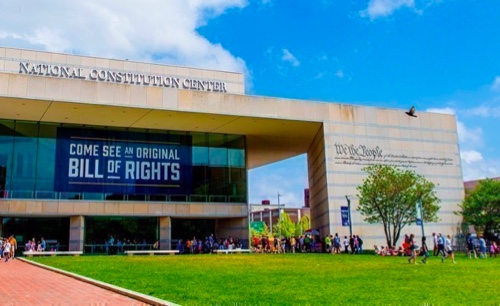

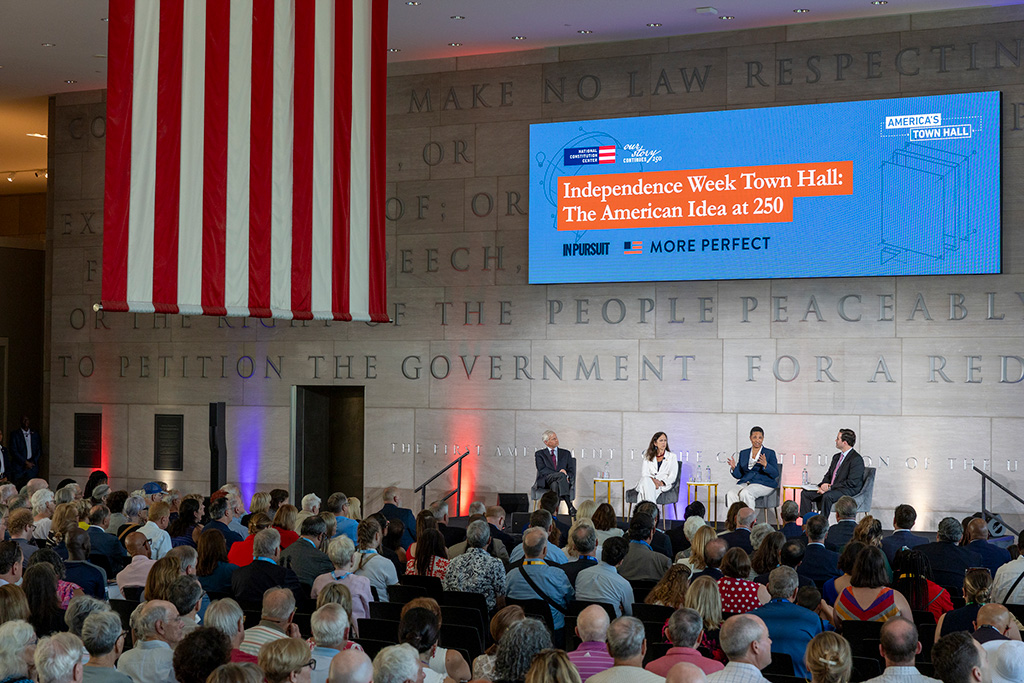
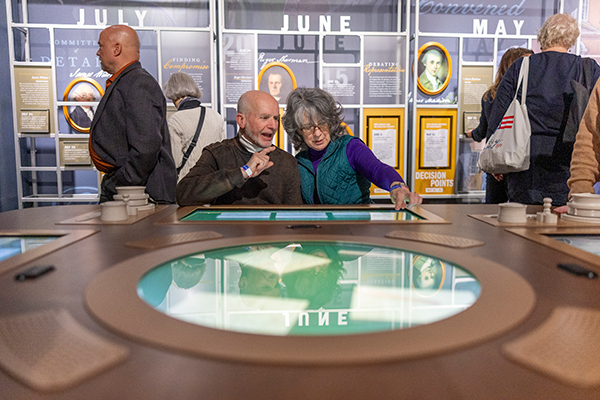

PHILADELPHIA, PA (August 13, 2026) — The National Constitution Center and Drexel University will present a new special exhibition, titled Pennsylvania’s Founding: How a City and a Colony Shaped America’s Civic DNA, from September 30, 2026, through January 3, 2027. In honor of the exhibit opening, the National Constitution Center will host a special public town hall program, The Holy Experiment: Religious Liberty, Pennsylvania, and the Making of America, on September 29.
The Center will host the exhibition on Pennsylvania’s early history as an essential chapter in America’s constitutional story, featuring original artifacts from collections across Philadelphia. Developed in partnership with Drexel University and curated by Drexel’s Lenfest Center for Cultural Partnerships and Atwater Kent Collection, the exhibition examines how Pennsylvania’s founding and Philadelphia’s development shaped ideas about representative government, religious liberty, civic participation, and constitutional self-government.
“The National Constitution Center is honored to host this important experience, which offers visitors rare opportunities to see the documents and artifacts that shaped Pennsylvania’s distinctive civic traditions and helped lay the groundwork for American constitutional democracy,” said Vince Stango, interim president and CEO of the National Constitution Center. “As we begin the Civic Decade, the years between the 250th anniversaries of the Declaration of Independence, the Constitution, and the Bill of Rights, it reminds us that constitutional democracy is not simply inherited. It is built and renewed by generations of people willing to put new ideas into practice, strengthen civic institutions, and expand the promise of self-government. By reflecting on those early experiments, we are reminded that each generation has a role to play in carrying America’s constitutional story forward.”
The opening of Pennsylvania’s Founding coincides with the 250th anniversary of the Pennsylvania Constitution of 1776, tracing a remarkable constitutional throughline across the documents on display. From a rare 1556 printing of Magna Carta owned by Benjamin Franklin and the 1681 Pennsylvania Charter to the documents that established Pennsylvania’s distinctive civic traditions, the exhibition explores the ideas about rights, representative government, and religious liberty that helped shape the Commonwealth’s first constitution. Adopted in Philadelphia in 1776, the Pennsylvania Constitution offered a bold vision of democratic government and became an important chapter in the continuing story of constitutional self-government in America.
“Drexel’s collections and exhibits professionals, as well as our students, have been privileged to collaborate with the National Constitution Center on this important show. In many ways, American history starts right here. This exhibit is a great way to tell that story to visitors—no matter where they’re from—as it’s a story that has resonance through the centuries to today,” said Rosalind Remer, PhD, senior vice provost of Drexel University Libraries, Collections & Archives.
This exhibition brings together for the first time original versions of several of the most important artifacts that helped define the civic character of early Pennsylvania and Philadelphia. Highlights include:
- Key materials linking William Penn’s legal vision to English constitutional tradition, including a 1556 edition of Magna Carta owned by Benjamin Franklin (Library Company of Philadelphia) and 1687 edition published by Penn himself (Haverford College)
- One of the original 1681 Pennsylvania Charters, with the seal of King Charles II, establishing the colony and granting Penn authority to govern (Private Collection)
- A Lenape wampum belt said to have been given to William Penn, associated with the 1682 Treaty of Shackamaxon, symbolizing a hoped-for moment of peace and cooperation (Atwater Kent Collection)
- Thomas Holme’s 1683 plan of Philadelphia, the first printed plan of the city and one of the earliest examples of planned urban design in North America (Atwater Kent Collection)
- Penn’s 1701 Charter of Privileges, a framework of government for Pennsylvania until 1776, establishing religious freedom and other protections (American Philosophical Society)
- Penn’s 1701 Charter of the City of Philadelphia, setting forth the governance bylaws for the incorporated city (City of Philadelphia Department of Records, City Archives)
- The 1696 Quaker Protest Against Slavery (Quaker & Special Collections, Haverford College, Haverford, PA), one of the earliest in the Americas, and materials connected to early abolitionist Benjamin Lay
- Rare 1776 copy of The Constitution of the Common-Wealth of Pennsylvania (Library Company of Philadelphia) printed by John Dunlap
The exhibition also features landmark original images and views of Philadelphia, including The South East Prospect of the City of Philadelphia (c. 1718), the oldest surviving painting of a North American urban center (Library Company of Philadelphia), and a series of 18th-century maps and views depicting the city through its rapid growth (Atwater Kent Collection).
The National Constitution Center will create and present a wide range of educational programming throughout the exhibition’s run, including interactive gallery talks for school groups, printed exhibit guides, family programs, artifact spotlights, and live virtual tours. Special events commemorating Native American Heritage Month and Pennsylvania Ratification Day will invite visitors to explore featured artifacts, including the Lenape wampum belt, the 1683 plan of Philadelphia, and the 1696 Quaker protest against slavery, through hands-on activities, historical interpretation, and conversations with museum educators.
Two interactive projects created with Drexel students accompany the exhibition: an interactive Timeline, tracing William Penn’s life and key events in the founding of Pennsylvania and Philadelphia, and Pennsylvania Mapped, exploring the region’s development through historic maps and illustrations, including Indigenous lands and the place names that connect past and present.
Organized in three sections—“A Holy Experiment,” “Selling an Ideal: Private Interest and the Commonwealth,” and “Liberty, Harmony, and the Struggle for Authority”—the exhibition examines Penn’s efforts to create a tolerant colony grounded in orderly settlement, English law, and freedom of conscience, while also confronting the realities of colonial life. The exhibition also addresses Penn’s promotion of religious tolerance and negotiated relationships with Indigenous peoples, as well as Penn’s own involvement in slavery and the colony’s evolving debate over it. These stories are told alongside the ways Penn’s ideals were complicated by land hunger, displacement, and conflict, including episodes such as the Walking Purchase.
Lenders to the exhibition include the American Philosophical Society, Atwater Kent Collection, Haverford College (Quaker & Special Collections), Library Company of Philadelphia, City of Philadelphia Department of Records (City Archives), Philadelphia Museum of Art, and an additional private lender.
Pennsylvania’s Founding: How a City and a Colony Shaped America’s Civic DNA is generously supported by the William Penn Foundation, Poor Richard’s Charitable Trust, Connelly Foundation, and Syde Hurdus Foundation.
A press kit is available and will be continually updated.
Earlier this year, the National Constitution Center opened two new permanent galleries in honor of America’s 250th: America’s Founding, which explores the ideas, events, and debates that shaped the Declaration of Independence and the U.S. Constitution, and Governing the Nation, which examines how the Constitution’s system of government has developed and operated throughout American history.
Media Contacts:
Annie Stone, [email protected]
Mike Tuberosa, [email protected]
About Drexel University
Drexel University is home to more than 10 unique libraries, collections, and archives that serve the University and our local, national, and international communities. This includes stewarding the Atwater Kent Collection–the collection of the former Philadelphia History Museum–more than 133,000 artifacts and archival materials reflecting more than 350 years of Philadelphia and American history. The Lenfest Center for Cultural Partnerships advances Drexel’s academic mission and civic engagement commitment while contributing to the success of cultural nonprofit partners, including supporting stewardship of the Atwater Kent Collection.
###
About the National Constitution Center
The National Constitution Center in Philadelphia brings together people of all ages and perspectives, across America and around the world, to learn about, debate, and celebrate the greatest vision of human freedom in history, the U.S. Constitution. A private, nonprofit organization, the Center serves as America’s leading platform for constitutional education and debate, fulfilling its congressional charter “to disseminate information about the U.S. Constitution on a nonpartisan basis.” As the Museum of We the People, the Center brings the Constitution to life for visitors of all ages through interactive programs and exhibits. As America’s Town Hall, the Center brings the leading conservative and liberal thought leaders together to debate the Constitution on all media platforms. As a Headquarters for Civic Education, the Center delivers the best educational programs and online resources that inspire citizens and engage all Americans in learning about the U.S. Constitution. For more information, call 215-409-6700 or visit constitutioncenter.org.