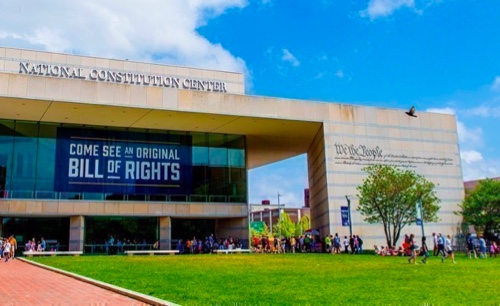


PHILADELPHIA, PA (March 11, 2026) — The National Constitution Center and Drexel University today announced a new special exhibition, Pennsylvania’s Founding: How a City and a Colony Shaped America’s Civic DNA, which will open to public view for free at the National Constitution Center from September 30, 2026 through January 3, 2027.
Initiated by a group of local funders and presented in partnership by the National Constitution Center and Drexel University, the exhibition is curated by the Drexel University Lenfest Center for Cultural Partnerships and features artifacts from the Atwater Kent Collection at Drexel and several other important Philadelphia institutions and collections. As the United States marks its 250th anniversary, the exhibition tells an earlier, essential story: how the founding of Pennsylvania in 1681 and the development of Philadelphia as a planned city helped shape the ideals, institutions, and civic habits that would later influence the American experiment.
“William Penn had a bold goal when he founded Pennsylvania in 1681: to prove that people of different religions and backgrounds could live together in harmony and prosperity,” said Rosalind Remer, PhD, senior vice provost of Drexel University Libraries, Collections & Archives. “More than any other English colony in North America, Pennsylvania was built on this idea. Drawing on founding documents and rare artifacts, the exhibition explores Penn’s vision, the ways it was realized, and how it was challenged and sometimes compromised by political, cultural, and economic pressures.”
“Philadelphia and Pennsylvania stand at the heart of the American constitutional story,” said Vince Stango, interim president and CEO of the National Constitution Center. “We are delighted to partner with Drexel to bring together extraordinary original artifacts that illuminate Penn’s commitment to freedom of conscience, the city he helped design, and the contested choices that helped define our nation’s opening chapters. During America’s 250th anniversary, this exhibition invites visitors to reflect on how these early experiments in self-government continue to shape our civic life today.”
Original Artifacts that Shaped Pennsylvania and America
For the first time, this focused exhibition brings together original versions of several of the most important artifacts that helped define the civic character of early Pennsylvania and Philadelphia. Highlights include:
- Key materials linking Penn’s legal vision to English constitutional tradition, including a 1556 edition of Magna Carta owned by Benjamin Franklin (Library Company of Philadelphia)
- The 1681 Pennsylvania Charter, signed by King Charles II, establishing the colony and granting Penn authority to govern (Private Collection)
- A Lenape wampum belt given to William Penn, associated with the 1682 Treaty of Shackamaxon, symbolizing a hoped-for moment of peace and cooperation (Atwater Kent Collection at Drexel)
- Thomas Holme’s 1683 plan of Philadelphia, the first printed plan of the city and one of the earliest examples of planned urban design in North America (Atwater Kent Collection at Drexel)
- Penn’s 1701 Charter of Privileges, a framework of government for Pennsylvania until 1776, establishing religious freedom and other protections (American Philosophical Society)
- The 1696 Quaker Protest Against Slavery (Quaker & Special Collections, Haverford College, Haverford, PA), one of the earliest in the Americas, and materials connected to early abolitionist Benjamin Lay
The exhibition also features landmark original images and views of Philadelphia, including The South East Prospect of the City of Philadelphia (c. 1718), the oldest surviving painting of a North American urban center (Library Company of Philadelphia), and a series of 18th-century maps and views depicting the city through its rapid growth (Atwater Kent Collection at Drexel).
A Clear-Eyed Look at the Ideals and the Difficult Questions
Organized in three sections—“A Holy Experiment,” “Selling an Ideal,” and “Liberty, Harmony, and the Struggle for Authority”—the exhibition examines Penn’s efforts to create a tolerant colony grounded in orderly settlement, English law, and freedom of conscience, while also confronting the realities of colonial life.
The exhibition addresses Penn’s promotion of religious tolerance and negotiated relationships with Indigenous peoples, as well as Penn’s own involvement in slavery and the colony’s evolving debate over it. These stories are told alongside the ways Penn’s ideals were complicated by land hunger, displacement, and conflict, including episodes such as the Walking Purchase.
Digital Experiences Developed with Drexel Students
The exhibition will feature two interactive digital projects developed with Drexel University students:
- Interactive Timeline — tracing William Penn’s life and key events in the founding and development of Pennsylvania and Philadelphia, connected to themes and artifacts on view
- Pennsylvania: Mapped — exploring the region’s development through historic maps and illustrations, including Indigenous lands and the ways place names and street names connect past and present
Lenders, Admission, and Related Programs
Lenders to the exhibition include the American Philosophical Society, Atwater Kent Collection at Drexel, Haverford College (Quaker & Special Collections), the Library Company of Philadelphia, and additional institutional and private lenders.
Admission is free. Related education programs and public events will accompany the exhibition throughout its run.
Sponsors
Pennsylvania’s Founding: How a City and a Colony Shaped America’s Civic DNA is generously supported by the William Penn Foundation, Poor Richard’s Charitable Trust, Connelly Foundation, and Syde Hurdus Foundation.
About Drexel University
Drexel University is home to more than 10 unique libraries, collections, and archives that serve the University and our local, national, and international communities. This includes stewarding the Atwater Kent Collection at Drexel–the collection of the former Philadelphia History Museum–more than 133,000 artifacts and archival materials reflecting more than 350 years of Philadelphia and American history. The Lenfest Center for Cultural Partnerships advances Drexel’s academic mission and civic engagement commitment while contributing to the success of cultural nonprofit partners, including supporting stewardship of the Atwater Kent Collection.
###
About the National Constitution Center
The National Constitution Center in Philadelphia brings together people of all ages and perspectives, across America and around the world, to learn about, debate, and celebrate the greatest vision of human freedom in history, the U.S. Constitution. A private, nonprofit organization, the Center serves as America’s leading platform for constitutional education and debate, fulfilling its congressional charter “to disseminate information about the U.S. Constitution on a nonpartisan basis.” As the Museum of We the People, the Center brings the Constitution to life for visitors of all ages through interactive programs and exhibits. As America’s Town Hall, the Center brings the leading conservative and liberal thought leaders together to debate the Constitution on all media platforms. As a Headquarters for Civic Education, the Center delivers the best educational programs and online resources that inspire citizens and engage all Americans in learning about the U.S. Constitution. For more information, call 215-409-6700 or visit constitutioncenter.org.