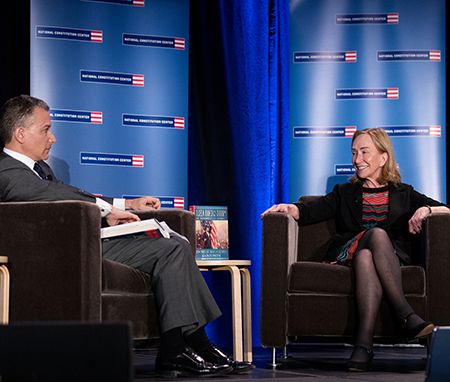



In this episode, Pulitzer Prize-winning historian David Levering Lewis joins to unpack Du Bois’ life, legacy, and enduring impact on American history and discuss his new memoir, The Stained Glass Window.
Follow We the People and Live at the National Constitution Center on Apple Podcasts, Spotify, or your favorite podcast app.
Today’s episode was produced by Bill Pollock and Griffin Richie. It was engineered by Bill Pollock. Research was provided by Gyuha Lee, Griffin Richie, Cooper Smith, Trey Sullivan and Tristan Worsham.
Participants
Daniel Levering Lewis is professor emeritus of history at New York University. A recipient of the National Humanities Medal, Lewis received the Pulitzer Prize for each volume of his W.E.B. Du Bois biography. He is the author of 11 books, including his new memoir, The Stained Glass Window: A Family History as the American Story, 1790–1958.
Jeffrey Rosen is the president and CEO of the National Constitution Center, a nonpartisan nonprofit organization devoted to educating the public about the U.S. Constitution. Rosen is also professor of law at The George Washington University Law School and a contributing editor of The Atlantic.
Additional Resources
- David Levering Lewis, The Stained Glass Window: A Family History as the American Story, 1790–1958, (2025)
- David Levering Lewis, W.E.B. Du Bois: A Biography 1868–1963, (2009)
- American Historical Association, “W.E.B. Du Bois (1868–1963): Historian, Sociologist, Editor, Activist,” Perspectives on History, (2023)
- W.E.B. Du Bois, The Talented Tenth, (1903)
- W.E.B. Du Bois, The Souls of Black Folk: Centennial Edition, (2003)
Excerpt from interview: David Levering Lewis describes Du Bois’s contributions to our understanding of the Reconstruction period.
David Levering Lewis: Nor were W.E.B. Du Bois' revisionist insights always appreciated by fellow historians, as when the paper presented at the 1909 annual AHA meeting confounded received professional wisdom in the presence of Columbia University's arbitral professor William Archibald Dunning. “Reconstruction and Its Benefits” was a brilliant prefiguration of Du Bois' magnum opus, Black Reconstruction in America, 1935. Scholarship that inspired, enhanced, and instigated the contemporary field consensus about the socio-racial, political, and economic long aftermath of the Civil War. The indebted acknowledgments of C. Vann Woodward, Kenneth Stamp, Leon Litwack, John Hope Franklin, Thomas Holt, and Eric Foner may be seen as posthumous professional consolations to an historian whose political heterodoxy in his final years invited the full wrath of the Cold War establishment.
He goes to the Soviet Union. He's profoundly impressed by its progress, as so many intellectuals of the time were. It was obligatory indeed for an intellectual to visit the Soviet Union in those days of the 1920s and 30s. And for Du Bois, because of the apparent absence of racism in that experiment, he drifted or marched left. And he did so also for reasons of scholarship. As he looked at the injustices that had flown from the destroyed Reconstruction period and the Redemption of the South, he revised his appreciation of the failures of Reconstruction. And so in 1935, having come back from the Soviet Union, he published Black Reconstruction in America, which had eventually a profound impact on the scholarship that we today live by.
Full Transcript
View Transcript (PDF)
Stay Connected and Learn More
- Questions or comments about the show? Email us at [email protected]
- Continue the conversation by following us on social media @ConstitutionCtr
- Sign up to receive Constitution Weekly, our email roundup of constitutional news and debate
- Follow, rate, and review wherever you listen
- Join us for an upcoming live program or watch recordings on YouTube
- Support our important work