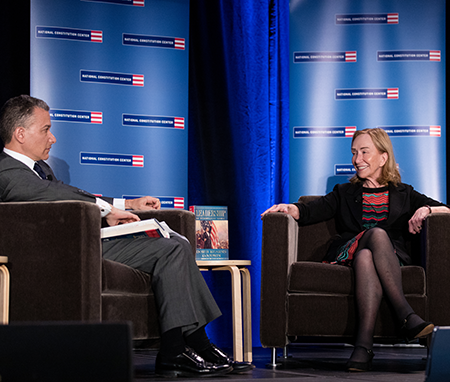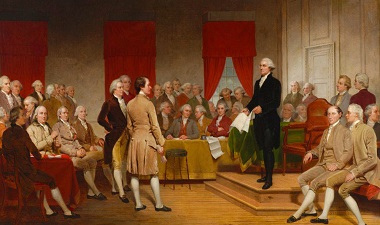





In this episode we’re sharing a live conversation that explores James Madison’s vision for the constitution with Mary Sarah Bilder of Boston College Law School, Robert P. George, of Princeton University, and Jonathan Rauch of The Brookings Institution. Julie Silverbrook, chief content and learning officer at the National Constitution Center, moderates.
This conversation was recorded on February 20, 2026, as part of the NCC’s President’s Council Retreat in Miami, FL.
Follow We the People, Live at the National Constitution Center, and Pursuit: The Founders’ Guide to Happiness on Apple Podcasts, Spotify, or your favorite podcast app.
This episode was produced and mixed by Bill Pollock. It was recorded by Advanced Staging Productions. With production support from Charles Sahm. Research was provided by Anna Salvatore, Trey Sullivan, and Tristan Worsham.
Participants
Mary Sarah Bilder is Founders Professor of Law and Michael and Helen Lee Distinguished Scholar at Boston College Law School. She has published numerous articles and is the author of three books: Madison's Hand: Revising the Constitutional Convention, which was awarded the 2016 Bancroft Prize in American History and Diplomacy; The Transatlantic Constitution: Colonial Legal Culture and the Empire; and, most recently, Female Genius: Eliza Harriot and George Washington at the Dawn of the Constitution.
Robert P. George is the McCormick Professor of Jurisprudence and director of the James Madison Program in American Ideals and Institutions at Princeton University. He has served as chair of the United States Commission on International Religious Freedom (USCIRF), and before that on the President’s Council on Bioethics and as a presidential appointee to the United States Commission on Civil Rights.
Jonathan Rauch is a senior fellow in the governance studies program at The Brookings Institution and a contributing writer for The Atlantic. He is the author of numerous books, including The Constitution of Knowledge: A Defense of Truth, The Happiness Curve, and Gay Marriage. His newest book is Cross Purposes: Christianity’s Broken Bargain with Democracy.
Julie Silverbrook is chief content and learning officer at the National Constitution Center where she leads the Center’s content and learning strategy and drives the development and national distribution of its educational resources and programs.
Additional Resources
- Mary Sarah Bilder, Madison's Hand: Revising the Constitutional Convention (2017)
- Mary Sarah Bilder, Female Genius: Eliza Harriot and George Washington at the Dawn of the Constitution (2022)
- Robert P. George, Making Men Moral: Civil Liberties and Public Morality (1995)
- Robert P. George, Natural Rights, the Common Good, and the American Revolution (America at 250) (2026)
- Jonathan Rauch, Cross Purposes: Christianity's broken bargain with democracy (2025)
- Jonathan Rauch, The Constitution of Knowledge: A Defense of Truth (2021)
- Federalist 10 (1787)
- Robert Tracy McKenzie, We the Fallen People: The Founders and the Future of American Democracy (2021)
- National Constitution Center, What the Founders Meant by Happiness: A Journey Through Virtue and Character
Excerpt from interview: Sarah Mary Bilder on inclusivity and the founding documents.
Sarah Mary Bilder: I think the great, amazing thing about this period is a set of documents come into existence that, regardless of what various people who wrote those documents might have imagined, other people hear them as, ‘That belongs to me. That is also my story.’ And what it means to be an American is to be part of that story.
Excerpt from interview: Robert P. George on the importance of structural constraints on power.
Robert P. George: Madison and his associates’ genius, in my opinion, was understanding… that the real protection against tyranny, the real protection of liberty understood as the absence of tyranny, is to be found in structural constraints on power, power checking power, power being rendered accountable.
Excerpt from interview: Jonathan Rauch on challenge of establishing a republic that is both dynamic and stable.
Jonathan Rauch: Madison solves the core problem of how do you make a republic both dynamic and stable?... if you divide government in various ways and then force factions into a constant state of negotiation with each other so that they have to compromise all the time to get anything done, you can create… both stability and constant adaptive change.
Full Transcript
View Transcript (PDF)
This transcript may not be in its final form, accuracy may vary, and it may be updated or revised in the future.
Stay Connected and Learn More
- Questions or comments about the show? Email us at [email protected]
- Continue the conversation by following us on social media @ConstitutionCtr
- Explore the America at 250 Civic Toolkit
- Sign up to receive Constitution Weekly, our email roundup of constitutional news and debate
- Subscribe, rate, and review wherever you listen
- Join us for an upcoming live program or watch recordings on YouTube
- Support our important work