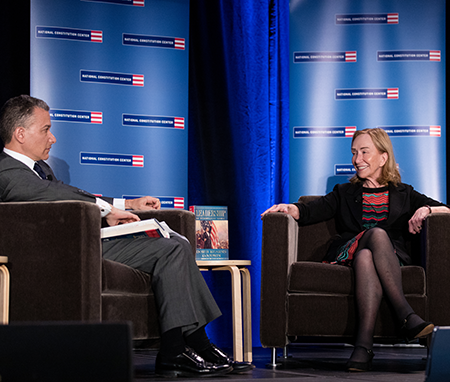

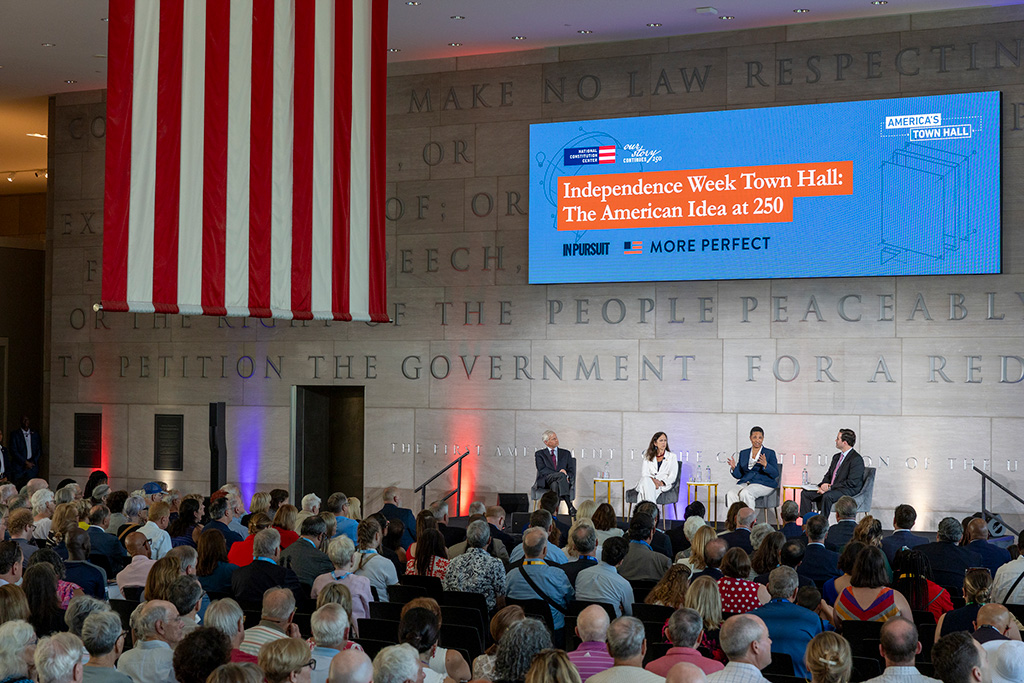


In celebration of Native American Heritage Month, award-winning historian Kathleen DuVal discusses her new book, Native Nations: A Millennium in North America, which traces a thousand years of Native history—from the rise of ancient cities and the arrival of Europeans to today’s ongoing fights for sovereignty. Thomas Donnelly, chief scholar of the National Constitution Center, moderates. This conversation was originally streamed live as part of the NCC’s America’s Town Hall program series on November 4, 2025.
Follow We the People, Live at the National Constitution Center, and Pursuit: The Founders’ Guide to Happiness on Apple Podcasts, Spotify, or your favorite podcast app.
Today’s episode was produced by Bill Pollock and Griffin Richie. It was recorded by Scott Bomboy and Greg Scheckler, and mixed by Bill Pollock. Research was provided by Griffin Richie, Anna Salvatore, Trey Sullivan, and Tristan Worsham.
Participants
Kathleen DuVal is Carl W. Ernst Distinguished Professor of History at the University of North Carolina at Chapel Hill, where she specializes in early American and Native American history. DuVal is the author of several publications including Give Me Liberty!, co-authored with Eric Foner and Lisa McGirr (2025), Independence Lost: Lives on the Edge of the American Revolution (2015), and Native Nations: A Millennium in North America (2025). DuVal is a Pulitzer Prize winner and a Guggenheim fellow. She is an elected fellow of the American Antiquarian Society and the Society of American Historians.
Thomas Donnelly is chief scholar at the National Constitution Center. Prior to joining the Center in 2016, he served as counsel at the Constitutional Accountability Center, as a Climenko Fellow and Lecturer on Law at Harvard Law School, and as a law clerk for Judge Thomas Ambro on the U.S. Court of Appeals for the Third Circuit.
Additional Resources
- Kathleen DuVal, Native Nations: A Millenium in North America (2025)
Excerpt from interview: Kathleen DuVal explains how Native governance structures inspired the Founding Fathers
Kathleen DuVal: The Mohawks, by this point, are one of the six nations of the Haudenosaunee, or Iroquois Confederacy. And so, each of the six nations governs itself locally, male and female leaders govern locally. And then the female clans in the various nations choose representatives who go to the Haudenosaunee Council, or Iroquois Council, to represent them. And so, it's a representative democracy. And it also has the kinds of checks and balances I was talking about earlier. So male and female power, towns versus nations, versus the Council. And the nations retain their sovereignty even within this confederacy. And so, not to go too far forward yet, but this is something that at the founding of the United States, that leaders like Benjamin Franklin know. They know this is a model of a kind of confederacy wherein the parts, which for them will be the states will retain sovereignty, even as they confederate to become more powerful. And the reason they know that is because Haudenosaunee diplomats tell them over, and over, and over. So there's so many councils where colonists are at, where the Haudenosaunee say, because, as you say, Thomas, because they're really evangelists adopt their way of politics. They say, this is the best way. The kind of democracy, the kind of representative democracy, the kind of balance that we have, the Great Peace, they call it that because it came out time immemorial, came out of a time of war, where the five nations at the time were fighting against one another. And within themselves, they came out... They created the Great Peace and created the system. But it also was a system that they felt mandated to spread, and share, and describe to people. Including, eventually, colonists, who would be forming their own confederacy.
Full Transcript
View Transcript (PDF)
This transcript may not be in its final form, accuracy may vary, and it may be updated or revised in the future.
Stay Connected and Learn More
- Questions or comments about the show? Email us at [email protected]
- Continue the conversation by following us on social media @ConstitutionCtr
- Explore the America at 250 Civic Toolkit
- Explore Pursuit: The Founders’ Guide to Happiness
- Sign up to receive Constitution Weekly, our email roundup of constitutional news and debate
- Follow, rate, and review wherever you listen
- Join us for an upcoming live program or watch recordings on YouTube
- Support our important work