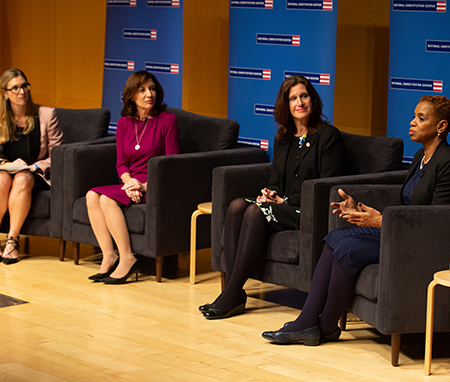

In celebration of Native American Heritage Month, award-winning historian Kathleen DuVal discusses her new book, Native Nations: A Millennium in North America, tracing a thousand years of Native history—from the rise of ancient cities and the arrival of Europeans to today’s ongoing fights for sovereignty. Thomas Donnelly, chief scholar of the National Constitution Center, moderates.
Video
Podcast
Participants
Kathleen DuVal is Carl W. Ernst Distinguished Professor of History at the University of North Carolina at Chapel Hill, where she specializes in early American and Native American history.
DuVal is the author of several publications including Give Me Liberty!, co-authored with Eric Foner and Lisa McGirr (2025), Independence Lost: Lives on the Edge of the American Revolution (2015), and Native Nations: A Millennium in North America (2024). DuVal is a Pulitzer Prize winner and a Guggenheim fellow. She is an elected fellow of the American Antiquarian Society and the Society of American Historians.
Thomas Donnelly is chief scholar at the National Constitution Center. Prior to joining the Center in 2016, he served as counsel at the Constitutional Accountability Center, as a Climenko Fellow and Lecturer on Law at Harvard Law School, and as a law clerk for Judge Thomas Ambro on the U.S. Court of Appeals for the Third Circuit.
Additional Resources
- Kathleen DuVal, Native Nations: A Millenium in North America (2025)
Excerpt from interview: Kathleen DuVal hopes to provide readers with a more expansive view of Native history
Kathleen DuVal: Well, I've worked on early American history my whole career, and Native American history is a central, maybe the central part of that. I've always been interested in the interactions among different European groups, different European groups... I'm sorry, different European groups, different African groups and different Native groups. And I teach a class on Native North America. And it starts long, long ago, many, many millennia ago, and goes to the present. And one of the things I've come to love about that class is that every student who takes it, ends up realizing that Native Americans have not only been here a long time, they've been in diverse sovereign polities, for much longer than Europeans, and Africans, and Asians have been here, and that they're still here today. That they're still here not only as Native Americans, individually, but as Native Nations. And I just wanted to give readers a little taste of that big truth, that long, long history. And you talk about kids learning Native history, and I think.... I have a teenager and a 21 year old, and I've been watching them through various levels of school. And I think early on, we tend to teach kids a very sort of generic, static sort of... in the past version of Native history. And they learn about how Native Americans used to do things, and used to build fires, and things like that. And then as they get older, into high school, and into adulthood, maybe they learn about Indian removal, and the residential schools, and the real traumatic tragedies of Native history. And that's not enough. Like, those two things, that's such a tiny tidbit of the huge complexity that is Native history, I'd say especially... I mean, the second part, the tragic part, is super important. And of course, we should all know that; the first part, the build things, fire... That way, then maybe we could get rid of that completely. But there's so much more. And I think I wanted to give readers just a little bit of that.
Full Transcript
View Transcript (PDF)
This transcript may not be in its final form, accuracy may vary, and it may be updated or revised in the future.
Stay Connected and Learn More
- Questions or comments about the show? Email us at [email protected]
- Continue the conversation by following us on social media @ConstitutionCtr
- Explore theAmerica at 250 Civic Toolkit
- Sign up to receive Constitution Weekly, our email roundup of constitutional news and debate
- Subscribe, rate, and review wherever you listen
- Join us for an upcoming live program or watch recordings on YouTube
- Support our important work