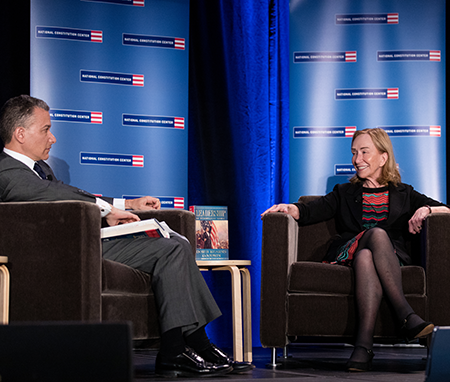

In this episode, prize-winning author and historian Fergus M. Bordewich discusses his latest book, Centennial: The Great Fair of 1876 and the Invention of America’s Future, which explores the story of the nation’s 100th birthday and the first world’s fair. Bordewich traces the lives of President Rutherford B. Hayes, the inventor Alexander Graham Bell, railroad magnate Tom Scott, and the African American sculptor Edmonia Lewis—revealing a country striving to live up to the promise of the founders while bracing for the tidal wave of the 20th century. Thomas Donnelly, lead scholar at the National Constitution Center, moderates.
Follow We the People, Live at the National Constitution Center, and Civic Parenting on Apple Podcasts, Spotify, or your favorite podcast app.
This episode was produced and mixed by Bill Pollock. With production support from Charles Sahm. Research was provided by Anna Salvatore and Tristan Worsham.
Participants
Fergus M. Bordewich is an independent historian and writer. He is the author of numerous books about 18th- and 19th-century American history. He is a frequent public speaker at universities and other forums, as well as on radio and television. His writing on American history has appeared in many magazines and newspapers, including The New York Times, The Wall Street Journal, Smithsonian, American Heritage, The Atlantic, and others.
Thomas Donnelly is lead scholar at the National Constitution Center and a law professor at the University of Richmond. Prior to joining the Center in 2016, he served as counsel at the Constitutional Accountability Center, as a Climenko Fellow and lecturer on law at Harvard Law School, and as a law clerk for Judge Thomas Ambro on the U.S. Court of Appeals for the Third Circuit.
Additional Resources
- Fergus M. Bordewich, Centennial: The Great Fair of 1876 and the Invention of America’s Future (2026)
- Fergus M. Bordewich, Klan War: Ulysses S. Grant and the Battle to Save Reconstruction (2023)
- Fergus M. Bordewich, Congress at War: How Republican Reformers Fought the Civil War, Defied Lincoln, Ended Slavery, and Remade America (2020)
- Fergus M. Bordewich, The First Congress: How James Madison, George Washington, and a Group of Extraordinary Men Invented the Government (2016)
- Fergus M. Bordewich, America’s Great Debate: Henry Clay, Stephen A. Douglas, and the Compromise that Preserved the Union (2012)
- The Hayes-Tilden Election of 1876, Live at the National Constitution Center (Oct 13, 2020)
Excerpts from interview: Historian Fergus Bordewich argues that the Great Centennial Exhibition of 1876 celebrated a triumphant, industrializing America while also reflecting the era’s deep failures on race, labor, and Native and women’s rights.
Fergus Bordewich: Yeah, that is a really good question. And that, I wrestled with that actually, because the framework here is that people loved this fair. 10 million people came. It was 20% of the American population. They loved it. They loved this great celebration. They'd never seen anything like this before. But unemployment had run as high as 30% in the United States in some industries, and 15% baseline, often as high as 30% since 1873. The country was lurching towards recovery, but it certainly wasn't there. I mean, imagine, it's easy because we have some of the same things today, there were homeless people all over the streets, very, very often written about, say, in New York in particular. Homeless people, people crouching in doorways, people crowding into police stations just to be out of the inclement weather. In those days, there was no social safety net. Zero. None. None. Hadn't been invented. And indeed, many leading Americans, including churchmen, opposed anything like a safety net because the ethics of the time, the common morality of the time, considered that people were all responsible for themselves, and if they were out of work and poor, it was their own bad luck or they weren't working hard enough. And I do talk about this in my book, actually. It's shocking, it's quite shocking how callous many Americans of the time were.
Fergus Bordewich: And Tom Scott therefore embodied that. He also made the Pennsylvania Railroad the chief backer of the Great Centennial Exhibition. It wouldn't have happened without Tom Scott. He twisted arms and, frankly, passed quite a bit of money under the table to the Pennsylvania State Legislature to approve this and appropriate money for the Centennial Exhibition. He also stands at the intersection of big money and politics. He is an ardent Republican. Bear in mind that the Republican Party, since its founding in the 1850s, had been the progressive party of its day. Okay? Through the 1870s, Black Americans who can vote are all Republicans because the Republican Party, of course, led the Union to victory during the war. And where there are radicals in government, they're all Republicans. Tom Scott was, like many of his peers, a radical on slavery. At any rate, by the 1870s, he is what in our present-day terms you might call a reactionary on the subject of labor. Sounds like a contradiction. It wasn't in the 19th century. And by writing about Tom Scott enables me also to talk about how the Republican Party by the 1870s has become the party of big money and is rapidly shedding its reformism. Hasn't totally gone. Hasn't totally gone, but you see it kind of hanging in shreds by 1876.
Fergus Bordewich: So it gets down to politics, which significantly played a role in the 1876 presidential election. At the same time, African Americans are more involved in public life than ever because slavery is over. And however, in spite of the fact that some of the figures that were managing, running, and organizing the great Centennial Exhibition came out of the abolitionist movement, they were former federal high-ranking officers and so on and supported civil rights and the radical wing of the Republican Party, the Centennial itself actually was built on a racist foundation. Because one, African Americans were not permitted to have a pavilion of their own. They wanted one, they were not permitted. There were very, vanishingly few black Americans who had exhibits, including a very important Philadelphian, by the way, William Still. William Still, famous within to historians anyway, as the head of the Underground Railroad pre-war, pre-Civil War in Philadelphia, and whose record of the Underground Railroad is the best that survived, 700 pages of detail about people who passed through his office. He wrote that to be... Partly to sell it at the great Centennial Exhibition. And he had a stand there in which he was... Where he was selling the books. There is no information about his experience there. Very frustrating. I would like to have written more, but there's just nothing survives that I found. Anyway, so African Americans were pretty much excluded as exhibitors. Were they welcome as visitors, tourists?
Fergus Bordewich: So the more... The Women's Pavilion did not welcome the radicals. They were distressed by them. There was one little corner of the Women's Pavilion which had a little display hidden in the shadows of paper material from Stanton's and Anthony's group. But at any rate, Susan B. Anthony basically stole the show on July 4, 1876. July 4th was the pivotal day of the entire Centennial, because the whole Centennial was meant to memorialize and celebrate the Declaration of Independence. So at any rate, there was another huge program on a huge platform with hundreds of people seated and so on, and various dignitaries led by the Vice President of the United States. He's actually a US Senator. Because the VP had died, the Senator has stepped in to fill that place. He was a pro-women's rights man, a senator from Connecticut. So politically, he was kind of aligned with the Anthony group. But he would not risk, nor would almost anybody in Congress risk, going out on a political limb to really advocate for legislation on behalf of women. Okay, at any rate, Anthony and a small group of her colleagues were on this huge platform, and when there was a lull, they rushed up to the... There's no microphone because there's no amplification, but at any rate, up to the podium where Vice President Ferry is standing and hand him a huge scroll. And what is it? It's the Women's Declaration of Rights.
Fergus Bordewich: Guilt-mongering about what our founders and their descendants might not have been is worthless. It's not history. It doesn't lead anywhere good. Okay? I mean, to deny the extraordinary, extraordinary political creativity and political courage of people like Madison and Jefferson, Washington, and many others, I mean, these men really deserve to be understood and honored for this extraordinary machine that they've built that's still here 250 years later. But let's be honest also about what happens to be true in the United States in the present day as in the 19th century. Yes, yes, labor was being squashed and brutalized in 1876. African Americans were being betrayed in 1876. Native Americans were losing their last chance at some kind of autonomy, organized autonomy in 1876, and so on. And racism, it has to be said, was as indelible a part of American history in 1876 as later, as the great struggle for expanding rights and constitutionalism and so on. We, I don't think we as a people, we're a mature people by now. We don't need to hide our history from ourselves. I think it's foolishness. And frankly, a lot of the darker side of American history is pretty interesting. Doesn't make us lesser people. Doesn't make it a lesser nation at all. We don't need comic book history anymore. We don't need it. Get rid of it. Get rid of it. It's boring. It's boring. It's shallow. And my point being that all Americans, everybody deserves to hear the truth. And we shouldn't be censoring each other from any end of the political spectrum.
Full Transcript
View Transcript (PDF)
This transcript may not be in its final form, accuracy may vary, and it may be updated or revised in the future.
Stay Connected and Learn More
- Stay connected with We the People—follow, rate, and review the show wherever you listen.
- Questions or comments? Email [email protected].
- Follow @ConstitutionCtr on social media and sign up to receive Constitution Weekly, our email roundup of constitutional news and debate.
- Support our important work by making a donation today.