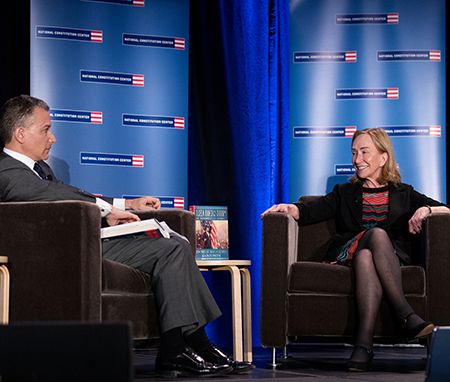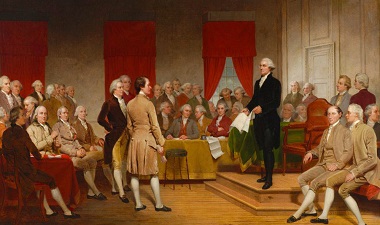

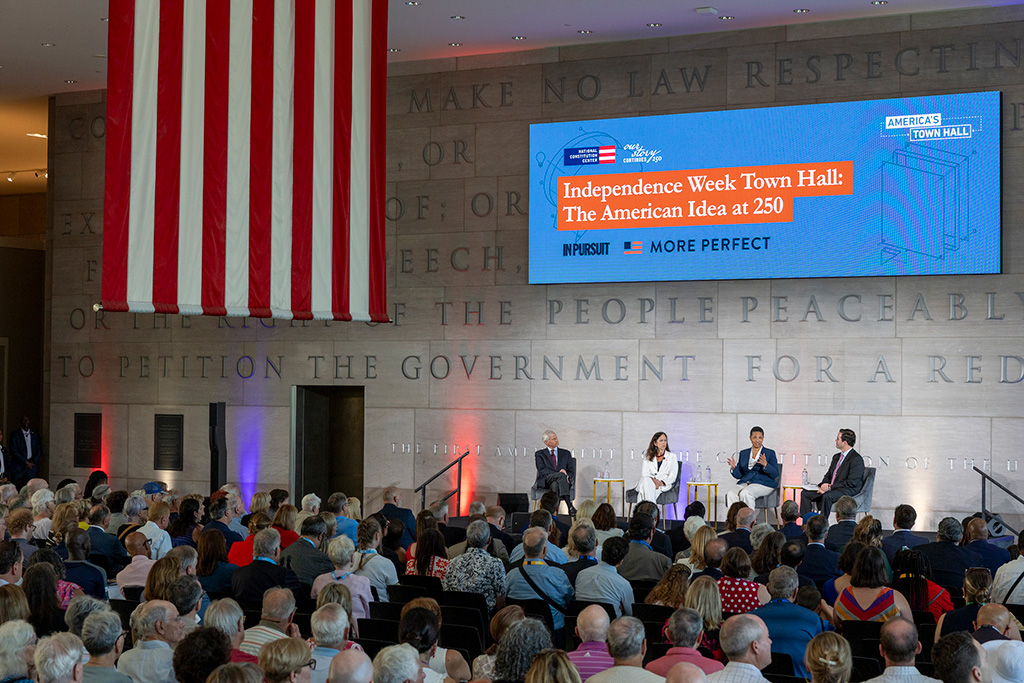



The National Constitution Center recently published The Promise of America: Reflections on Our Enduring Ideals (Simon & Schuster), a keepsake collection of essays bringing together leading thinkers from across perspectives to reflect on the ideals at the heart of the American experiment and what those principles have meant across generations of American life. In this episode, Professor Eric Slauter discusses his essay, “The Declaration’s Promises,” which explores how the Declaration of Independence evolved from a justification of America’s separation from the British Empire into a global charter of liberty. As Slauter writes, in 1776, “very few in the newly United States besides a small contingent of Black and white antislavery activists would have seen the Declaration as a document of radical egalitarianism or even as a founding document.” However, over time, figures like Elizabeth Cady Stanton, Frederick Douglass, Abraham Lincoln, and Martin Luther King Jr. transformed the phrase “all men are created equal” into a foundational national promise and a powerful tool for social change. As Slauter notes, “it is largely their Declaration, as much as Jefferson’s or Congress’s, that we continue to celebrate today.” Julie Silverbrook, chief content and learning officer at the National Constitution Center, moderates.
Follow We the People, Live at the National Constitution Center, and Civic Parenting on Apple Podcasts, Spotify, or your favorite podcast app.
This episode was produced and mixed by Bill Pollock. With production support from Charles Sahm. Research was provided by Anna Salvatore, Trey Sullivan, and Tristan Worsham.
Participants
Eric Slauter is deputy dean of the humanities and the college at the University of Chicago, where he serves as an associate professor in the Department of English, an associate faculty member in the Divinity School, and serves as the founding director of the Karla Scherer Center for the Study of American Culture. He is the author of The State as a Work of Art: The Cultural Origins of the Constitution and the forthcoming book The Promises of the Declaration.
Julie Silverbrook is chief content and learning officer at the National Constitution Center, where she leads the strategy, development, and delivery of the Center’s content, public programs, and educational initiatives, advancing its mission of nonpartisan constitutional education and civil dialogue. She oversees the creation of public-facing constitutional content and works to ensure the Center’s programs, scholarly engagement, and educational resources operate as a coordinated national strategy serving students, educators, families, and lifelong learners across the country.
Additional Resources
- Eric Slauter, “The Declaration’s Promises”
- National Constitution Center, The Declaration of Independence
Eric Slauter describes how the promises of the Declaration of Independence have inspired generations of Americans.
Eric Slauter: It's a lovely, complicated story of how what is essentially the same document came to be understood in different ways at different times. And it's not an uncontested story, but it's a story that centers ordinary people’s voices in making that profound change. The Declaration we have all inherited is a profoundly different one, I think, than the one that they might have expected they were editing in July 3rd, July 4th, 1776. The most important thing to say is that, yes, extraordinary politicians and spokespeople like Lincoln and Frederick Douglass and Martin Luther King, Jr., exercise sort of incredible sway over how we understand this document. But they were hardly alone in doing it.
It's hard to think of a group that has not used the Declaration. So you could begin even earlier than Lincoln with anti-slavery activists who are also women's rights activists and who are employing the Declaration. So someone like Elizabeth Cady Stanton taking on and expanding or clarifying what the Declaration is meant to represent. You could look to the 1870s and the use of the Declaration in the suffrage movement all the way up through the 19th Amendment in 1920. You could look at the kind of quest for human rights that is represented by something like the Universal Declaration of Human Rights, the UN Declaration in the 1940s, and members of the NAACP like W.E.B. Du Bois, who are trying to bring a kind of indictment of the United States through an appeal to the world about the condition of black people in the United States, whether there are human rights violations and violations of the Declaration.
It has certainly been an inspirational document or a document that could be used to help expand ideas of liberty and equality for gays and lesbians in the 1970s, 1980s, all the way through the present. So it is very hard to find a group that has not in some way taken up the Declaration.
Full Transcript
View Transcript (PDF)
This transcript may not be in its final form, accuracy may vary, and it may be updated or revised in the future.
Stay Connected and Learn More
- Stay connected with We the People—follow, rate, and review the show wherever you listen.
- Questions or comments? Email [email protected].
- Follow @ConstitutionCtr on social media and sign up to receive Constitution Weekly, our email roundup of constitutional news and debate.
- Support our important work by making a donation today.