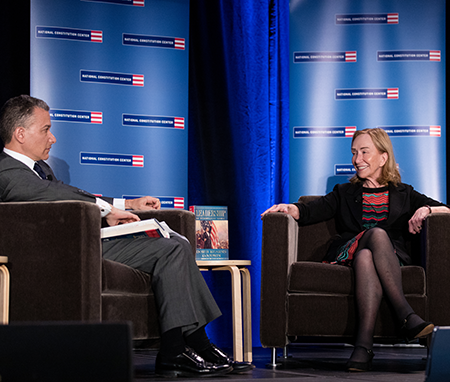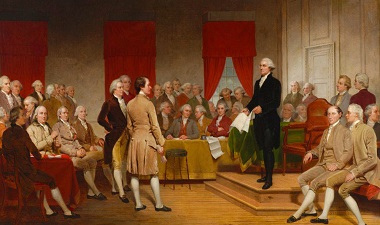

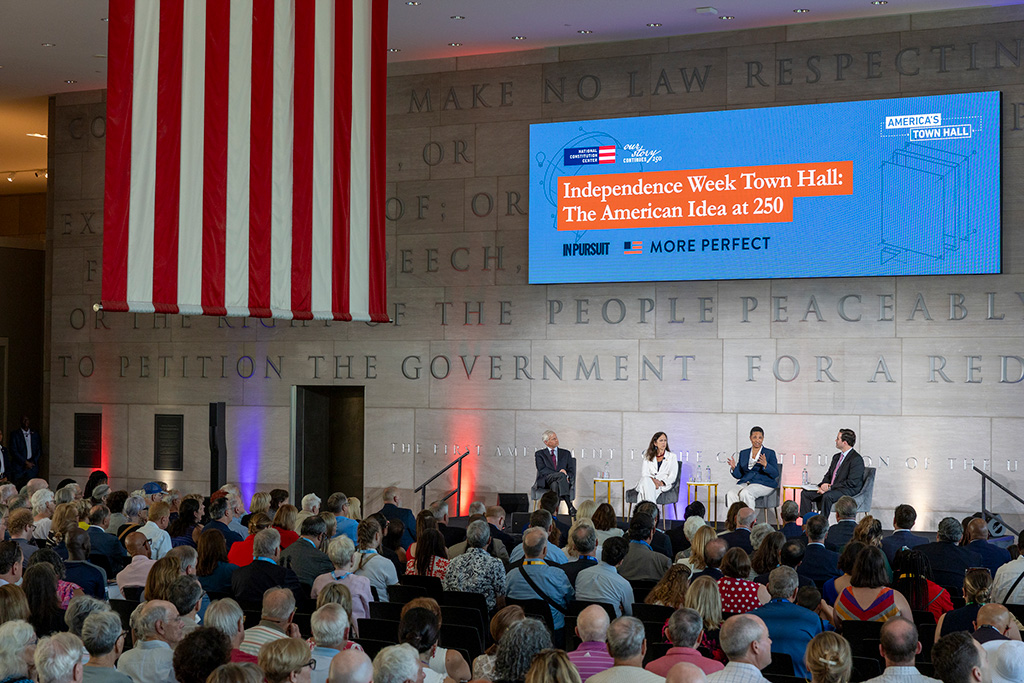



In this episode, Thomas Berry of the Cato Institute and Jed Shugerman of the Boston University School of Law join the recap the oral arguments from Trump v. Slaughter and debate whether the statutory removal protections for members of the Federal Trade Commission violate the separation of powers. Jeffrey Rosen, president and CEO of the National Constitution Center, moderates.
Follow We the People, Live at the National Constitution Center, and Pursuit: The Founders’ Guide to Happiness on Apple Podcasts, Spotify, or your favorite podcast app.
Today’s episode was produced by Bill Pollock and Griffin Richie. It was engineered by Sedona LaMarre and Bill Pollock. Research was provided by Griffin Richie, Anna Salvatore, Trey Sullivan, and Tristan Worsham.
Participants
Thomas Berry is the director of the Cato Institute’s Robert A. Levy Center for Constitutional Studies and editor in chief of the Cato Supreme Court Review. Before joining Cato, he was an attorney at the Pacific Legal Foundation.
Jed Shugerman is Professor, Joseph Lipsitt Scholar, and Henry Elwood Warren Scholar at Boston University School of Law. The author of several law review articles about the original public meaning of Article II, he is currently working on two books about the history of executive power and prosecution in America.
Jeffrey Rosen is the president and CEO of the National Constitution Center, a nonpartisan nonprofit organization devoted to educating the public about the U.S. Constitution. He is also professor of law at the George Washington University Law School and a contributing editor of The Atlantic. His new book is Pursuit of Liberty: How Hamilton vs. Jefferson Ignited the Lasting Battle over Power in America.
Additional Resources
- Thomas Berry, Brief of the Cato Institute as Amicus Curiae in Support of Petitioners (10/17/2025)
- Jed Shugerman, Brief Amicus Curiae of Professor Jed Handelsman Shugerman in Support of Respondents (11/14/2025)
- Jed Shugerman, “The Indecisions of 1789: Inconstant Originalism and Strategic Ambiguity” (2023)
- Jane Manners and Lev Menand, “The Three Permissions: Presidential Removal and the Statutory Limits of Agency Independence” (2021)
- Marbury v. Madison (1803)
- Myers v. United States (1926)
- Humphrey’s Executor v. United States (1935)
- Morrison v. Olson (1988)
- Seila Law LLC v. CFPB (2020)
Excerpt from interview: Jed Shugerman argues that the Founding-era record and ratification debates provide no support for a sweeping presidential “removal power,” and that there’s a long historical tradition of treating quasi-judicial executive offices as properly independent from at-will presidential control.
Jed Shugerman: Yeah, let me go through that step by step and take a big step back to your question both geographically and chronologically. So it is true as you just said, exactly right. The Convention never talked about a removal power of anyone's, and not the Senate's, not the Senate's and the Presidents. It was something left open ended. And in fact when there are debates about the executive power, the debate made it very clear that whatever executive power meant, James Wilson considered one of the architects of Article II, said heaven forbid anyone think that I'm suggesting that it is inclusive of royal prerogatives. So there is first of all the question of even if there's an assumption of what the royal prerogatives were, they knew that it would be odd that the revolution against the royalism and also extensive parliamentary power that they would endorse indefeasible power by many people. There is a theory of checks and balances. So then Jeffrey, why did the ratification debates in all of those volumes? Jonathan Gienapp and I have gone through the entire Anti-Federalists debates and have challenged the unitary executive theorists to come up with a single example of any one of the ratification debates either suggesting it because they wanted it or here's the more interesting question.
If you were an Anti-Federalist, wouldn't an obvious argument, whether you believed it or not, wouldn't it be important to warn people that the Article II presidential power was going to include things like removal power? They warned about the veto, they warned about pardons, and they warned about the commander-in-chief. And the one example that the unitary executive theorists point to is wrong. So Luther Martin invokes not executive power. He says that the president seems to have a power to fire military officials under the Commander-in-Chief Clause. We call that a dog that didn't bark. Now, let me take a step back to the history here. There's a reason why. It wasn't that the assumption was obvious that there would be removal power, but it was quite the opposite. So this is work that I and other historians have done. I want to explicitly direct readers to Jane Manners and Lev Menand's outstanding article, The Three Permissions, that also has this background. I wrote a couple of articles, but the most recent is called Venality and the explanation is that it was quite functional in an era without phones or cars or digital communication to have other systems for decentralizing power.
But I do want to go back to this question exactly on this last point you were raising about Humphrey's Executor, Jeffrey, and the use of the term quasi-judicial. This is a piece I've just uploaded with a co-author, Beau Baumann, an outstanding young scholar, and it's called Quasi-Judicial: A History and Tradition. From English history to the founding, to Madison's proposed comptroller, to Hamilton's sinking fund, to Marbury, all the way up to Humphrey's, there is a history and tradition and a through line of an original public meaning, an original understanding that quasi-judicial executive offices should be independent. Let me be very specific. One, I mean, I haven't even talked about Madison yet, so I haven't talked about Madison v. Marbury or Marbury v. Madison. One, in Federalist No. 39, let me go back and quote what Madison said. So Hamilton originally thought it was the Senate. Madison originally thought this was a congressional power. This is Madison in Federalist No. 39. The tenure by which the judges are to hold their places is, as it unquestionably ought to be, that of good behavior. The tenure of the ministerial offices will be subject of legal regulation conformably to the reason of the case and example of the state constitutions. Which were, by the way, a mix of different practices, especially under quasi-judicial.
Excerpt from interview: Thomas Berry says removal turns on the Appointments Clause. Since officers are appointed through a President–Senate partnership, the early question was whether removals also required Senate consent, but the 1789 settlement favored presidential at-will removal of Cabinet officials.
Thomas Berry: Sure. So I think to understand Article II and the removal question, you have to also understand the Appointments Clause. And I'm not just saying that because I'm an Appointments Clause nerd, but they really are closely tied together. And there was much more debate at the Constitutional Convention about the Appointments Clause rather than the removal power. So there was the debate and a lot of shifting perspectives about whether the President should appoint unilaterally, whether the Senate should appoint some or all officers, and then eventually they compromised on the system we know well now, which is the President nominates officers and then the Senate provides its advice and consent. So they can't enter office without the Senate saying we approve and think this person is qualified. So Gouverneur Morris famously said that this was the best of both worlds. You'd have accountability in the President, but security in the Senate to make sure he didn't just pick a crony. And one of the things they were concerned about is that a President from Massachusetts might only know friends and family from Massachusetts. A president from Virginia might only appoint people from Virginia. So this Senate consent and advice would allow a more national pool of people being picked.
So given that we ended up with that system, this kind of weird combined system of presidential nomination and Senate confirmation, the question then becomes, how does that interact with what was considered essentially the default common law rule for appointments going back to English common law, which is that the power to appoint comes with the power to remove? And you can in fact think of it in some cases as removal didn't even need to formally happen. Just if someone had the power to appoint to an office, they could appoint a new person while an old person was still in there. And simply the appointment of the new person meant, okay, this is automatically kicking out the old person. So that was sort of the default rule that made sense for them. But then, as you mentioned, this decision of 1789, when they're creating the first cabinet offices, the Secretary of War, the Secretary of Treasury, et cetera, they're thinking, well, how does that rule, how does that sort of default standard apply now to this odd combination system we have of appointments? If the President appoints with the Senate combined, does that mean the President can only remove with the Senate consent?
Is it the mirror image of the system that we have? So these were essentially the two sides or the two main proponents. One side wanted to create systems that said these Cabinet secretaries could only be removed with the consent of the Senate. The other side wanted to say, no, it's just in the President himself. And they looked to a few clauses in the Constitution for why that made more sense, focusing on the vesting of all executive power in the President. Ultimately, the statute that they passed did not include any provision giving the Senate any say over who's removed. It doesn't even explicitly sort of say who has the power to remove, but it obliquely refers to what happens when someone is removed. And so in effect, the result of that, the practice afterward, was at will removal by the President of those cabinet members who were created in 1789.
Full Transcript
View Transcript (PDF)
This transcript may not be in its final form, accuracy may vary, and it may be updated or revised in the future.
Stay Connected and Learn More
- Questions or comments about the show? Email us at [email protected]
- Continue the conversation by following us on social media @ConstitutionCtr
- Explore the America at 250 Civic Toolkit
- Explore Pursuit: The Founders’ Guide to Happiness
- Sign up to receive Constitution Weekly, our email roundup of constitutional news and debate
- Follow, rate, and review wherever you listen
- Join us for an upcoming live program or watch recordings on YouTube
- Support our important work: