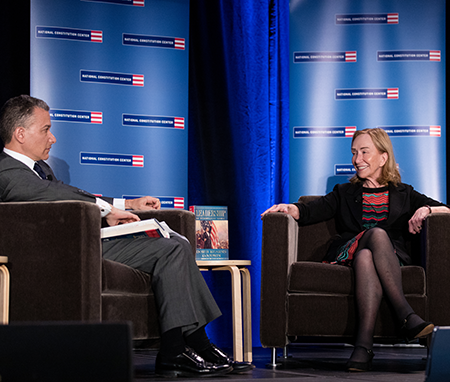

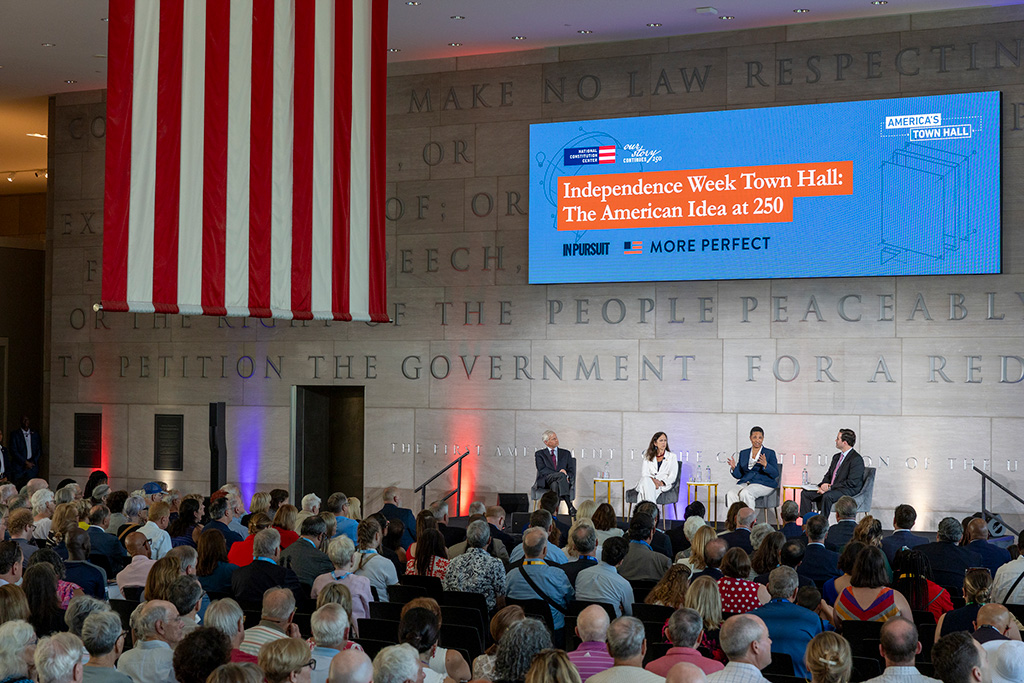

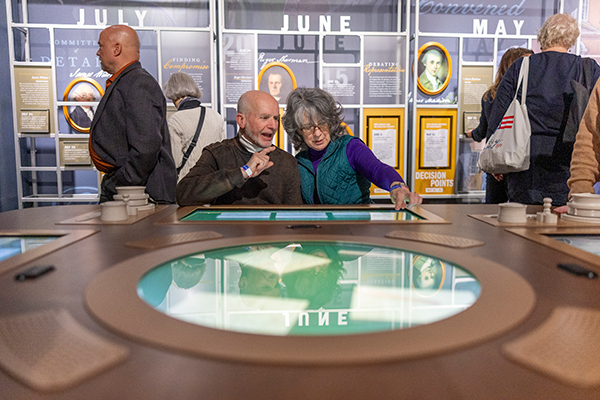

Acclaimed historians Mary Beth Norton, the Mary Donlon Alger Professor Emerita of American History at Cornell University, and Rosemarie Zagarri, distinguished university professor of history at George Mason University, examine how women influenced the political, social, and intellectual currents of the American Revolution. The conversation explores how women’s experiences and contributions deepen and expand our understanding of America’s founding. Julie Silverbrook, chief content and learning officer at the National Constitution Center moderates.
This program was streamed live from Philadelphia on March 23, 2026, as a part of the NCC's America's Town Hall Series.
Follow We the People, Live at the National Constitution Center, and Pursuit: The Founders’ Guide to Happiness on Apple Podcasts, Spotify, or your favorite podcast app.
This episode was produced and mixed by Bill Pollock. It was recorded by David Stotz and Greg Scheckler. With production support from Charles Sahm. Research was provided by Anna Salvatore, Trey Sullivan, and Tristan Worsham.
Participants
Mary Beth Norton, the Mary Donlon Alger Professor Emerita at Cornell University, is a leading scholar of women’s history, particularly in the colonial and Revolutionary eras. She is the author of five books and co-editor of several others. Her works include Founding Mothers & Fathers, In the Devil’s Snare, and 1774: The Long Year of Revolution. Norton also co-authored the widely used textbook A People and a Nation. Her latest work, “I Humbly Beg Your Speedy Answer”: Letters on Love & Marriage from the World’s First Personal Advice Column, was published last year.
Rosemarie Zagarri is a distinguished university professor at George Mason University. She has published four books, including Revolutionary Backlash: Women and Politics in the Early American Republic, and A Woman’s Dilemma: Mercy Otis Warren and the American Revolution. Her articles have appeared in leading scholarly journals and in numerous edited collections. Zagarri’s latest book project is titled Liberty and Oppression: Thomas Law and the Problem of Empire in Colonial British India and the Early American Republic. She is also the author of "The Declaration's Grievances Against the King," part of the National Constitution Center's Interactive Declaration of Independence project.
Julie Silverbrook is chief content and learning officer at the National Constitution Center where she leads the Center’s content and learning strategy and drives the development and national distribution of its educational resources and programs.
Additional Resources
- Mary Beth Norton, Founding Mothers & Fathers: Gendered Power and the Forming of American Society
- Mary Beth Norton, 1774: The Long Year of Revolution
- Rosemarie Zagarri, Revolutionary Backlash: Women and Politics in the Early American Republic
- Rosemarie Zagarri, “The Declaration’s Grievances Against the King”
Excerpt from interview: Mary Beth Norton explains how the Revolution impacted women of different races and classes.
Mary Beth Norton: Well, I think one of the most interesting things that I found was that if you look at records of enslaved people who ran away from plantations, before the war, basically they were almost all men. During the war, they were women and children who ran to the British Army. And that was because, as I said earlier, the British army offered freedom to slaves. They expected actually to be offering the freedom to male slaves because they wanted to use their labor, but women took advantage of it. And so many women ran away with their children. One reason why women didn't run away before was because they had children. They didn't want to leave the children. And so the Revolution really changed the patterns of enslaved... Of the lives of enslaved people who ran away. Now, as for free Black women, it's very hard to find their information, but I can say that there is some new scholarship coming out by a wonderful young scholar named Lauren Duval, who has worked on a particular problem. She has worked on the issue of what happens in American cities when they are occupied by the British army during the Revolution, and what does that do to American households.
And one of the things she discovered is that in those households, shall we say, servant women, whether they were free or enslaved and whatever race they were, tended to become, guess what? More uppity. [laughter] Because the male leadership of the household was in question. Because the... either they were gone, either they were rebels and they were off in the army, or they were off somewhere else, or they were being subsumed under the power of the occupying British army so they could not control the situation.
And as for Native women, a lot depended on what the role their particular nation chose. And of course, many of the Native groups in the colonies chose to align with the British because the British had been their major protector in the war, in the period before the war, it was the American settlers who wanted the land that the Native people had. And the British Indian agents were the ones who pretended to protect them. And so more Native groups aligned themselves with the British during the war than with the Americans. And that affected the women as well as the men of those Nations.
Excerpt from interview: Rosemarie Zagarri discusses republican motherhood/womanhood.
Rosemarie Zagarri: I'd just like to build on that a little bit and emphasize that this shift from a republic, I mean, from a monarchy under England to a republic, small “R” republic, transformed the way Americans thought about their roles and rights and responsibilities in this new government. And I think we don't think about that enough. We just throw around the term citizenship. But I think it's especially pertinent this time. In a monarchy, it was thought that the crown, the monarch was the ultimate repository safeguarding the people's rights and liberties. But that in a self governing system, a republic, that all the people bore the burden of governing themselves. And even non-voters, even non-voting white males, even women, should have a role to play in that new form of government. And you get a general push toward greater emphasis on education in the post Revolutionary period. This is why in the Northwest ordinance, in the areas that became Ohio and other new places, west of the Appalachian mountains, there's land set aside for schools. Because in this new form of government, you needed people who knew about their government, who knew about their world, who would be informed about it and would be active, participatory citizens in this new government so that they would be virtuous and vigilant and safeguard their liberties.
I mean, I think that connection between education and a small “R” republican form of government self governing system is just absolutely essential. And I think what's amazing is that because women had played a significant role during the American Revolution, that men recognized, they talked about women being patriotic in a manner befitting their sex. In a manner befitting their sex. And I mean, I think in some ways that may sound a little patronizing to us, but in fact it was a recognition of the incredible contributions women made in supporting the home front while men were gone, in making sacrifices in their daily lives for this cause, in making sure that they suffered along with their husbands and sons. And don't forget, this was a civil war and women were short of food, women were raped, women suffered greatly in their daily lives because of this war and men recognized that. And part of this new change in perception that women could make a contribution in this new form of government was a recognition that they had done so much during the Revolution. And by saying that women have a role to play, they will be educating the future citizens, they will be encouraging their husbands to vote or to serve in the military. That this was saying this role for women, this political participation doesn't stop with the Revolution. It started with the Revolution. And so I think it's really important, especially even today, to be reminded of civic responsibilities of the role virtue of in safeguarding our rights and liberties. And I think women were thought to have a particular role in raising the new generation and encouraging their husbands and sons to participate as, even more actively than they could.
Full Transcript
View Transcript (PDF)
This transcript may not be in its final form, accuracy may vary, and it may be updated or revised in the future.
Stay Connected and Learn More
- Questions or comments about the show? Email us at [email protected]
- Continue the conversation by following us on social media @ConstitutionCtr
- Explore the America at 250 Civic Toolkit
- Sign up to receive Constitution Weekly, our email roundup of constitutional news and debate
- Subscribe, rate, and review wherever you listen
- Join us for an upcoming live program or watch recordings on YouTube
- Support our important work