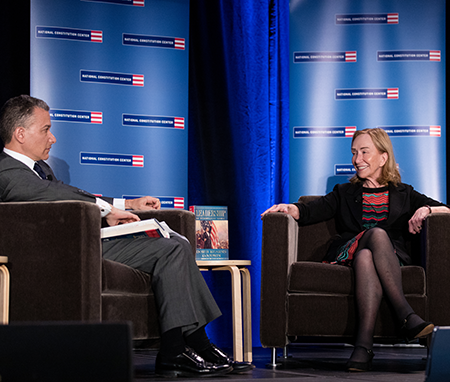


In this episode, Richard Epstein and Martha Jones discuss the Supreme Court’s landmark decision in Trump v. Barbara, which struck down President Trump’s Executive Order on birthright citizenship. At issue in the case was whether the Constitution guarantees citizenship to children born to parents unlawfully or temporarily present in the United States. The Court concluded that it did. Thomas Donnelly, lead scholar at the National Constitution Center, moderates.
Follow We the People, Live at the National Constitution Center, and Civic Parenting on Apple Podcasts, Spotify, or your favorite podcast app.
This episode was produced and mixed by Bill Pollock. It was recorded by David Stotz and Greg Schekler. With production support from Charles Sahm. Research was provided by Anna Salvatore, Trey Sullivan, and Tristan Worsham.
Participants
Richard Epstein is the inaugural Laurence A. Tisch Professor of Law at NYU School of Law, where he serves as Director of the Classical Liberal Institute. He is the author of numerous books including The Myth of Birthright Citizenship: What the Fourteenth Amendment Really Says, The Classical Liberal Constitution, and Design for Liberty.
Martha Jones is the Society of Black Alumni Presidential Professor and Professor of History at Johns Hopkins University. She is the author of numerous books, including Birthright Citizens: A History of Race and Rights in Antebellum America and The Trouble of Color.
Thomas Donnelly is lead scholar at the National Constitution Center. Prior to joining the Center in 2016, he served as counsel at the Constitutional Accountability Center, as a Climenko Fellow and lecturer on law at Harvard Law School, and as a law clerk to Judge Thomas Ambro on the U.S. Court of Appeals for the Third Circuit.
Additional Resources
- Trump v. Barbara (2026)
- Brief of Amicus Curiae Professor Richard A. Epstein
- Brief of Historians Martha S. Jones and Kate Masur as Amici Curiae
- “Supreme Court strikes down Trump’s birthright citizenship executive order in landmark decision,” Scott Bomboy for the National Constitution Center’s Constitution Daily Blog
- “In birthright citizenship opinions, a major constitutional disagreement,” Marcia Coyle for the National Constitution Center’s Constitution Daily Blog
- United States v. Wong Kim Ark (1898), National Constitution Center
- The Citizenship Clause, National Constitution Center
Excerpt from interview: Jones argues that the drafting debates, the pre–Civil War experience of free Black Americans, and the text’s deliberate breadth all show that the 14th Amendment’s birthright guarantee was meant to reach the children of immigrants, and that today’s challenge revives the exclusionary logic of Dred Scott.
Martha Jones: I want to emphasize that part of what the 14th Amendment and its birthright provision does for us is to sequester the racism that runs through the challenges to Black citizenship, that run through the challenges to Chinese citizenship, that run through the challenges of the citizenship of immigrants today. The 14th Amendment, its birthright provision, not only does not respect race, it does not respect color, it does not respect the status or the origins of one's parents, nor does it respect religion, wealth or health, sex and sexuality. It is perhaps, in my view, regretfully, one of the very few human rights provisions in our Constitution today. I have heard it said many times, why does the US stand apart from its peer nations? The US stands apart from its peer nations with respect to its citizenship regime, in part because it continues to be governed by an 18th-century Constitution that was amended in the 19th century. Our peer nations, Western Europe, for example, Western Europe rewrote its constitutions in the 20th century in the wake of the Second World War, in the wake of the Holocaust. Those are constitutions that understand and anticipate everything from the extraordinary migrations of humanity that are characteristic of the modern world to the possibilities of the rise of an authoritarian regime within a nation.
Excerpt from interview: Epstein argues that the 14th Amendment reversed Dred Scott only for the domestic question of freed slaves, that “subject to the jurisdiction thereof” requires allegiance rather than mere presence, and that Wong Kim Ark and the majority’s reading distort both the history and the sovereign’s essential power to decide who becomes a citizen.
Richard Epstein: Okay, well, let's first go. What Martha's doing is fighting a war that was already won. The entire purpose of the 14th Amendment, disputed by nobody, was to reverse the decision of Dred Scott. But Dred Scott was only a case that devoted to domestic issues that had nothing to do with foreigners. If you look at the 1866 Civil Rights Act, which tried to address the question, what it did is it did not use the phrase subject to the jurisdiction thereof, but it basically said foreigners are not included and Indian tribes are also out. This was done in 1865. So by the time you get 1866 on the amendment, they changed the word into the other direction, subject to the jurisdiction thereof. So this was meant to obviously protect people from deportation and abuse by virtue of their black birth, but it had nothing whatsoever to do with the question of whether we're going to take other people into this country from foreign nations.
Full Transcript
View Transcript (PDF)
This transcript may not be in its final form, accuracy may vary, and it may be updated or revised in the future.
Stay Connected and Learn More
- Stay connected with We the People—follow, rate, and review the show wherever you listen.
- Questions or comments? Email [email protected].
- Follow @ConstitutionCtr on social media and sign up to receive Constitution Weekly, our email roundup of constitutional news and debate.
- Support our important work by making a donation today.