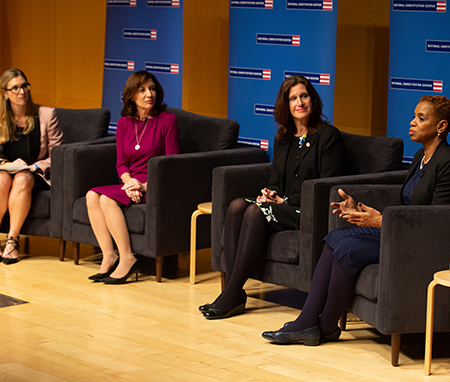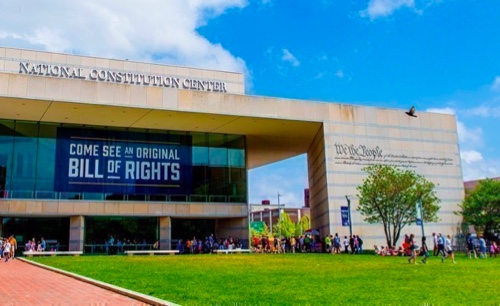
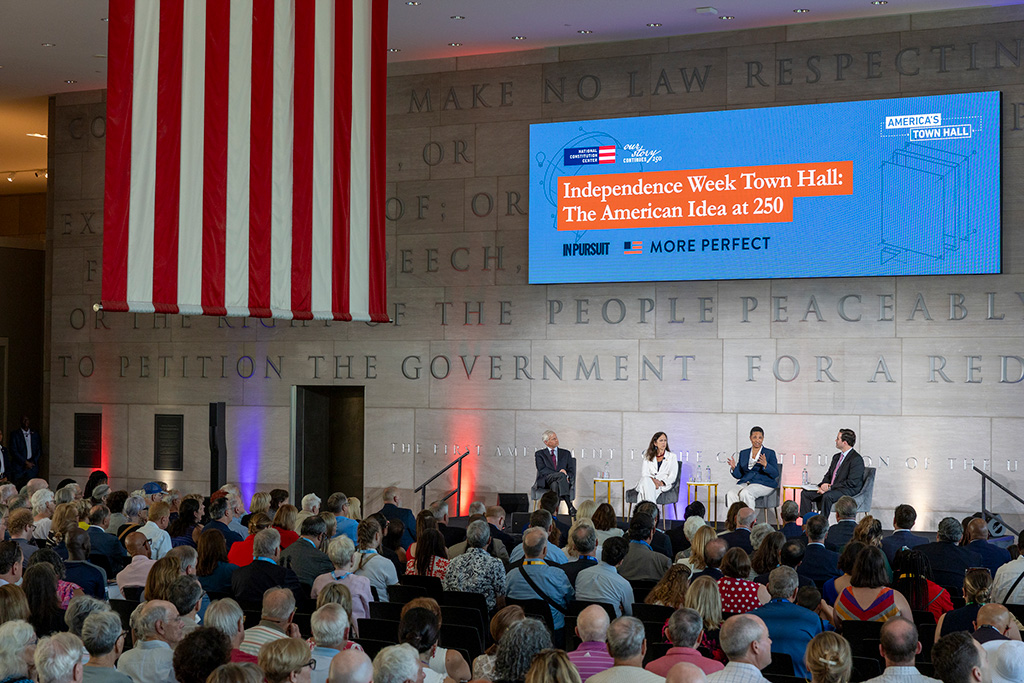
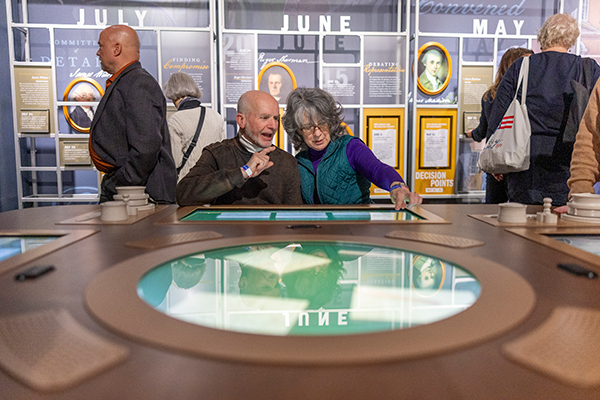

The National Constitution Center, in partnership with a coalition of leading free speech organizations, convenes a National First Amendment Summit to discuss the increasing threats to freedom of expression and to celebrate the opening of the Center’s new First Amendment gallery. To lead off the event, author and free-speech advocate Salman Rushdie engages in a virtual keynote conversation with Suzanne Nossel, CEO of PEN America about the importance of free speech in a democratic society and the forces of censorship that imperil its existence. After Salman Rushdie’s keynote conversation, the summit features a series of panels with America’s leading First Amendment thinkers. In-person summit participants include First Amendment lawyer Floyd Abrams, Bruce Brown of the Reporters Committee for Freedom of the Press, Will Creeley of the Foundation for Individual Rights and Expression, Jameel Jaffer of the Knight First Amendment Institute at Columbia University, Stephen Solomon of NYU’s First Amendment Watch, and leading scholars Akhil Reed Amar, Jeannie Suk Gersen, Lyrissa Barnett Lidsky, Jacob Mchangama, and Nadine Strossen.
This program is presented in partnership with the Freedom Forum, FIRE, the First Amendment Watch at NYU, PEN America, and the Reporters Committee for Freedom of the Press.
Video National First Amendment Summit
Podcast National First Amendment Summit
Participants
Keynote Conversation featuring Salman Rushdie
- Salman Rushdie, author and former president of PEN America
- Moderator: Suzanne Nossel, CEO of PEN America
Panel 1: The Origins of the First Amendment and Its Central Role in Democracy
- Akhil Reed Amar, Sterling Professor of Law and Political Science at Yale University
- Jacob Mchangama, founder and CEO of The Future of Free Speech Project; Research Professor at Vanderbilt University
- Stephen Solomon, Marjorie Deane Professor of Journalism at New York University; founder of NYU’s First Amendment Watch
- Moderator:Jeffrey Rosen,president and CEO of the National Constitution Center
Panel 2: The First Amendment in the Courts
- Floyd Abrams,senior counsel at Cahill Gordon & Reindel
- Jameel Jaffer,executive director of the Knight First Amendment Institute at Columbia University
- Lyrissa Lidsky,Raymond & Miriam Ehrlich Chair in U.S. Constitutional Law at Florida Law
- Moderator: Bruce Brown, executive director of the Reporters Committee for Freedom of the Press
Panel 3: The First Amendment on Campus and Online
- Will Creeley, legal director at FIRE, the Foundation for Individual Rights and Expression
- Jeannie Suk GersenJohn H. Watson, Jr., Professor of Law at Harvard Law School
- Nadine Strossen, John Marshall Harlan II Professor of Law, Emerita, at New York Law School
- Moderator:Jeffrey Rosen, president and CEO of the National Constitution Center
Additional Resources
- National Constitution Center gallery, The First Amendment
- Jacob Mchangama, Free Speech: A History from Socrates to Social Media
- Akhil Amar, The Bill of Rights: Creation and Reconstruction
- Akhil Amar, The Words that Made US: America’s Constitutional Conversation 1760-1840
- Stephen Solomon, Revolutionary Dissent: How the Founding Generation Created the Freedom of Speech
- Floyd Abrams, Speaking Freely: Trials of the First Amendment
- Floyd Abrams, The Soul of the First Amendment
- Floyd Abrams, Friend of the Court: On the Front Lines with the First Amendment
- New York Times v. Sullivan
- Lyrissa Lidsky, Case Book The First Amendment: Cases and Theory, Fourth Edition
- Lyrissa Lidsky, Freedom of the Press: A Reference Guide to the United States Constitution
- Floyd Abrams Institute for Freedom of Expression
- Mahanoy Area School District v. B.L.
- Will Creeley and Geoffrey R. Stone, “Restoring Free Speech on Campus”
- Nadine Strossen, Free Speech: What Everyone Needs to Know
- Nadine Strossen, Hate: Why We Should Resist It With Free Speech, Not Censorship (Inalienable Rights)
- Jeannie Suk Gersen, “What If Trigger Warnings Don’t Work?”
- Jeannie Suk Gersen, “Free Speech, Bullying, and The Complicated Case of the Pennsylvania Cheerleader”
- Will Creeley, Book First Things First: A Modern Coursebook on Free Speech Fundamentals
- Jeannie Suk Gersen, “Shutting Down Conversations About Rape at Harvard Law”
- Palsgaard v. Christian (E.D. Ca.)
Excerpts from the transcript
Salman Rushdie and Suzanne Nossel on how the Internet has changed free speech
Salman Rushdie: Now, we have this new thing which functions like the Wild West, where you can ride into Dodge with a gun because, "Hey, we believe in freedom." [laughs] So the question is whether some of the principles that govern all other media can somehow be applied to these new media. And I'm, by no means, equipped to answer how, because it's a really difficult problem. But I do think there's something that needs to be really thought about, because it's not true in any other form of expression that you can just shoot your mouth off without consequences.
Suzanne Nossel: Right. I mean if you go back to the early days of the internet, that ability that it affords to just shoot your mouth out immediately and reach an audience sometimes hundreds of thousands or even millions, if what you've said or what you've shown is potent enough. That was seen as a great boon to free expression, those-
Salman Rushdie: Yeah.
Suzanne Nossel: ... barriers, having to get the New York Times op-ed editor to green light your piece, or get a publishing contract. You know, there was another route. And that was celebrated, and it has enabled an enormous amount of expression. But, now, we face not just social media, but with AI and large language models. The very nature of these services is that immediacy, is the fact that there's no intermediary. There's no editor that you send it to. These posts are not reviewed before they make it out into the world.
On the threat of authoritarianism to free speech, truth, and the First Amendment
Salman Rushdie: I think now we're facing another old enemy, which is authoritarianism. I think there's a real rise in authoritarian movements around the world, populist authoritarian demagoguery and, coupled with that, a willingness amongst at least some part of the population to cease to value the democratic values enshrined in the First Amendment. So I think the problem is, I would now say, political more than primarily religious.
Suzanne Nossel: And how do you make sense of the ways in which, even in this country, these authoritarian tendencies and a readiness to, for example, ban books, enact laws that circumscribe what can be taught in the college classroom? How has that taken hold in this place that you came to as a beacon not so long ago? How do you explain it, and how do we get past it?
Salman Rushdie: I find it bewildering, and I think it has to do with two kinds of attack that have been unleashed, not unsuccessfully in recent years. One is on the idea of education itself. I remember seeing some years ago a survey carried out amongst Republican voters in which something like two-thirds of them subscribed to the idea that universities were bad for America because they were places where people were indoctrinated with communism and so forth. That's one thing.
The other thing is the thing that you and I, Suzanne, have talked about a lot, which is the assault on the idea of the truth, because one of the preconditions for the rise of authoritarian strongmen is that people cease to believe in the truth. People are told so often that what everything they're being told is a lie, that they begin to internalize that. And at that point, the demagogue, the authoritarian, can rise to his feet and can say, "I am the truth. Believe me, because I am the truth." That's how dictatorships start. That's how tyrannies rise.
And we're seeing phenomena like that in this country, but around the world as well, you know. And those two attacks on education, on the value of education, and on the absolute value of the truth, unfortunately, have been, to some degree, successful.
On the importance of education and the historical foundation of protecting free speech in America
Akhil Amar: The only thing we have in common is our Constitution and our national narrative. And the kids don't learn it. They don't know their presence. They don't know the history of the Revolution and the Civil War, which give us the Bill of Rights and the Fourteenth Amendment. And if we don't know that, we die. Okay? So, that's our narrative. And we need great storytellers to tell that story. And when they come here, they begin to learn that story, Jeff. But we have to bring the children here. We really do. That's the national narrative that needs to be taught.
Jeffrey Rosen: Absolutely, Akhil. And it's so exciting to think of bringing all those school kids to stand in this space, to see the tablet, and then to see that gallery and to see Brandeis' original opinion and George Washington's letter to the Quakers and Mary Beth Tinker's armband. And it's just a privilege to be able to inspire the next generation. Steve Solomon, as Akhil and Jacob have said, many of the Founders were not especially committed to a libertarian conception of freedom of speech.
Jefferson was more concerned about keeping the federal government out of prosecuting sedition, but he himself authorized state sedition prosecutions. Hamilton would have allowed prosecution of laws with bad tendency after the facts. Did any of those juries that acquitted accused critics of the government in the colonial era articulate the idea that speech was a natural right that should only be banned if it's intended to and likely to cause imminent violence, or was that really just crystallized later?
Steve Solomon: The juries themselves did not articulate that, because that's not what juries do. They come back with guilty and not guilty. Grand juries either indict or don't indict, so they don't come out with, necessarily with reasons for it. But the Founders did.
So in their papers, in their essays, in their pamphlets, and there were so many of them, they articulated. They went back to the Enlightenment philosophers, John Locke's natural rights. And they also worked from the Bills of Rights that the states had passed, which nine of the 11 Bills of Rights included the right to a free press. And they called it... It wasn't just a right to a free press. It was... They called it the bulwark of liberty.
Now, I think that gives us some clues because if it was just one of a lot of other rights, they would just say freedom of the press. What they saw was the press as a bulwark of liberty, meaning that you can't protect all the other rights if you don't have a free press.
And so they were also concerned about general warrants. They were concerned about their jury… The rights to a jury trial being taken away. Without the right to protest, without the right to protest, you can't protect the other rights. You're silenced. And so you lose the other rights by not being able to stand up to them. And so there are clues. There was no committee that sat down and said, "Here's what we mean by freedom of speech and freedom of the press." There's no committee.
But I think what you try to do is draw from the writings and their actions and what do they actually understand the concept to mean. And you take that from all the debates that went on, especially in the ratification period. Almost, I would say probably all of the ratification conventions involved a lot of talk about freedom of speech and freedom of the press. So yeah.
Jeffrey Rosen: Speech is the bulwark of every other right. It's so important to remember. We just have time for one final round of concluding thoughts. Salman Rushdie challenged us to debate the idea that the American principle, that free speech should only be banned if it's intended to and likely to cause imminent violence, is more persuasive, more worthy of respect, better than the view embraced by all other Western democracies in Europe and around the world that speech can be banned if it offends dignity and if it offends honor.
Jacob Mchangama, tell us about the competing European view. It has its roots in earliest European history. It was crystallized in the French Revolution. It was embraced in Weimar Germany and is rampant in Europe today. So that our audience understands how different it is from the American view.
Jacob Mchangama: Yeah. So, the classic example would be so-called hate speech laws. So every European democracy has laws that, for instance, criminalize making hateful statements about specific groups, whether based on race or ethnicity or religion.
And if you want to steel man the case for that, well, then the argument goes, "Well the Nazis came into power through democratic means. And, therefore democracies have to be intolerant of intolerance because, otherwise, totalitarian movements will abuse democracy and free speech to abolish democracy itself.” And you could say "Well, you know..." To those of us who are more persuaded by the American approach, you could say, "Well, European democracies since World War II have been prosperous, stable. You have robust political debate, and so what's, what's the danger?"
Yes, there might be... Sometimes, someone might be imprisoned or fined for speech that we would consider that should be protected... But all in all, you know, things have gone well. But you know, my counter-argument is what I call the Weimar fallacy. So, the idea that Weimar Germany is an argument in favor of restricting free speech, I think, rests on pretty shaky historical grounds because the short-lived Weimar democracy between 1918 and 1933 actually banned a lot of speech, including those of Nazis.
On the Supreme Court and applying First Amendment principles to social media platforms
Jameel Jaffer: But there are a lot of differences between social media companies and newspapers. And figuring out which of those differences should matter, whether any of them should matter is a really difficult task and I think that how the court answers those questions is going to make a huge difference to what the digital landscape looks like over the next 20 years. And, we're all here because at some level, we are enthusiasts of the First Amendment. We all believe in the centrality of free speech to our society. I think most of us probably believe that free speech and democracy are almost synonymous but you can believe all those things and still have a hard time figuring out how these cases should be decided.
So I think it's very difficult to predict what the Supreme Court will do and not always obvious even to people who care about free speech.
Bruce Brown: And Floyd?
Floyd Abrams: Just a word more on social media. We haven't talked about this Section 230 of the federal law, which governs this. Which basically immunizes social media against libel claims for what people say on social media. It was intended to, and it has allowed social media to explode in terms of its ability to put in effect people, while the social media entity doesn't have to check it. The New York Times has to check it. They even have to check it when the person is a public person, in many circumstances. And whether we're going to continue to have that, I don't know. But we should. And I'm not even advocating one thing or the other. A final note for me, I know we want to save you time. If I had to tell you one thing you want to tell your children when you go home tonight, it's that Salman Rushdie spoke to you.
Bruce Brown: Yeah. And, Lyrissa, what would you tell your class next time you convene?
Lyrissa Lidsky: So last term in the Supreme Court, the Supreme Court dealt with at least two very significant internet-related cases. And Elena Kagan famously said at an oral argument, "Well, we're not the nine greatest experts on the internet."
Bruce Brown: Yeah. [laughs]
Lyrissa Lidsky: And so I'm going to leave you with a little optimism because here's the thing. They waited a lot ... We've been dealing with adapting First Amendment principles to the internet for more than 25 years now. It's a long time. And the Supreme Court's been reluctant to weigh in. There aren't that many cases, but they're finally starting to take some, which makes us a little trepidatious. But, when they dealt in Counterman v. Colorado, which dealt with threats last term, they were very sensitive to the misinterpretation that you could put on threats in internet context and they set mens rea standards high so that we didn't accidentally punish speech that wasn't really a threat. And then they rejected the invitation to make Twitter responsible for all extremism on the internet generated by its algorithms.
And so they're really trying to be careful in the adaptation of these principles and it gives me a little hope. As Jameel said, the point is the principles, and we reason by analogy, but sometimes the big tech companies are not really analogous to anything we've seen before. They're kind of like newspapers. They're kind of like common carriers. They're kind of like this, they're that kind of like that. So hopefully, the Supreme Court will be modest in their own abilities and be very careful in that adaptation process this term.
On how self-censorship and compelled speech threatens academic freedom
Will Creeley: Now, again, no matter what you think of "woke" or "antiracist principles,” those things should be hotly debated in our public college campuses. That's the whole idea. You start the knowledge-generating machine and you back away slowly if you're a legislator. You don't get to push and poke and say, "Well, now we're a Blue State, so we're going to say you can't talk about Red State things," or vice versa. So yeah, we're working hard to, [laughs] to protect academic freedom, but it's a full-time job.
Jeffrey Rosen: It is indeed and it's so urgently important, as you just said, that you are defending academic freedom against threats from the right and forms of anti-WOKE Act and from the left in terms of those who would punish those who failed to pledge allegiance to a particular diversity statement or a particular dogma. Nadine Strossen, tell us more about the threats on both sides. Are those refusals to pledge allegiance to diversity statements a form of compelled speech and do you think that the threats on this count are coming more from the right or the left or on the, on both sides?
Nadine Strossen: Definitely, the threats are coming from across the ideological spectrum including a persistent phenomenon that each side, and I hate to use the word sides because I see all of us as part of a continuum. But many of us see ourselves in tribes and each tribe is happy to complain about censorship that's coming from the other side, but not willing to recognize that they too are engaging in it. And, Jeff, if I could say, to me, the greatest threat to free speech on campus is coming from students themselves because they are afraid of their fellow students. The peer pressure is so enormous. The latest FIRE and College Pulse survey showed that this is so pervasive that even the schools that had the best free speech culture, because the administration was relatively enlightened, the policies were relatively enlightened, there was almost no difference between the top schools and the bottom schools in terms of student self-censorship.
And that self-censorship, I was really startled to see, comes not only in the classroom but also in individual conversations with faculty members, also in conversations with other students. 25% or so across the board said that they either very often or quite often are engaging in self-censorship and the survey had a very specific definition that you fear punishment, either legal punishment or social punishment or even physical attack. So it was a very specific definition. And the most concerning to me as an educator, 25% of students across the board, at the time that they answered these surveys, they were enrolled in college. Many of them had been there for a number of years, but all for at least a semester, that they are engaging in more self-censorship now than when they began college.
So the exact opposite of what we would expect and hope for, that the college experience would be something that would free your mind, that would free your tongue that would open you to speaking and to listening and that's not happening unfortunately.
Jeffrey Rosen: It is tragic to hear that truth and it's so important that you remind us that self-censorship and the fear of offending the conformity of the mob is perhaps the greatest threat to speech, confirming John Stuart Mill's warning that the threats to speech would come less from government than from the tyranny of social opinion. Jeannie Suk, how are you seeing that self-censorship and fear of conventional disapproval manifesting itself on campus and what can be done about it?
Jeannie Suk Gersen: So unfortunately, Harvard University, I think, may have come in dead last ...
Nadine Strossen: Oh, yes.
Jeannie Suk Gersen: ...in the FIRE...rankings of schools. And there's we've internally had some debates about your methodology, but...but be that as it may. What I am seeing, and I'll now speak in the first person as a teacher. I'm a constitutional law professor, I also teach criminal law. Those are two topics in which you run the gamut of controversial issues. Everything from abortion to affirmative action to the civil rights movement. And in criminal law, you've got the death penalty, you've got all kinds of sexual assault, all of the different topics that students generally today would tend to associate with the danger of getting emotionally harmed in a conversation if someone were to say something that were, that they would find offensive, hurtful. Like denying their own identity, something like that. So that's just my daily teaching experience. That's what I'm doing every day.
Full Transcript
View Transcript
This transcript may not be in its final form, accuracy may vary, and it may be updated or revised in the future.
Stay Connected and Learn More
Continue the conversation on Facebook and Twitter using @ConstitutionCtr.
Sign up to receive Constitution Weekly, our email roundup of constitutional news and debate, at bit.ly/constitutionweekly.
Please subscribe to Live at the National Constitution Center and our companion podcast We the People on Apple Podcasts, Stitcher, or your favorite podcast app.