



After the results of the 2026 general election, the Democratic party will have majorities in the House of Representatives and Senate in the 120th Congress starting in January 2027. Under general guidelines established by the Constitution, the Democrats as a majority party will have a greater ability to pass laws and take other actions, but subject to some significant restraints.
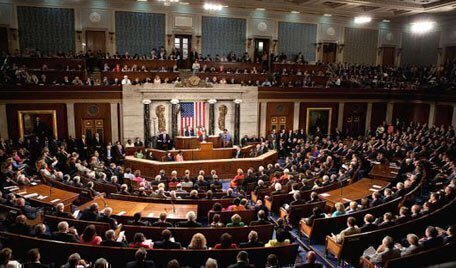 As of Nov. 5, 2026, the Democrats will have at least 54 seats in the Senate and 251 seats in the House, well beyond a simple majority needed to control each chamber along party lines. Under the Constitution's Article I, Congress has many powers and responsibilities. The most prominent powers of Congress include the authority to pass laws and raise revenues through taxes.
President Donald Trump, a Republican, still retains considerable Article II powers in relation to Congress. Among those powers is the ability to veto legislation, to nominate lower-court judges and justices to the Supreme Court (subject to approval by the Democrat-controlled Senate), and to enforce the laws approved by Congress. Several major constitutional powers also are shared between the president and Congress, and they require mutual approval.
Divided government is not unusual in recent history. Presidents Barack Obama, George W. Bush, Bill Clinton, George H.W. Bush, and Ronald Reagan at one time held the White House with an opposing party in full control of Congress.
The powers of Congress related to the president
Congress has many explicit powers listed, or enumerated, in Article I and other parts of the Constitution. These powers include playing a role shaping federal elections to operating the District of Columbia to proposing constitutional amendments. The majority party in Congress has a leading role in determining policy in such matters.
The Constitution reserves some powers to just the House or just the Senate. For example, only the Senate approves treaties and confirms nominees for judicial vacancies or other vacancies in the government, selected by the president. Formally, the House has the job of originating revenue bills. But the Senate can shape even these bills through the lawmaking process.
The House has the important task of electing a president if no candidate wins an Electoral College majority. The Senate would select the vice president. Also, the speaker of the House is the next person in line to succeed or replace the president, after the vice president.
Congress has the impeachment power under Article II, Section 4: “The President, Vice President and all civil Officers of the United States, shall be removed from Office on Impeachment for, and Conviction of, Treason, Bribery, or other high Crimes and Misdemeanors.”
Article I, Section 2, Clause 5, gives the House the sole power to bring charges. This action is usually initiated by the House Judiciary Committee. If a majority of the House approves these charges, presented as a resolution called “articles of impeachment,” the matter is sent to the Senate. Article I, Section 3, Clause 6, gives the Senate the power to try an official facing impeachment. The Senate must find the person guilty by a two-thirds voting margin; the main punishment is removal from office, and disqualification from holding future offices is also a potential punishment.
The powers of the president
Article I, Section 7 of the Constitution gives the president the power to veto legislation. This clause reads as follows: “Every Order, Resolution, or Vote to which the Concurrence of the Senate and House of Representatives may be necessary (except on a question of Adjournment) shall be presented to the President of the United States; and before the Same shall take Effect, shall be approved by him, or being disapproved by him, shall be repassed by two thirds of the Senate and House of Representatives, according to the Rules and Limitations prescribed in the Case of a Bill.”
If the president sends the bill or other measure back to Congress with a message explaining his objections, this is known as a direct veto. If the president withholds his signature during the 10-day review period allowed by the Constitution and Congress adjourns during that period, it is considered a “pocket veto” and the bill doesn’t become a law.
Overriding a presidential veto requires a two-thirds majority in the House and the Senate, as specified in Article I, Section 7. In the last five presidential administrations, six out of 49 presidential vetoes have been overridden by Congress. Among the most important pieces of legislation subject to a veto are various budget measures to keep the government in operation.
Executive orders issued by president do not require congressional approval, but controversies over them may be considered by federal courts. Congress has the power to pass laws that override executive orders but only for those orders enacted “pursuant to powers delegated to the President” by Congress.
The procedural rules of Congress
Another dynamic related to a shift in party powers in Congress is how voting procedures are handled, including moving bills to the floor and the Senate filibuster.
Article I, Section 5, of the Constitution defines the structure, duties, and powers held by Congress, including its powers to “determine the Rules of its Proceedings.”
At the start of the new Congress, the majority party takes over the chairs of various committees. Also, majority leaders in Congress through committee positions can conduct investigations into the conduct of government officials, including the use of subpoenas to get documents, the ability to compel witnesses to testify, and the holding of witnesses in contempt for not testifying or providing information.
The Senate’s filibuster and cloture rules determine if 60 votes are needed for certain bills and actions to be sent to the floor for consideration. In a filibuster, a group of senators can signal their opposition or take the floor to make lengthy speeches. The cloture rule, also known as Rule XXII of the Senate, requires at least 60 votes to end the debate after 30 hours. Then a simple majority vote can pass or reject any “any measure, motion, other matter pending before the Senate, or the unfinished business.”
In recent years, the Senate has allowed exceptions to this rule for budget reconciliation bills, and some trade agreements. The Senate used parliamentary procedures to eliminate the 60-vote requirement for votes on executive nominees and some judicial nominees in 2013 and for Supreme Court nominees in 2017. In those casesit uses a simple majority vote instead.
Scott Bomboy is the editor in chief of the National Constitution Center.