

A March 2026 executive order from President Donald Trump requiring the United States Postal Service to only send mail-in ballots to people on a federal list of voters is the latest dispute to reach the Supreme Court’s emergency docket.
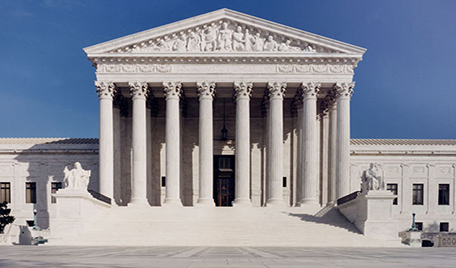 Since late July, several lower-court decisions have added urgency to the Supreme Court to act in some fashion in response to the legal dispute over the executive order (EO).
On July 27, 2026, the Justice Department asked the Supreme Court to stay a preliminary injunction issued by the United States District Court for the District of Massachusetts in Trump v. California. Since then, 12 states have joined the Justice Department in requesting the stay in a separate application in Trump v. California, while 23 states support the district court’s injunction against the executive order.
Then, on July 28, 2026, the United States Court of Appeals for the District of Columbia Circuit, in DSCC v. Trump, denied a preliminary injunction blocking the same executive order in a per curiam opinion.
And on August 11, 2026, the same judge who issued the Trump v. California injunction, expanded its impact in a separate case, League of Women Voters of Massachusetts v. Trump. United States District Judge Indira Talwani has issued a nationwide injunction against the executive order on constitutional grounds. Talwani also said the District of Columbia appeals court did not consider proposed Postal Service rules to enforce the executive order, which she felt was critical to the case.
Given the deadlines for preparing ballots for the November elections, all parties involved seek a quick resolution by the Supreme Court. “Every day that the district court’s injunction remains in place, it blocks the government’s ability to finalize and implement the President’s proposed policies,” claimed Solicitor General D. John Sauer in a brief filed on Aug. 4, 2026.
The executive order and the lower court’s decisions
The dispute over Trump v. California is currently on the Supreme Court’s interim or emergency docket, which deals with certain requests for injunctive relief and stays that arrive at the Supreme Court. Decisions on the interim docket by the justices usually occur without full briefing and oral argument.
Executive Order 14399, Ensuring Citizenship Verification and Integrity in Federal Elections, includes several provisions that the Massachusetts district court required injunctive relief. In the executive order’s Section 2, the Secretary of Homeland Security is empowered to create State Citizenship Lists “derived from Federal citizenship and naturalization records, SSA records, SAVE data, and other relevant Federal databases.” States can suggest “modifications or amendments to the State Citizenship List.” The United States Attorney General can also prosecute “state and local officials or any others involved in the administration of Federal elections who issue Federal ballots to individuals not eligible to vote in a Federal election.”
In Section 3, the United States Postal Service “shall not transmit mail-in or absentee ballots from any individual unless those individuals have been enrolled on a State-specific list.” The order also requires design changes to ballot envelopes, including identifiers for individuals on State Citizenship Lists.
In her June 25, 2026, ruling, District Judge Talwani held that “Sections 2 and 3 of the EO are legally void as they are ultra vires and unconstitutionally violate the separation of powers.” (The term ultra vires means “beyond the powers.”) “The creation of the Confirmed Citizen Lists is ultra vires because the President lacks any authority to compile voter lists for each State,” Talwani determined.
Talwani enjoined the Trump administration “from implementing or giving effect to Sections 2 and 3 of the EO with respect to the November 3, 2026, or any earlier federal election in the Plaintiff States.”
On July 7, 2026, Talwani denied a stay pending appeal. The First Circuit Court of Appeals denied a stay pending appeal on July 25, 2026. The majority decision from the three-judge panel determined that the executive order “directs unprecedented levels of involvement by federal officials in how states administer elections. In doing so, the EO plainly affects the Plaintiff States’ ‘sovereign power . . . to create and enforce a legal code’ for elections.”
Responses to the Supreme Court
In his response to the Supreme Court, California attorney general Rob Bonta argued the executive order was an attempt to alter election rules too close to an election being held. He also pointed to what he saw as a clear constitutional conflict. “The Framers entrusted the States and Congress—not the President—with the responsibility to set rules for federal elections. And Congress has not authorized the EO’s unprecedented directives.” Bonda also said the case’s eventual timeline supported an injunction as the issue continued in court beyond midterm elections.
Solicitor General Sauer in his reply to the Court pointed to a “parallel” opinion on July 28 in DSCC v. Trump, which upheld the denial of a preliminary injunction. In that case, Democratic Party leaders sought a preliminary injunction to block Trump’s mail-in voting executive order. The U.S. Court of Appeals for the District of Columbia held that while the “Plaintiffs have identified a number of serious questions concerning the lawfulness of proposed actions if implemented on the threshold of the upcoming federal election, this case likely is unripe for review in its present posture.” The court concluded that “[i]f the defendant agencies take steps to implement the Executive Order in a manner that violates federal law or the Constitution, Plaintiffs can promptly seek relief.”
“The same analysis applies here,” Sauer reasoned. “Like the DSCC plaintiffs, the respondent States rest their challenge on speculation about what impact the Executive Order would have if it were ultimately implemented in violation of federal law.”
Sauer argued separately that the executive order represented “modest and commonsense steps, consistent with federal law,” taken “to help States ensure that only U.S. citizens vote in federal elections and to facilitate the enforcement of federal law, including laws involving election fraud.”
Judge Talwani’s latest ruling
In her August 11 opinion in League of Women Voters of Massachusetts v. Trump, Talwani noted that the Justice Department had “asked this court and others to postpone judicial review on standing and ripeness grounds” and decide the constitutional questions after the Postal Service issued a final ruling on envelope designs and voter list verifications.
Instead, Talwani said the case’s urgency required a ruling on the constitutional questions now. “The court finds it prudent to review the EO now, where less than 90 days pend before the midterms and the millions of citizens who rely on mail voting require clarity as to how or whether they will vote in November.”
Talwani repeated her findings in July 2026 that the executive order violated the Constitution’s protection of the separation of powers. “The court has already answered and will again resolve the question clearly and affirmatively. The executive branch has no authority to regulate elections.” She cited Article 1, Section 4, Clause 1, the Elections Clause of the Constitution, which reads that the individual states and Congress have rule-making powers over federal elections.
“Where the EO is presently causing confusion and threatening both increasing chaos and an erosion of trust in our democracy, the court finds that enfranchisement heavily outweighs the executive’s attempt to unconstitutionally insert itself into the domain of election regulation,” she concluded.
Whatever action the Supreme Court takes in Trump v. California will be closely watched, given the proximity of general elections. In all, 37 states and the District of Columbia allow mail-in voting without electors citing a reason, and 10 states send out mail-in ballots at least 45 days in advance of election day. And as both sides argue, there will be a limited period to change procedures for the mail-in ballots process.
Scott Bomboy is the editor in chief of the National Constitution Center.