

Thanksgiving has always been more than a meal. From George Washington’s 1789 proclamation calling for a national day of “public thanksgiving and prayer” to Abraham Lincoln’s 1863 appeal for a war-torn nation to “set apart and observe the last Thursday of November as a day of Thanksgiving and Praise,” the holiday has carried a civic purpose.
 It reminds us that gratitude is not only personal; it is public. It is a moment to give thanks for the shared ideals that bind us together as “We the People.”
And yet, for many Americans, big family meals can bring a degree of anxiety. We’ve all experienced moments when a stray comment sharpened the room or when political differences made gatherings feel fraught. Surveys suggest that many now try to difficult conversations—or even interacting with relatives they disagree with altogether—during the holidays.
This is precisely why Thanksgiving offers such an important opportunity—not to sow our divisions but to create shared traditions with our children and across generations. The holiday gives us a natural pause, a moment to remember that family, gratitude, and belonging run deeper than any disagreement.
Instead of bracing for discord, we can choose to kindle something far more enduring: the small, meaningful moments that invite our loved ones into the American story and help form habits of civic curiosity necessary for the Founders’ vision of self-government.
Every person needs a moment, or a series of moments, that invites them into civic learning and engagement. Maybe it was your parents taking you to the voting booth, visiting a museum, or reading together at your local library or bookstore. Maybe it was a grandparent who told family stories around the holiday table that connected personal experience to the nation’s larger story.
However it happens, that moment transforms abstract ideas into personal meaning.
I call this the civic spark: those small but powerful moments that awaken lifelong curiosity, draw us into the American story and inspire us to carry it forward. The spark can begin in the classroom, but it often takes root at home through stories, questions, and traditions shared across generations.
My own civic spark began one winter during a historic blizzard that closed school for days. My mother, determined to keep my siblings and me occupied, gave us a “snow day assignment”: pick a volume from our well-worn print encyclopedia set and learn something new.
By chance, or providence, I opened the entry on the U.S. Constitution. I was mesmerized. The text, the stories, the ideas all leapt off the page. When school resumed and my fourth-grade class began its government unit, I suddenly had all the answers and enthusiasm my teacher encouraged and amplified.
That spark, nurtured at home and affirmed in the classroom, became a steady flame. It followed me through college, law school, and into a career devoted to civic education and constitutional literacy.
Now, as a mother of two young daughters, ages 2 and 4, I find myself creating those same kinds of moments for them. We read picture books with civic and historical themes, and sometimes I read short passages from the Declaration of Independence or the Constitution at bedtime. My girls are too young to understand the words, but they feel their rhythm and importance.
Helping set the table for Thanksgiving dinner or putting away gifts shared at the holidays become small lessons in gratitude, responsibility and participation. They are acts of citizenship in miniature, the first steps toward understanding what it means to belong to something larger than ourselves.
So how can your family nurture civic sparks this holiday season?
- Tell civic stories together. When did you vote for the first time? Why did your family emigrate to the United States?
- Read aloud from the founding texts. A few lines from the Preamble or the Declaration connect gratitude and responsibility.
- Engage with history. Visit a local landmark, monument or museum, or attend or even stream a reenactment together.
- Ask civic questions at the table. Prompts like “What are we grateful for about our country?” or “What makes a good citizen?” invite reflection.
- Highlight everyday acts of citizenship. Helping clean up, writing thank you notes, or sharing with others can teach that civic life begins at home.
As we look to the 250th anniversary of the signing of the Declaration of Independence in 2026, our shared future depends on these habits of gratitude, listening, and learning. When families kindle curiosity and embrace civic habits in the home, they do more than honor the past. They prepare the next generation to carry the work of citizenship forward.
That is the enduring power of the civic spark. Once lit, it can illuminate not only for a lifetime, but across generations.
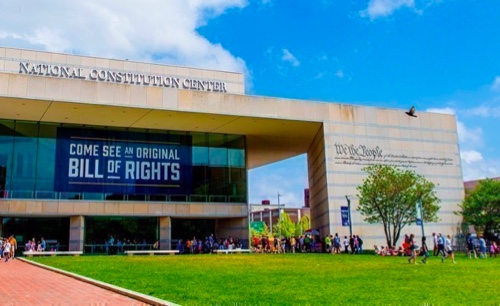
Julie Silverbrook is vice president of civic education at the National Constitution Center.
Editor's Note: This post first appeared on the website The Hill.