

Editor’s Note: On March 27, 2026, the SAVE Act failed to advance in the Senate before the chamber recessed for two weeks. The proposed bill still remains active for consideration. Some Republican leaders have proposed including parts of the act in a budget reconciliation process this fall that only requires a simple majority for approval but faces similar challenges with Senate procedures.
This week, the Senate is expected to start an extended public debate about the SAVE America Act, a proposed bill that would require photo identification for voters in federal elections and proof of citizenship to register to vote in person or by mail.
 A version of the bill passed in the House on Feb. 11, 2026, in a 218-213 vote along party lines, with one Democrat, Henry Cuellar of Texas, voting with House Republicans in favor of the bill.
It is widely expected that the chamber’s filibuster rules will prevent a full vote on the floor, but the act and debate process itself will touch on several constitutional issues.
What is the SAVE America Act?
In its current form, the Safeguard American Voter Eligibility Act seeks to amend Section 3 of the National Voter Registration Act of 1993. The changes include requiring a passport, REAL ID card, military ID card, or other forms of identification that list the applicant as a citizen of the United States when applying to register to vote in elections for federal office. The act also requires documentary proof of United States citizenship when a person applies for the National Mail Voter Registration Form.
The SAVE America Act also requires that a “state shall remove an individual who is not a citizen of the United States from the official list of eligible voters for elections for Federal office.” For states that don’t require advance voter registration, such as North Dakota, they must establish “a system for confirming the citizenship of individuals voting in an election for Federal office prior to the first day for voting.”
In addition, the Help America Vote Act of 2002 would be amended to require that people who want to vote in person present an official valid physical photo identification at the polls. For people not voting in person, a copy of a valid photo identification or a state-approved affidavit with the last four digits of the individual’s Social Security number must accompany a remote ballot for federal office elections. Exceptions to the remote ballot ID requirement include absent uniformed services voters and people covered under the Voting Accessibility for the Elderly and Handicapped Act.
The Constitution and subsequent voter eligibility laws
In Article I, Section 4, of the Constitution, the ability to establish and regulate elections for federal office is divided between state governments and the federal government. The Elections Clause reads, “The Times, Places and Manner of holding Elections for Senators and Representatives, shall be prescribed in each State by the Legislature thereof; but the Congress may at any time by Law make or alter such Regulations ….”
In general, the Constitution delegates the powers to conduct and administer voter registration to states and territories. However, Congress has passed laws under Article I, Section 4, using its ability to “make or alter” federal election regulations to add additional conditions. The National Voter Registration Act of 1993 established some requirements for voter registration applications for federal elections, which included a statement specifying eligibility requirements, including citizenship.
The Help America Vote Act of 2002 also required registration applications for federal elections include information such as a current and valid driver's license number, the last four digits of a Social Security number, or a unique identification number provided by the state for voter registration purposes.
Also, Section 611 of Title 18, U.S. Code, generally prohibits “any alien to vote” in an election for federal candidates with some exceptions, including if an “alien’s” parents is or was a U.S. citizen by birth or naturalization, if an “alien” permanently resided in the United States prior to attaining the age of 16, and if an “alien . . . reasonably believed at the time of voting” that they were a U.S. citizen.
Congress has various election enforcement powers under several amendments, which include banning discrimination at the ballot box based on race (15th Amendment) and on sex (19th Amendment). And Congress has passed statutes like the Voting Rights Act of 1965 to protect these rights.
The filibuster and congressional debate
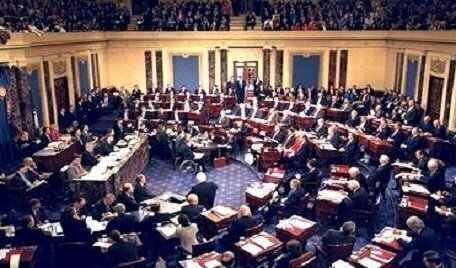
The Senate voted 51-48 on Tuesday to move the House-approved SAVE America Act for consideration, with Republican Sen. Lisa Murkowski of Alaska joining the Democrats in objecting to the motion. Senate Majority Leader John Thune (R-S.D.) has indicated that the bill’s supporters could debate as long as possible until he calls for a cloture vote. In interviews, Thune has acknowledged publicly that enough votes don’t exist to overcome a filibuster for a vote beyond the debates.
The filibuster is a tactic that dates back to the 1840s in the Senate. The Senate’s website defines a filibuster as “a loosely defined term for action designed to prolong debate and delay or prevent a vote on a bill, resolution, amendment, or other debatable question.”
The modern version requires that at least 60 Senate members vote for cloture, or to end a debate if a member threatens a filibuster, to get a final floor vote to pass a law. The Senate currently uses a “silent” filibuster system where a member only needs to threaten a filibuster via a message to the Senate Majority Leader. A cloture vote is then required, with a 60-vote majority, to override the filibuster, limit debate time, and have a floor vote.
Another possibility is that Majority Leader Thune could allow for a “talking filibuster” that could extend for weeks by getting 51 votes to force Senate’s Democrats to conduct lengthy floor speeches against the SAVE America Act while requiring constant in-person attendance by the Republicans. In such a scenario, the Senate could not consider most other business until the filibuster ends. Thune has already stated he doesn’t plan to pursue a talking filibuster due to a lack of votes.
Thune also has not supported efforts to eliminate the filibuster entirely, an idea frequently championed by President Donald Trump. The president and some members of the Republican caucus want a talking filibuster to force a vote. How that plays out remains to be seen, but there will be considerable attention to the filibuster’s future in coming weeks.
Scott Bomboy is the editor in chief of the National Constitution Center.