

An appeal over a Texas state law requiring Ten Commandments displays in public school classrooms is heading to the Supreme Court after a federal court upheld the law in April 2026.
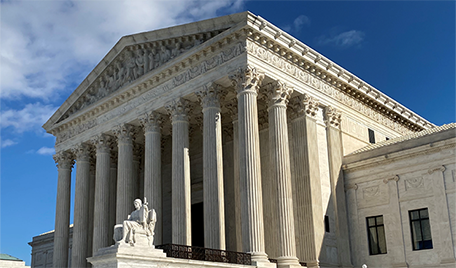 On Monday, the American Civil Liberties Union and others announced they were filing a joint petition for a writ of certiorari to reverse the United States Court of Appeals for the Fifth Circuit’s decision in Nathan v. Alamo. The ACLU published the petition on its website. Justice Samuel Alito had extended the filing deadline for the petition until Wednesday.
On April 21, 2026, a deeply divided Fifth Circuit, in a 9-8 en banc ruling, held that a state law, S.B. 10, requiring the commandments classroom display did not violate the First Amendment’s Establishment Clause or Free Exercise Clause. These clauses read as follows: “Congress shall make no law respecting an establishment of religion, or prohibiting the free exercise thereof…”
In a statement issued after the Fifth Circuit ruling in April, the American Civil Liberties Union of Texas said it anticipated appealing the decision to the Supreme Court.
The joint petition for a writ of certiorari
In a press release accompanying Monday’s cert petition, the ACLU says that more than two dozen Texas families were challenging S.B. 10. In addition to the ACLU, the Americans United for Separation of Church and State, the Freedom from Religion Foundation, and Simpson Thacher & Bartlett LLP are involved in challenge. It also includes a related case, Cribbs Ringer v. Comal Independent School District, in the petition.
The petition asks the Supreme Court to decide two questions. The first is whether the First Amendment’s Establishment Clause forbids a state from “mandating the permanent, conspicuous display of a government-selected version of the Ten Commandments in every public-school classroom.”
The second is whether permanently displaying the Ten Commandments in every public-school classroom “interferes with parents’ Free Exercise Clause right to direct their children’s religious education and burdens children’s religious freedom.”
“The Court should grant the petition because the court of appeals, in upholding S.B. 10, flouted this Court’s binding precedents and gutted the religious freedom rights of public-school children and parents,” the petition claims. The ACLU asks the Supreme Court to act soon, since “no Article III barriers exist, the Fifth Circuit having reached the merits in full in Nathan.”
The Fifth Circuit’s decision in Texas
Central to the Fifth Circuit’s majority opinion are two key Supreme Court precedents. In Stone v. Graham (1980), a divided Supreme Court ruled that a Kentucky law requiring the Ten Commandments in public school classrooms violated the Establishment Clause. However, the Fifth Circuit majority also cited the Supreme Court’s 2022 decision in Kennedy v. Bremerton School District as rendering the Stone precedent obsolete.
Link: Read the Fifth Circuit Decision
In his majority opinion, Circuit Judge Stuart Kyle Duncan said the Fifth Circuit majority properly discarded Stone since Stone relied on a prior Supreme Court precedent, Lemon v. Kurtzman (1971). Under Lemon, the Supreme Court created a three-part test to determine if a law violated the Establishment Clause.
However, in Bremerton, Justice Neil Gorsuch established a new method to replace the Lemon test. In his majority opinion, Gorsuch cited the “shortcomings” associated the Lemon test’s “abstract, and ahistorical approach to the Establishment Clause. “
“This Court long ago abandoned Lemon and its endorsement test offshoot,” Gorsuch wrote in Bremerton. “In place of Lemon and the endorsement test, this Court has instructed that the Establishment Clause must be interpreted by ‘reference to historical practices and understandings.’
Applying the Bremerton test, Duncan said “S.B. 10 looks nothing like a historical religious establishment. It does not tell churches or synagogues or mosques what to believe or how to worship or whom to employ as priests, rabbis, or imams. It punishes no one who rejects the Ten Commandments, no matter the reason.”
Duncan also disagreed with arguments that S.B. 10 conflicted with a recent Supreme Court decision, Mahmoud v. Taylor (2025), where a divided Supreme Court held that parents could opt their children out from public school instruction they believed violated their free exercise of religion rights.
In a dissent joined by six other judges, Circuit Judge Irma Carrillo Ramirez stated S.B. 10 clearly violated the Establishment Clause and the Free Exercise Clause. Ramirez objected to Duncan’s claim that the Supreme Court has overruled the Stone precedent, and she said that under Bremerton’s historical test, the Texas law was still unconstitutional.
She repeatedly cited the Supreme Court’s precedent in Lee v. Weisman (1992), where a divided court ruled that including prayers from a rabbi at a public-school graduation was a subtle and indirect religious coercion because students felt compelled to stand during the recitals.
The ACLU agrees with the minority dissent
In its petition to the Court, the ACLU echoes arguments from the Fifth Circuit’s Nathan dissent.
“Nearly fifty years ago, Stone v. Graham held that permanently posting the Ten Commandments in public-school classrooms violates the Establishment Clause. And Mahmoud v. Taylor recently reaffirmed that public schools burden parents’ free-exercise rights when they ‘substantially interfere with the religious development’ of their children or ‘pose ‘a very real threat of undermining’ the religious beliefs and practices the parent[s] wish to instill in the[ir] child[ren],” it argues.
“Notwithstanding these precedents, the en banc Fifth Circuit declared that Stone is no longer good law and upheld a Texas statute mandating the display of a state-selected version of the Ten Commandments in every public-school classroom,” it concludes.
It also cites the holding in Lee v. Weisman that acknowledged there are “heightened concerns with protecting freedom of conscience from subtle coercive pressure in the elementary and secondary public schools.”
The ACLU also asks the Supreme Court to consider the national implications of the Fifth Circuit’s decision. “In the last two years, legislatures in two dozen states have either enacted or considered proposed laws regarding the display of the Ten Commandments in public schools, with more sure to follow absent this Court’s intervention.”
The petition concludes with a plea for a full Supreme Court review of the case on the merits with oral argument, or that the Supreme Court reverse or remand the judgments in Nathan and Cribbs Ringer back to the appeals court to apply the precedent in Stone.
Given the case’s national importance, it will be watched closely as the justices consider accepting cases for its next term starting in October 2026.
Scott Bomboy is the editor-in-chief of the National Constitution Center.