


On Monday, the Supreme Court will hear arguments in Trump v. Slaughter, a dispute over the ability of the president to fire Federal Trade Commission (FTC) members that could have wide-ranging implications. A ruling also could have a significant impact beyond independent agencies.
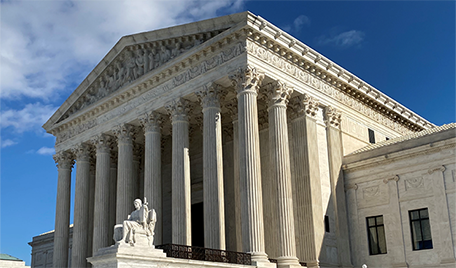 In March 2025, President Donald Trump removed Rebecca Kelly Slaughter from her position as a commissioner for the FTC. Slaughter countered by suing Trump and others, claiming her dismissal violated the terms of the Federal Trade Commission Act.
The U.S. District Court for the District of Columbia found that Slaughter’s firing violated a precedent set in Humphrey’s Executor v. United States (1935), which established the constitutionality of the FTC’s removal protections. A divided U.S. Court of Appeals for the District of Columbia Circuit denied a stay request from the Trump administration, citing the precent of Humphrey’s Executor. Then on Sept. 22, 2025, the Supreme Court treated the Trump administration’s emergency relief application as a petition for certiorari before judgment on the following two questions:
1) Whether the statutory removal protections for members of the FTC violate the separation of powers and, if so, whether Humphrey’s Executor v. United States should be overruled.
(2) Whether a federal court may prevent a person’s removal from public office, either through relief at equity or at law.
The Fate of Humphrey’s Executor
The Supreme Court considered the Humphrey’s Executor case in another era where an incoming president wanted to make a change to the Federal Trade Commission after an election.
William E. Humphrey was serving a six-year term in 1933 at the FTC when President Franklin Roosevelt asked Humphrey for his resignation, on the grounds that “that the aims and purposes of the Administration with respect to the work of the Commission can be carried out most effectively with personnel of my own selection.” When Humphrey refused to resign, Roosevelt fired Humphrey, but Humphrey did not acknowledge Roosevelt’s decision and continued to collect his salary. After Humphrey died in 1934, his estate sued for back pay.
In the Court’s unanimous Humphrey’s Executor decision, Justice George Sutherland said the Federal Trade Commission Act’s language provided that its commissioners could only be removed by the president for inefficiency, neglect of duty, or malfeasance in office. The Court noted its prior decision in Myers v. United States, which held that a postmaster could be removed by the chief executive because “an officer is merely one of the units in the executive department.”
Justice Sutherland drew a distinction between the Myers majority decision written by Chief Justice William Howard Taft and the case at hand in Humphrey’s Executor: “When Congress provides for the appointment of officers whose functions, like those of the Federal Trade Commissioners, are of Legislative and judicial quality, rather than executive, and limits the grounds upon which they may be removed from office, the president has no constitutional power to remove them for reasons other than those so specified,” Sutherland noted.
The Arguments in the Slaughter Case
In a response brief, Slaughter’s attorneys point to Humphrey’s Executor and other precedents limiting the president’s ability to remove board members from multi-member federal agencies. “This case raises momentous questions.” they argue. “In blessing removal protections for traditional multimember agencies—first in Humphrey’s Executor v. United States and then, time and again, in succeeding cases involving the constitutionality of such protections—has this Court gotten it wrong for the last 90 years?”
The brief also points to the original intent of the First Congress, which it says “created multimember bodies over which the president did not have the ‘illimitable’ and ‘unrestricted’ removal power they posit.”
Slaughter’s attorneys also argue that a ruling for the Trump administration would greatly upset the separation of powers between the executive and legislative branches, adding to the “power of the executive branch by transferring to the presidency vast new powers that Congress and prior presidents, working together, chose not to vest in the president alone.”
In his brief, Solicitor General John Sauer states that Article II of the Constitution allows a president “to remove those who assist him in carrying out his duties.” Sauer also cites Seila Law LLC v. Consumer Financial Protection Bureau (2020), which he believes questioned the reasoning of the Humphrey’s Executor case.
Seila Law LLC, a firm that provided debt-related legal services to clients, was under investigation by the Consumer Financial Protection Bureau. Seila Law argued that the agency’s structure, consisting of a single director who exercised substantial executive power but who was removable only for cause was unconstitutional because such a structure violated the separation of powers.
Chief Justice John Roberts wrote the 5-4 majority’s Seila Law decision, agreeing that “the CFPB’s leadership by a single individual removable only for inefficiency, neglect, or malfeasance violates the separation of powers.” The Chief Justice believed the structure of the modern CFPB bore little resemblance to the New Deal era-created Federal Trade Commission.
Sauer points to the reasoning in Seila Law and other precedents that Humphrey’s Executor wrongly concluded in 1935 that “FTC exercised no executive power at all” and that the modern commission has little resemblance to today’s FTC.
On the second question presented to the Supreme Court, a ruling could have a significant impact on independent agencies. Judge Neomi Rao in her dissenting opinion in the D.C. Circuit wrote that courts do not have the power to issue injunctions reinstating terminated officials and instead can only provide remedies at law. If the Supreme Court agrees with Rao’s stance, the president might be able to remove any executive branch employee, as long as the president is willing to pay out an employee’s damages claim.
As the Court considers arguments in Trump v. Slaughter, related cases possibly affected include President Trump’s ability to fire Shira Perlmutter, the Register of Copyrights and Director of the U.S. Copyright Office, and to terminate Lisa Cook from the Federal Reserve Board of Governors.
The Supreme Court has deferred a decision in Perlmutter’s case until its hears arguments in Trump v. Slaughter and Cook’s case, which will be heard by the Supreme Court on Jan. 21, 2026. In August 2025, President Trump removed Lisa Cook from the Federal Reserve Board based on claims of alleged mortgage fraud. Cook claims Trump lacked the power to fire her from the board. A divided U.S. District Court for the District of Columbia ruled for Cook on her claims she was not fired for cause and she lacked due process. The Supreme Court is considering if it should stay the district court’s decision.
Scott Bomboy is the editor in chief of the National Constitution Center.