


On Thursday, a unanimous Supreme Court said that part of a federal law could not be used to prosecute a man solely for possessing a gun and a controlled substance at the same time.
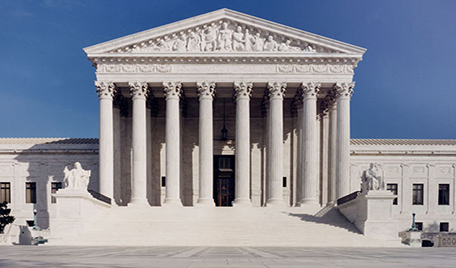 In United States v. Hemani, the Court upheld a U.S. Court of Appeals for the Fifth Circuit bench opinion that struck down part of a federal law, U.S.C. 922(g)(3), known as the “unlawful user” provision.” It banned anyone who is an “unlawful user of or addicted to any controlled substance” from possessing firearms or ammunition.
The Federal Bureau of Investigation arrested Ali Danial Hemani after it obtained a warrant to search his home. Agents found a 9mm pistol, 60 grams of marijuana, and 4.7 grams of cocaine in Hemani’s possession, according to court documents. The government believed that Hemani was a habitual marijuana user.
A grand jury found that Hemani had violated the unlawful user provision by possessing a handgun while in possession of marijuana. Hemani said that U.S.C. 922(g)(3) didn’t apply to his case and that the arrest violated his rights under the Second Amendment, which protects an individual’s right to keep and bear arms. The Fifth Circuit court agreed with Hemani.
In his opinion for the Supreme Court, Justice Neil Gorsuch held that “the government’s prosecution of Mr. Hemani under §922(g)(3)’s unlawful user provision is inconsistent with the Second Amendment.”
“The Second Amendment protects the right of ‘all Americans’ to keep and bear firearms for self-defense, though like most individual rights it has its limits,” Gorsuch said. “The government bears the burden of showing its regulatory efforts are ‘consistent with the Nation’s historical tradition of firearm regulation,’” he added, quoting the Court’s 2022 decision in New York State Rifle & Pistol Association, Inc. v. Bruen.
“The government construes §922(g)(3) to automatically ban an individual from possessing a gun from the moment he becomes an unlawful user of any controlled substance and remains in effect until he ceases being one, regardless of what controlled substance an individual uses, in what amounts, whether his drug use has ever made him a danger to himself or others, why he keeps a gun, or how safely he does so,” Gorsuch stated.
Rejecting the government’s use of “habitual drunkard” laws to make its case, Gorsuch concluded that “the government’s analogy fails on every metric it invites the Court to consider. Taken cumulatively, these problems prove fatal to the government’s prosecution of Mr. Hemani.”
Gorsuch also added that the decision was narrow and did not apply to laws that ban addicts or those intoxicated from possessing a firearm, or other laws “Congress might adopt after determining that users of a particular drug pose a special risk of misusing firearms.”
In his concurring opinion, Justice Clarence Thomas agreed with the Court’s opinion, and he also thought the law violated the Constitution’s Commerce Clause. “Congress lacks the power to regulate the possession of firearms solely on the ground that they crossed state lines at some point in the past,” he stated.
In another concurring opinion, Justice Ketanji Brown Jackson, joined by Justice Sonia Sotomayor, wrote to confirm that the appeals court properly applied the Bruen precedent and United States v. Rahimi (2024), another ruling that an individual found to pose a credible threat to the physical safety of another person may be temporarily disarmed. However, Jackson still argued that the Bruen ruling was flawed, and its “history and tradition” requirement was problematic.
And Justice Samuel Alito, joined by Justice Elena Kagan, said he would have rejected the appeal because the government’s reliance on the habitual drunkard laws ignored substance use in a current context. “Marijuana use today is like alcohol use at the founding. It is widespread and increasingly considered socially acceptable in many quarters. And from a practical standpoint, law enforcement widely tolerates the use of marijuana,” he concluded.
The case had attracted a considerable amount of attention, with groups like the National Rifle Association (NRA), the National Organization for the Reform of Marijuana Laws (NORML), the New York State Rifle & Pistol Association, and the Cato Institute filing briefs supporting Hemani. In addition to United States Solicitor General John Sauer, a group of 19 states, Everytown for Gun Safety, and the Brady Center to Prevent Gun Violence support the federal government’s position.
Scott Bomboy is the editor in chief of the National Constitution Center.