

Sometimes the nation’s highest court can make a statement when it stays silent.
 On Monday, the Supreme Court rejected a petition in C. S. v. Craig McCrumb, a case that asked the justices to rule on the limits of First Amendment rights inside of public schools. Specifically, the case addressed a school decision on what counted as an appropriate clothing choice for a Michigan elementary school student inside of the classroom.
In her petition, the student was contesting a ban placed on a hat she wore at school. The plaintiffs sought a ruling related to one of the Court’s landmark decisions, Tinker v. Des Moines Independent Community School District (1969), which involved the use of protest-related armbands in public schools.
An attempt to redefine the Tinker precedent
In McCrumb, the student’s petition for a writ of certiorari was offered by her father, Adam Stroub. The petition argued that the school’s response to the student’s hat was part of a pattern of cases where schools were forcing their own viewpoints on students, using a wrongly applied version of the Tinker precedent.
“Tinker is being circumvented by school officials silencing views with which they disagree while hiding behind the notion of avoiding hurt feelings,” the petitioners claimed. “This Court should restore for the Nation’s schoolchildren the promise of First Amendment protections Tinker guaranteed their grandparents’ generation more than half-century ago.”
In December 1965, at the height of the Vietnam War, three students, including Mary Beth Tinker, a 13-year-old student at Warren Harding Junior High School in Des Moines, Iowa, wore black armbands to school to protest the war. They were all suspended.
In his 7-2 majority opinion in Tinker, Justice Abe Fortas said, “First Amendment rights, applied in light of the special characteristics of the school environment, are available to teachers and students. It can hardly be argued that either students or teachers shed their constitutional rights to freedom of speech or expression at the schoolhouse gate.”
However, Fortas noted that students’ free speech rights didn’t extend to conduct that “materially disrupts classwork or involves substantial disorder or invasion of the rights of others.” But he also held that silent protests—such as wearing armbands—were constitutionally permitted. “Our problem involves direct, primary First Amendment rights akin to ‘pure speech.’ The school officials banned and sought to punish petitioners for a silent, passive expression of opinion, unaccompanied by any disorder or disturbance on the part of petitioners,” Fortas concluded.
Since 1969, the Tinker precedent has been repeatedly cited by the Supreme Court when defining the boundaries of student expression.
A dispute escalates over a hat
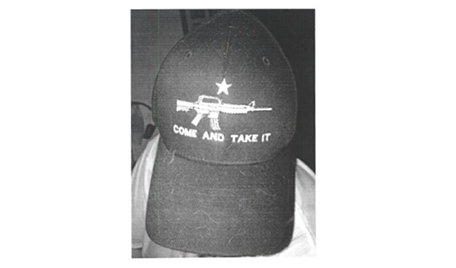
In the McCrumb case, Kerr Elementary’s weeklong “Great Kindness Challenge” in February 2022 included “Hat Day,” when the school asked students to wear hats of their choice. For C.S., her hat choice was a black baseball cap with a white star, a white image of an AR-style rifle, and the phrase “come and take it” printed on the cap. As later revealed in court, C.S. chose that hat as a tribute to her father and to show her support for “the right of people to have guns.”
A school officer saw C.S with the hat and called her parents, who declined to send a substitute hat to the school. Officials then asked C.S. to remove her hat and place it in her locker and she complied. Through her father, C.S. sued the school district, alleging violations of the First Amendment’s Free Speech Clause and the 14th Amendment’s Due Process Clause. A district court ruled in favor of the school and the case was sent to the U.S. Court of Appeals for the Sixth Circuit.
A three-judge panel affirmed the lower court's decision in May 2025 where several facts came into play. On Nov. 30, 2021, in Oakland County, Michigan, a student opened fire on his classmates at Oxford High School, killing four other students. The educators at Robert Kerr Elementary School felt the hat was inappropriate in the context of the event held on February 17, 2022, just 10 weeks after the Oxford High shooting. Oxford High was a one-hour drive away, and the incident was highly publicized. The school also felt the hat could cause a disruption among students who had recently transferred to Robert Kerr from the Oxford School District as a result of the shooting.
The attorneys for C.S. argued the school lacked evidence that the hat would cause a “substantial disruption” under Tinker and the school’s actions also censured the free speech rights of C.S. under the Tinker standard. They also stated school officials disagreed with the speech “COME AND TAKE IT” on the hat, which represented the support of C.S. for the Second Amendment.
The unanimous appeals court held that “special characteristics” and circumstances, such as the presence of former Oxford School District students in the district, the young age of plaintiff and her classmates, and the hat’s message, combined to give school officials good cause to expect substantial disruption to the school’s educational environment under Tinker.
The entire Sixth Circuit declined to hear the case, but several circuit judges published opinions concurring with the ruling. One of the judges questioned the timing of the school’s statements linking its decision to the Oxford School District shooting well after the incident happened on Hat Day.
The Supreme Court declines the case
In their petition to the Supreme Court, the attorneys for C.S. made the argument that a rule created by the schools’ leaders “allowed them to hide behind a post hoc excuse they invented (with the aid of counsel) months after the fact, and which is unsupported by the record.”
“The Sixth Circuit opinions blow a gaping hole in Tinker. School officials, with the luxury of 10 months’ time and counsel’s advice, will usually be able to contrive some justification for squelching student speech akin to the panel’s notion of protecting ‘children reeling from an irrefutably tragic and traumatic event,’” they said.
Her attorneys also claimed the case merited Supreme Court consideration because the Sixth Circuit had created a new “potential emotional harm” exception to the First Amendment, as a fourth category of regulatable student speech regulated by the Court.
The justices considered the McCrumb case twice in private conference before refusing to grant the petition. There were no comments from any of the justices.
Absent from the denial of certiorari were any opinions from the justices on the case’s merits, and only four of the nine justices are needed to accept a case. In the end, the Tinker disruption standard remains in place.
Scott Bomboy is the editor in chief of the National Constitution Center.