


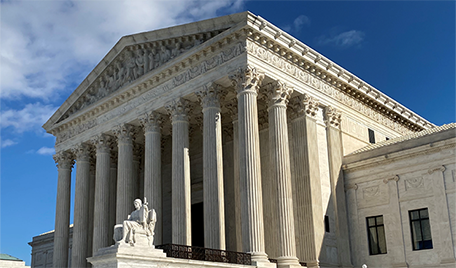
How far can law enforcement go in asking digital companies to turn over data about their customers without violating the Fourth Amendment? This basic question of balancing privacy and public safety interests in the digital age will soon be considered at the Supreme Court, with potentially major implications.
 As ratified as part of the Bill of Rights, the Constitution’s Fourth Amendment reads, “The right of the people to be secure in their persons, houses, papers, and effects, against unreasonable searches and seizures, shall not be violated, and no Warrants shall issue, but upon probable cause, supported by Oath or affirmation, and particularly describing the place to be searched, and the persons or things to be seized.”
In United States v. Chatrie, a Virginia man claims a detective did not reasonably obtain the search warrants required by the Fourth Amendment to track down his cellphone location data, which was used eventually to convict him of a crime. Law enforcement had asked for a geofence warrant from a magistrate, which sets a distance from a certain physical point from which service providers must provide data to law enforcement about mobile phones users’ activities.
While the Court is only asked in Chatrie to consider the specific execution of the geofence warrant in the case, its decision could expand or limit the Fourth Amendment protections established for cellphone users in Carpenter v. United States (2018). In his 5-4 majority decision in Carpenter, Chief Justice John Roberts held that “the Government’s acquisition of . . . cell-site records was a search within the meaning of the Fourth Amendment. … [T]he Government must generally obtain a warrant supported by probable cause before acquiring such records.”
The basic facts in the case
Okello Chatrie was convicted of bank robbery based on evidence gathered by law enforcement in three different cellphone data requests to Google, based on a protocol developed by Google and approved by a magistrate. Digital services like Google, Apple, and others use location data for mapping applications and other products to provide a customized experience. A detective in Midlothian, Virginia, sought a geofence warrant about a month after the bank robbery.
After receiving the geofence warrant from a magistrate, law enforcement at first received data from within a 300-meter diameter of the crime scene; the detective made requests directly to Google for data related to specific phones and then for a specific user by name.
Chatrie’s attorneys claimed in court that law enforcement needed separate warrants for all three data requests. In his initial hearing, a district court judge agreed with Chatrie’s claims that his Fourth Amendment rights had been violated. But it allowed the evidence to be considered in the case because officers had received the warrant in “good faith.” The lower court cited the Supreme Court precedent in United States v. Leon (1984) that evidence gathered from a mistakenly issued search warrant cannot be excluded at trial.
His attorneys then appealed and the full U.S. Court of Appeals for the Fourth Circuit split equally 7-7 on the Fourth Amendment question when the chief judge declined to consider it and instead based his decision on the Leon precedent. In their appeal to the Supreme Court, Chatrie’s attorneys cited a circuit split in Fifth Circuit on the same question. The Supreme Court accepted the case on Jan. 16, 2026, limited to the Fourth Amendment question presented by Chatrie.
The Fourth Amendment in a digital context
Chatrie as the petitioner makes several arguments in his appeal. His attorneys believe that Chatrie’s situation goes beyond the issues considered by Chief Justice Roberts and the Carpenter majority. “In Carpenter, law enforcement officials sought information about the movements of a single individual suspected of a crime based on the movements of his cell phone. By contrast, using a geofence warrant, law enforcement may request information regarding all people who were at a sensitive location—an abortion clinic, a protest, a political party’s convention—at a particular time.”
The use of the geofence warrant violates basic constitutional principles, they believe. “The search of petitioner violated the Fourth Amendment. The technology may be novel, but the constitutional problem it presents is not,” Chatrie’s attorneys claim in a brief filed in February 2026. “The Fourth Amendment was born of the Founders’ revulsion for general warrants and writs of assistance—instruments that allowed the government to search first and develop suspicions later.”
After reaching a decision that a search of the petitioner occurred that violated Chatrie’s property rights and his reasonable expectation of privacy, Chatrie’s attorneys are asking the Court to rule that the warrant was defective since it did not require separate warrants for each step in the search process.
“At Steps Two and Three, the government retrieved additional private information and hence conducted additional searches. Those searches were unconstitutional,” they conclude. “Although Google reviewed the government’s Step Two and Step Three requests, Google is not a judge and has no authority to approve warrants.”
The government’s response
In its most recent response to the Court, the federal government makes several counterarguments. It also states that the proper question in front of the Court should be “[w]hether the government violated petitioner’s Fourth Amendment rights by obtaining—pursuant to a judicial warrant—cellphone location information that petitioner sent to Google LLC."
Solicitor General D. John Sauer believes Chatrie forfeited his Fourth Amendment rights when he opted in to Google’s data and location history policy. “He took no steps to protect his location from disclosure, such as pausing the Location History feature, he had enabled or adjusting, deactivating, or forgoing his cellphone during his crime.”
Another argument from Sauer supports the legitimacy of the search warrant from the magistrate. “A magistrate approved a three-step procedure for law enforcement to receive up to two hours of location information—most of it anonymized—from Google about mobile devices that were archiving locations near the bank at that time. That procedure was fully consistent with the Constitution.”
Sauer also cites the precedents in Carpenter as reasonably considering basic privacy rights in the context of a law enforcement investigation. “Even for long-term involuntarily collected location data in which an individual does have a reasonable expectation of privacy, law enforcement can obtain such information through a warrant expectation of privacy claims,” Sauer notes.
The federal government also believes that law enforcement had probable cause for the search since it was “particularized to the information on Google’s servers” that would “identify suspects and witnesses” while minimizing the scope of the information investigators received.
With the case set for arguments on April 27, numerous friends of the court briefs have been filed, including a brief from Google that supports neither party in the case. Also, of great interest will be if the current Court expands the Carpenter precedent or refines it, since only three of the majority votes from Carpenter remain on the Court: John Roberts, Elena Kagan and Sonia Sotomayor.
Scott Bomboy is the editor-in-chief of the National Constitution Center.