

On Monday, Microsoft added projections to its elections coverage for the first four primary-season presidential races, including the Iowa caucuses, using a computer-generated system integrated with its Bing search engine.
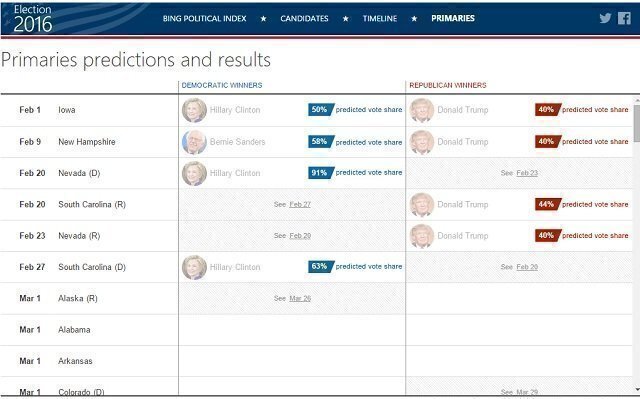 In a preview blog post, the software giant says the latest addition to its Bing Predicts product suite will use “machine-learning models” to interpret “data from polls, prediction markets, and anonymized and aggregated search-engine queries to forecast the winners of the Republican and Democratic nominations at each state.”
Microsoft previewed its first results last week in a blog post. It had Donald Trump easily winning the first four GOP races, while Hillary Clinton took three races (Iowa, South Carolina and Nevada) and Bernie Sanders won the Iowa caucus.
With Gallup Research and Pew Research deciding to sit out this season’s “horse-race” polling cycle, Microsoft could fill a vital niche that complements tradition election polling.
The popular election website Real Clear Politics does gather data from published polls and produces an average that attempts project balanced poll results. For example, as of Friday, Real Clear Politics had Clinton with an average 2.5% lead over Sanders in Iowa, and Trump up 7.0% in Iowa.
Bing’s prediction had Clinton up by 3.3% on Sanders in Iowa and Trump up 7.0% in Iowa 9.3%.
Microsoft and Bing boast about some success in the past two year predicting the outcomes of events and contests by adding in-depth analysis of Bing user searches to its algorithm.
For example, its prediction accuracy in the 2014 mid-term elections as 97 percent for the U.S. Senate, 96 percent for the House, and 89 percent for gubernatorial contests. Its highest rates included predicting the outcome of reality contests shows Dancing With The Stars (95 percent) and The Voice (84 percent), and the Cricket World Cup (85 percent).
However, Bing Predicts recently said that the New England Patriots would win next weekend’s Super Bowl 50; instead, Denver and Carolina will battle for the title.