


Shortly after the September 11, 2001, terrorist attacks carried out against the United States, Congress approved legislation granting the president sweeping powers to prevent similar terrorist actions. The 2001 statute related to the 9/11 attacks remains active today, amid questions about whether Congress should repeal or replace it.
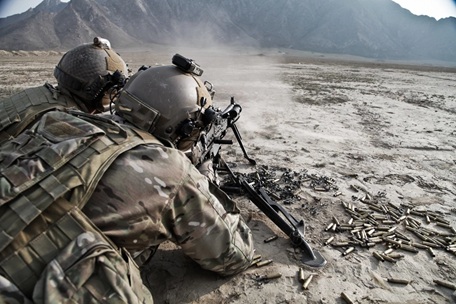 Congress passed the Authorization for Use of Military Force of 2001 on Sept. 14, 2001, and it became a law four days later. Since then, the AUMF of 2001 has been cited dozens of times as statutory authority for military or counter-terrorism actions taken by American presidents in the Middle East, Africa, South Asia, and other regions.
A year later, a separate Authorization for Use of Military Force Against Iraq passed in October 2002 that gave the president powers to take “necessary and appropriate” actions to “defend the national security of the United States against the continuing threat posed by Iraq.” In December 2025, the Fiscal Year 2026 National Defense Authorization Act (NDAA) repealed the AUMF of 2002 and also the AUMF for the 1991 Gulf War.
However, the AUMF of 2001, which lacked an expiration date when signed into law, remains in force. In recent years, it has been cited as authorizing detention operations at Guantanamo Bay, strikes at ISIS locations in Nigeria, and operations in Iraq and Syria against ISIS and al-Qaida
The AUMF, Article II, and the War Powers Resolution
Presidents have cited the AUMF of 2001 for taking military actions, along with war powers granted to the chief executive under the Constitution under the Commander in Chief Clause in Article II, Section 2, which states, “The President shall be Commander in Chief of the Army and Navy of the United States, and of the Militia of the several States, when called into the actual Service of the United States.”
Opponents of these actions argue that they conflict with the Declare War Clause in Article I, Section 8, of the Constitution, which grants Congress the ability to initiate prolonged armed hostilities. However, Congress has not formally declared war against a foreign power since World War II.
Opponents also cite the War Powers Resolution of 1973, which Congress passed in response to fallout from the Vietnam War and ongoing conflicts with President Richard Nixon. The Resolution requires that, in the absence of the authorization for the use of military force by Congress, a president must report to Congress within 48 hours after introducing military forces into hostilities and must end the use of such forces within 60 days unless Congress permits otherwise.
The Resolution also requires the president “in every possible instance” to consult with Congress before introducing the military into imminent hostilities. It also gives Congress the ability to terminate the use of force in unauthorized hostilities at any time by concurrent resolution of the House and Senate. (These resolution powers were later modified by a Supreme Court decision in 1983.)
A Brief History of the AUMF of 2001 and Legal Cases
The primary initial action taken under the AUMF of 2001 was the October 2001 invasion of Afghanistan, during which Operation Enduring Freedom targeted Taliban and al-Qaeda operations. United States military forces remained in Afghanistan until 2021. While American forces have left the country, the AUMF passed to approve the military operations there remains in effect.
Between 2004 and 2009, the Bush administration cited the AUMF of 2001 and the AUMF of 2002 as statutory authority to target al-Qaida operations in Iraq. According to a Brown University study in 2021, there were at least 22 countries where presidents deployed actions citing powers under the AUMF of 2001.
Target areas included air and ground operations in Syria, raids and airstrikes in Libya, operations targeting Abu Sayyaf in the Philippines, and drone strikes and ground raids against al-Qaida in the Arabian Peninsula (AQAP) and ISIS targets in Yemen.
Another controversy related to the AUMF of 2001 was the detention of terrorism suspects at Guantanamo Bay in Cuba. Provisions of the act allowed the executive branch to label prisoners taken during these conflicts as “enemy combatants” – a status that would set the stage for several Supreme Court cases.
In Hamdi v. Rumsfeld (2004), the Supreme Court considered the detainment of Yaser Hamdi, a U.S. citizen captured in Afghanistan by the U.S. military in 2001. Hamdi was declared to be an “enemy combatant” fighting for the Taliban and was sent to Guantanamo Bay for indefinite detention. When it was discovered that he was a U.S. citizen, Hamdi was transferred to a military prison in Virginia and his father petitioned the court for his release.
In the plurality opinion, Justice Sandra Day O’Connor wrote that, although Hamdi’s detention was authorized by Congress, due process under the Fifth Amendment applied, and a United States citizen held as an enemy combatant must be given an opportunity to contest the basis for that detention before a neutral decisionmaker. “Hamdi contends that the AUMF does not authorize indefinite or perpetual detention,” O’Connor noted. “Certainly, we agree that indefinite detention for the purpose of interrogation is not authorized.” After the decision, Hamdi was released after agreeing to renounce his U.S. citizenship.
Then in Hamdan v. Rumsfeld (2006), Salim Ahmed Hamdan, a bodyguard and chauffeur for Osama bin Laden, was captured during military actions taken under the AUMF of 2001. Hamdan was sent to Guantanamo Bay after being tried and convicted in a military tribunal that was established by the Department of Defense.
Hamdan asserted that the military tribunal violated the Constitution and international law. In a 5-3 ruling, the Court—with a majority opinion authored by Justice John Paul Stevens— held that the president had no inherent constitutional authority to establish the military tribunals under the AUMF. It then held that Congress had at most authorized military commissions that complied with the Uniform Code of Military Justice and the law of war. Because Hamdan’s trial had violated the UCMJ and the Geneva Conventions, it exceeded the president’s authority.
The Supreme Court held in Boumediene v. Bush (2008) that military commissions established for Guantanamo Bay by Congress after the Court’s Hamdan decision denied detainees their constitutional right to the writ of habeas corpus. It also rejected parts of the law also barred foreign nationals labeled as “enemy combatants” from challenging their detention in Article III courts.
There have been attempts to repeal or end the AUMF of 2001. In December 2025, Representatives Pramila Jayapal and Thomas Massie introduced legislation to fully repeal the AUMF of 2001. That legislation has not progressed through the House.
But in the actions taken by the United States in Iran, the president has not cited the AUMF as statutory authority. Instead, the president’s powers under Article II are more often cited as the authorizing power under the Constitution in such situations in recent years.
Scott Bomboy is the editor in chief of the National Constitution Center.