


On Monday, a divided Supreme Court held that a police request to obtain cellphone user location data represents a search and generally requires a warrant under the Fourth Amendment. Justice Elena Kagan authored the Court’s majority opinion in the case.
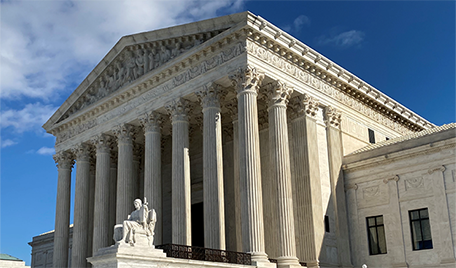 The Constitution’s Fourth Amendment reads, “The right of the people to be secure in their persons, houses, papers, and effects, against unreasonable searches and seizures, shall not be violated, and no Warrants shall issue, but upon probable cause, supported by Oath or affirmation, and particularly describing the place to be searched, and the persons or things to be seized.”
In Chatrie v. United States, a Virginia man, Okello Chatrie, claimed a detective did not reasonably obtain search warrants used to track down his cellphone location data. The government later used this data to convict him of robbing a bank.
Law enforcement had asked for a geofence warrant from a magistrate. Geofence warrants set a distance from a certain physical point from which service providers such as Google must provide data to law enforcement about a mobile phone users’ activity.
Chatrie was convicted of bank robbery based on evidence gathered in three different cellphone data requests to Google covered under one warrant, based on a protocol developed by Google and approved by a magistrate.
Justice Elena Kagan, in a 6-3 decision, said the Court was presented with a two-part Fourth Amendment question. “Answering that question in full would mean deciding whether the police conducted a Fourth Amendment ‘search’ when they acquired the cellphone data leading to Chatrie’s arrest and, if so, whether that search was reasonable given the features of the warrant they employed.”
“We decide the first part of that inquiry today, concluding that the police conducted a search when they gained access to [Google’s] Location History data,” Kagan noted. The second part of the question Kagan returned to a federal court of appeals to determine if the search was reasonable, properly described with particularity, and supported by probable cause.
Citing the Court’s precedent in Carpenter v. United States (2018), Kagan said, “The Fourth Amendment protects individuals’ reasonable expectations of privacy, and governmental intrusion into that private sphere generally qualifies as a search.”
Kagan found the question presented in this case closely mapped to Carpenter. “In Carpenter, this Court held that accessing cell-site location information (CSLI) constitutes a Fourth Amendment search because ‘individuals have a reasonable expectation of privacy in the whole of their physical movements.’”
“Everything Carpenter relied on to find that law enforcement officers conducted a Fourth Amendment search when they accessed CSLI records applies as well or better to the police’s accessing of Location History data,” she concluded.
The second part of the question will head back to the Fourth Circuit Court of Appeals. “The Fourth Circuit did not address the questions that unusual warrant raises. Because this is ‘a court of review, not of first view,’ the Court leaves it up to the Court of Appeals to decide whether, at each step of the search process, the warrant satisfied the Fourth Amendment’s requirements of particularity and probable cause,” Kagan concluded. Chief Justice John Roberts, and Justices Sonia Sotomayor, Brett Kavanaugh, and Ketanji Brown Jackson, joined Kagan’s majority opinion.
In her concurrence, Justice Jackson wrote the Supreme Court should have settled the question returned to the Fourth Circuit. “As the Court observes, ‘[w]hen officers have obtained a warrant,’ the validity of a search turns on ‘whether a magistrate has properly found probable cause to support a particularly described search.’ In my view, it is clear that at a minimum the second and third stages of the search process here did not satisfy this foundational requirement.”
Justice Neil Gorsuch filed an opinion concurring in the Court’s judgment. But he would have taken a different approach to answering the Fourth Amendment issue. “To decide whether the Fourth Amendment is in play, I would consult its terms, asking first whether Location History qualifies as one of Mr. Chatrie’s papers or effects, and then asking whether the government searched those papers or effects. This traditional approach remains very much part of our law.”
“So just as the First Amendment protects speech over the internet today no less than it did speech delivered in the town square in 1791, it should hardly come as a surprise that the Fourth Amendment might protect as personal ‘effects’ electronic diaries of one’s travels as it always has more traditional ones,” he wrote.
Justice Samuel Alito, joined by Justices Clarence Thomas and Amy Coney Barrett, dissented—arguing that this decision and Carpenter established a “protected Fourth Amendment interest in any sensitive personal information about them that is collected and owned by third parties.” This expanded definition also included a requirement, he believed, that “the police must obtain a warrant every time they access any cell-phone location information from a third party, however brief the duration, however innocuous the request, and however voluntarily that information was disclosed by the user.”
Justice Barrett, in a brief dissent, wrote that she agreed with Alito that “under our Fourth Amendment precedent, including Carpenter, Chatrie had no reasonable expectation of privacy in data about his public movements that he voluntarily disclosed to Google. I therefore respectfully dissent.”
Scott Bomboy is the editor-in-chief of the National Constitution Center.