

This series of profiles features noteworthy people over the past 250 years who have shaped the American constitutional tradition in various ways. In this post, National Constitution Center content fellow Tristan Worsham examines the career of Gouverneur Morris, a colorful framer who influenced the Constitution at a critical stage in 1787.
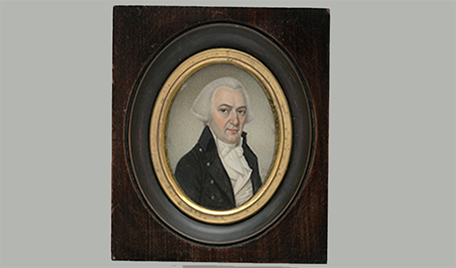 To many Americans, the most memorable and significant part of the Constitution is its opening, “We the People of the United States.” The principles expressed in the Constitution’s Preamble animate our political culture and announce our government’s aspirations. Yet it was neither Madison nor Jefferson nor Washington who wrote those famous words. That distinction belongs to the largely overlooked Gouverneur Morris—perhaps the most important and colorful of the forgotten Founding Fathers.
Gouverneur Morris was born in 1752 in Morrisania, New York. The son of a wealthy family, he showed early promise as a scholar, attending King’s College (now Columbia University) at just 12 years old. Morris graduated with bachelor’s and master’s degrees by 1771. While pursuing his master’s, he apprenticed under New York Supreme Court Judge William Smith. The 19-year-old Morris who emerged in New York society as a licensed lawyer cut quite a figure. Known for his wit and charisma, he was over 6 feet tall at a time when the average American man stood at around 5 1/2 feet. Theodore Roosevelt, who wrote a biography of Morris, described him as “[i]mperious, light-hearted, good-looking, well-dressed. . . [and with] just a touch of erratic levity that served to render him still more charming.”
Morris and the Revolutionary War
Everything was looking up for the young Morris, but his life was forever changed by the growing hostilities between the American colonies and Britain. Much of his social circle remained loyal to the Crown. Many scholars paint Morris as a “conservative” who was “slow to support the revolutionary cause,” but historian Dennis Rasmussen notes that he “embraced the idea of independence right around the same time as did the bulk of his fellow patriots.” By 1776, Morris was firmly on the side of Revolution, a stance that put him at odds with many of his friends and family.
During the Revolutionary War, Morris served as a delegate to the Second Continental Congress, which functioned as the de facto national government during the Revolutionary War. Notably, Morris was selected to be on a five-member committee sent to Valley Forge to meet with General George Washington. He witnessed firsthand the battered and underfunded Continental Army, describing in a letter the “naked starving Condition” of the Army rendered “out of Health [and] out of Spirits.” The visit to Valley Forge instilled in Morris a deep admiration for Washington. Morris returned to Congress as Washington’s advocate and ally.
As a member of the Continental Congress, Morris was young, opinionated, and intent on furthering the interests of the union as a whole, rather than just those of New York. This nationalist commitment displeased the New York Legislature, which failed to reappoint Morris in 1779. It was also around this time that Morris suffered an accident that led to the loss of his left leg. The story accepted by most historians is that his leg was amputated following a carriage accident. This explanation has not stopped the dissemination of the likely apocryphal tale that Morris broke his leg jumping out of a window to escape the enraged husband of a woman he was seeing. The tall, handsome, well-to-do Morris was well known for his rollicking social life. In any case, Morris would walk with the help of a wooden peg leg the rest of his life.
After losing his seat in Congress, Gouverneur Morris moved to Pennsylvania in 1779, drawn to the nation’s political and financial center. There, he resumed his law practice while continuing to write and correspond on the young nation’s political and financial future. Within two years, he returned to public service as assistant superintendent of finance to Robert Morris (no relation), helping to stabilize the nation’s precarious wartime finances. His growing influence in Pennsylvania led to his appointment as one of the state’s delegates to the Constitutional Convention.
Morris at the Convention
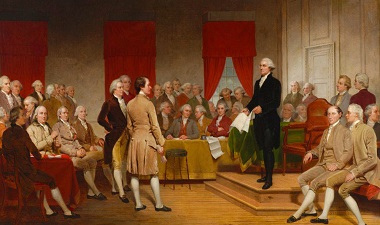
“He came here as a Representative of America,” Morris boldly proclaimed in July 1787, “he flattered himself he came here in some degree as a Representative of the whole human race.” Rather than representing the provincial interests of any one state or region of America, Morris sought to further the interests of the nation. He implored his fellow delegates “to extend their views beyond the present moment of time; beyond the narrow limits of place from which they derive their political origin.” For too long under the Articles of Confederation had “the great objects of the nation” been “sacrificed constantly to local views.” The creation of the Constitution was an opportunity to finally embrace a truly national identity—to “form a compact for the good of America.” This nationalistic conception, historian Jonathan Gienapp argues, was the “core of his thinking.” Morris wanted “more Americans [to] feel like Americans: defang the states; bolster the nation.”
Morris’ attempts to convince his fellow delegates to look to “the good of America,” rather than the interests of their own states, ran up against a persistent problem: slavery. In one of his most passionate and significant speeches, Morris declared that he “never would concur in upholding domestic slavery. It was a nefarious institution — It was the curse of heaven on the States where it prevailed.” Southern delegates were obstinate, insisting not only on protecting slavery but on skewing representation to favor their own interests via the Three-Fifths Compromise, which counted enslaved people as three-fifths of a person for purposes of representation and taxation. Throughout the Convention, Morris remained perhaps the most vocal opponent of slavery. In Morris’ words, whenever he was presented with the “dilemma of doing injustice to the Southern States or to human nature,” he chose “the former.”
While Morris had great influence through debate and discussion, speaking 173 times (the most of any delegate), his greatest contributions came in his role as the Constitution’s penman. In September 1787, the Convention formed a five-member Committee of Style tasked with organizing and revising the Constitution. The chair of the Committee, William Johnson, chose Morris to put together the draft. Various accounts consider Morris’ alterations merely stylistic, but recent scholarship by William Treanor has uncovered multiple substantive changes. In Treanor’s estimation, by making slight edits Morris strengthened the national government, creating “the basis for the Federalist Constitution.”
Many of Morris’ edits are necessarily subtle; his rewrite of the Preamble is not. James Wilson, another influential forgotten founder, had written an earlier draft of the Preamble as a member of the Committee of Detail. Wilson was the originator of the famous first words of the Constitution, “We the People” — although with a different meaning. This preliminary draft conceived of the Constitution as an agreement between the peoples of each state:
We the People of the States of New-Hampshire, Massachusetts, Rhode-Island and Providence Plantations, Connecticut, New-York, New-Jersey, Pennsylvania, Delaware, Maryland, Virginia, North-Carolina, South-Carolina, and Georgia, do ordain, declare and establish the following Constitution for the Government of Ourselves and our Posterity.
In contrast, Morris’ version, the Preamble we know today, conceived of one American people:
We the People of the United States, in Order to form a more perfect Union, establish Justice, insure domestic Tranquility, provide for the common defence, promote the general Welfare, and secure the Blessings of Liberty to ourselves and our Posterity, do ordain and establish this Constitution for the United States of America.
While the first lists each state and refers to the people principally as members of their respective states, the second refers to the “People of the United States” and sets out goals common to all Americans. This change encapsulates Morris’ political project: the Constitution was meant to create one nation, the “United States of America.”
Following the Convention, Morris opted to travel to Europe rather than stay in America. During his time abroad, he was called upon to serve as Minister to France during the French Revolution. Returning to America in 1798, Morris, who was reluctant to rejoin public life, was convinced to serve as one of New York’s Senators from 1800 to 1803. During his later years, Morris faced disillusionment as he witnessed the ascendancy of the Democratic Republicans and the downfall of the Federalist party. Morris published numerous works and chaired the Erie Canal Commission before passing away in November 1816.
In an 1814 letter, Morris wrote to a friend that the Constitution “was written by the fingers, which write this letter.” And in the words of James Madison, the “finish given to the style and arrangement of the Constitution fairly belongs to the pen of Mr Morris. . . . A better choice could not have been made.” It was Morris who wrote the Preamble and organized the Constitution into the set of seven articles that became the law of the land. Despite his myriad achievements, the peg-legged penman of the Constitution has faded into obscurity. So many historians who write on Morris come to express the same sentiment: Gouverneur Morris is unforgettable yet forgotten.
Tristan Worsham is a National Constitution Center content fellow and a graduate of the University of California, Berkeley.
Resources:
Jonathan Gienapp, “Representing the Nation: Gouverneur Morris’s Nationalist Constitutionalism,” Georgetown Journal of Law & Public Policy (2023)
Gouverneur Morris, ed. J. Jackson Barlow, To Secure the Blessings of Liberty: Selected Writings of Gouverneur Morris (2012)
Dennis C. Rasmussen, The Constitution’s Penman: Gouverneur Morris and the Creation of America’s Basic Charter (2023)
Theodore Roosevelt, Gouverneur Morris (1888)
William M. Treanor, “The Case of the Dishonest Scrivener: Gouverneur Morris and the Creation of the Federalist Constitution,” Michigan Law Review (2021)