

In his time, Patrick Henry achieved great fame for his skills as an orator and for his advocacy for independence from Great Britain. However, Henry’s constitutional legacy is complicated, and Henry was often in conflict with some Founders while respected by others.
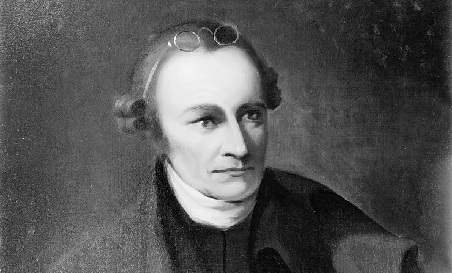 Henry led the effort in Virginia to oppose the Stamp Act of 1765, and he served in the First and Second Continental Congresses in Philadelphia, but he was not in Philadelphia when the Declaration of Independence was signed. In his later years, Henry rejected an appointment to the 1787 Constitutional Convention in Philadelphia, and he soon became a vocal critic of the document, which he called “a resolution as radical as that which separated us from Great Britain.”
Henry was a prominent anti-Federalist who demanded a Bill of Rights be included in the Constitution during ratification debates in Virginia. Henry also was present at some of the key moments during the founding era, and he also was a slaveholder for his entire adult life. In his later years, Henry declined or failed to act on offers to serve as Chief Justice of the United States, Secretary of State, and a United States Senator from Virginia.
Part of his legacy today comes from a moment in March 1775 when Henry reportedly used the phrase “give me liberty or give me death” in a political speech. Those seven words, and Henry’s own conflicts with them, frame much of the debate about Henry’s importance as a Founder.
Firebrand of the Revolution
Patrick Henry was born on May 29, 1736, in Hanover County, Virginia at Studley plantation. He was reportedly influenced at a young age by Samuel Davies, an evangelical Presbyterian pastor who used fiery rhetoric in his sermons. A self-taught attorney, Henry passed Virginia’s bar exam in 1760. He soon gained a reputation within the colony for his role in the Parsons’ Cause case.
The Virginia legislature passed the Two-Penny Act in 1758, which regulated tobacco prices when the crop was used as a form of currency. The Crown vetoed the law and members of the Anglican Church, which was part of Virginia’s government, sued their vestry for lost wages. After losing in court, the vestry brought in Henry to its sentencing hearing. Henry directly attacked the King, who he claimed, “by annulling or disallowing acts of so salutary a nature, from being Father of his people degenerated into a Tyrant and forfeits all right to his subjects’ obedience.” The jury award was just one penny to the clergy.
Within months, Henry was serving in the House of Burgesses and news came that Parliament had passed the Stamp Act of 1765. The act required colonists to pay taxes on every page of printed paper they used. The tax also included fees for playing cards, dice, and newspapers. The measure sparked outrage across the colonies.
Henry introduced five written radical resolutions in the Virginia House of Burgesses, four of which passed. The resolutions were also published in newspapers across the colonies. Henry argued that his majesty’s subjects in Virginia enjoyed “the Priviledges [sic], Franchises & Immunities, that have at any Time been held, enjoyed, & possessed by the People of Great Britain.” He also claimed that taxation with representation was a distinguishing characteristic of “British Freedom and without which the ancient Constitution cannot subsist,” and only Virginia’s assembly had “the only and sole exclusive Right & Power to lay Taxes & Impositions upon the Inhabitants.”
In March 1773, Henry met with Thomas Jefferson, Richard Henry Lee, and several others in Williamsburg to form a Committee of Correspondence system after the Gaspee affair. In June 1772, the royal revenue schooner HMS Gaspee had run around in Rhode Island and was burned by local residents who believed the Crown lacked the power to regulate trade. The official response was the Dockyards, etc., Protection Act of April 1772, which required the extradition to Britain of anyone suspected of burning its ships.
The act immediately triggered a new committee of correspondence in Boston, and the resolution of response introduced by Henry and others in Virginia became the model for most other colonies. “The minds of his Majesty's faithful subjects in this colony have been much disturbed by various rumors and reports of proceedings tending to deprive them of their ancient, legal, and constitutional rights,” the resolution noted.
Henry’s Rhetoric in Action
In September 1774, Henry, George Washington, Richard Henry Lee, and Peyton Randolph were part of Virginia’s delegation at the First Continental Congress in Philadelphia. In all, 56 delegates from 12 colonies (excluding Georgia) came to the meeting to address the Coercive or Intolerable Acts. The laws were meant as punishment for the activities of the Boston Tea Party. Henry openly lobbied for a united front against the Crown.
In the notes of John Adams, he recorded parts of debate over representation in a new government of the colonies. “We are in a State of Nature, Sir, the Distinctions between Virginians, Pennsylvanians, New Yorkers and New Englanders, are no more. I am not a Virginian, but an American. Slaves are to be thrown out of the Question, and if the freemen can be represented according to their Numbers I am satisfied,” Henry said.
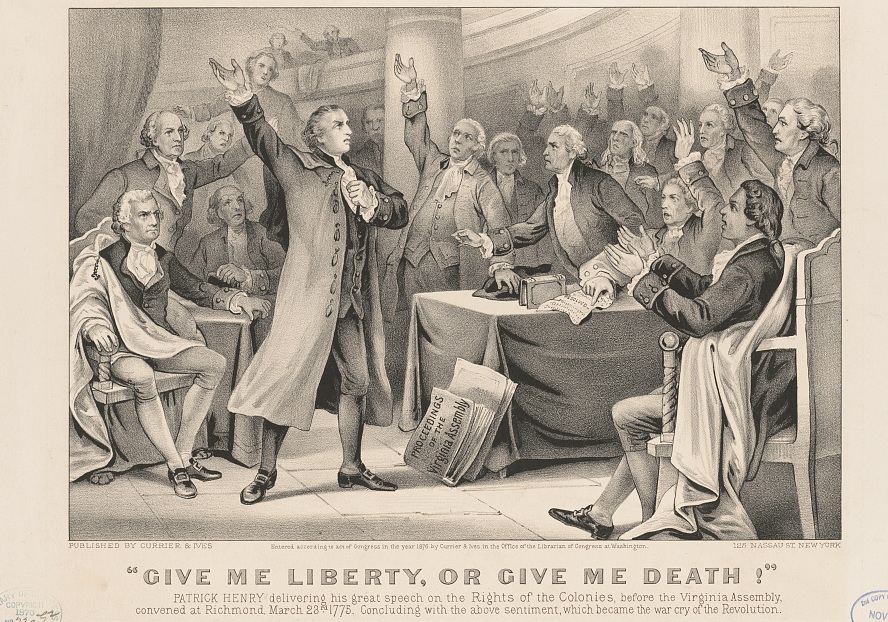 In March 1775, Henry spoke at a Virginia convention to discuss the events in Philadelphia and the need to form armed militias in case British troops attempted to control the area. In later years, biographer William Wirt in 1817 reconstructed Henry’s speech based on the recollections of Thomas Jefferson and others. Wirt’s account ends with the famous lines, “Is life so dear, or peace so sweet, as to be purchased at the price of chains and slavery? Forbid it, Almighty God! I know not what course others may take; but as for me, give me liberty or give me death!” In recent years, some scholars have questioned Wirt’s account of the speech.
Henry also represented Virginia at the opening of the Second Continental Congress in Philadelphia. It was Henry who was first chosen to write a petition to King George III listing colonial grievances. However, the delegates thought Henry’s version was too radical and they settled a more conservative version, John Dickinson’s Olive Branch petition. Henry left Philadelphia in August 1775, never to return to national office.
Life in Virginia and Henry’s Opposition to the Constitution
Henry’s political career in Virginia had national consequences. At the Virginia Convention of 1776, Henry supported the Declaration of Rights written primarily by George Mason, which influenced Jefferson’s work for the Declaration of Independence. Edmund Randolph later noted that Henry contributed to the Virginia Declaration’s final two articles, which required that no free government could exist without “firm adherence to justice, moderation, temperance, frugality, and virtue” or without “the free exercise of religion.”
The Virginia Convention of 1776 concluded with the selection of Henry as Virginia’s first governor. He served for three consecutive one-year terms, where he worked closely on war efforts with George Washington. Henry was elected to the Virginia House of Delegates in 1779. In later years, after his reelection to the governorship in 1784, Henry came into conflict with James Madison. Henry supported a tax to support Christian teachers. Madison responded with his Memorial and Remonstrance of 1785 which called the bill a “dangerous abuse of power.” Virginia lawmakers sided with Madison over Henry, and a bill written by Jefferson and supported by Madison established the official disconnection between church and state in Virginia.
The dispute became greatly magnified when Virginia considered ratification of the Constitution adopted in Philadelphia in September 1787. Henry, George Mason, James Madison, and Edmund Randolph dominated the proceedings at the Virginia Ratification Convention of June 1788. Henry and Mason led the anti-Federalists, who opposed the Constitution as consolidating federal power at the cost of the states surrendering their sovereignty and as an attack on individual natural rights. In another landmark speech, Henry questioned the motives behind the Constitution. “Have they said, We, the states? Have they made a proposal of a compact between states? If they had, this would be a confederation. It is otherwise most clearly a consolidated government,” he argued.
Henry then attacked the Constitution’s preamble directly as evidence of a new monarchy such as the one he opposed in 1775. “The question turns, sir, on that poor little thing — the expression, We, the people, instead of the states, of America. I need not take much pains to show that the principles of this system are extremely pernicious, impolitic, and dangerous.” He was equally horrified by the lack of a Bill of Rights in the document.
In the end, Madison and the Federalists prevailed when they agreed to add two lists of rights to Virginia’s ratification documents. A year later, Madison introduced a federal Bill of Rights in Congress after he defeated Henry’s hand-picked candidate, James Monroe, for a seat in the first U.S. House of Representatives.
Henry’s Legacy
Henry retired from politics in 1791 and returned to his legal career. In 1796, in Ware v. Hylton, Henry argued along with John Marshall about international treaty rights, and the case made it to the Supreme Court. Although Henry and Marshall did not prevail, the case enhanced their legal reputation. George Washington asked Henry to return to politics in 1799. Although Henry won election to the Virginia House of Delegates, Henry died at his plantation at Red Hill before taking office.
In his last public speech on March 4, 1799, Henry, now a Federalist, explained his support for the Alien and Sedition Acts. According to later accounts, Henry noted that “he had seen with regret the unlimited power over the purse and sword consigned to the General government, but that he had been overruled, and it was now necessary to submit to the constitutional exercise of that Power.”
In his will, Henry declined to free the enslaved people at Red Hill. The will also was accompanied by a sealed envelope containing his handwritten version of the Stamp Act Resolves of 1765 and a personal note for future generations.
Henry told Americans that their independence and future “will depend on the use our people make of the blessings which a gracious God hath bestowed on us. If they are wise, they will be great and happy. If they are of a contrary character, they will be miserable. Righteousness alone can exalt them as a Nation.”
In a conversation with Daniel Webster in 1824, Thomas Jefferson, Henry’s former friend and long-time enemy, acknowledged Henry’s importance. “He was as well suited to the times as any man ever was; and it is not now easy to say what we should have done without Patrick Henry. He was far before all in maintaining the spirit of the Revolution.”
Scott Bomboy is the editor in chief of the National Constitution Center.