

Supreme Court justices often gain colorful epithets. John Marshall Harlan is “The Great Dissenter.” William Rehnquist is “The Lone Ranger.” There is only one justice, however, who is referred to with the unqualified “The Great,” who was not only an influential jurist but “The Definer of a Nation”: Chief Justice John Marshall. In the words of longtime friend and colleague Justice Joseph Story, “[h]is proudest epitaph may be written in a single line—‘Here lies the expounder of the Constitution.’”
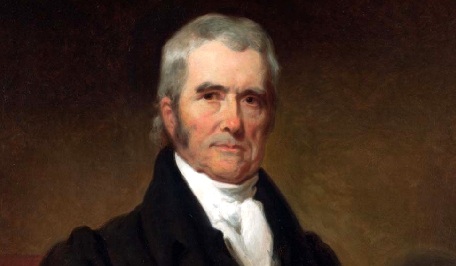 John Marshall was born in September 1755 in Fauquier County, Virginia. His paternal ancestors were typical working-class landowners. Marshall’s father, Thomas Marshall, became a successful surveyor and spent several years in local and state government. On his mother’s side, Marshall was the descendant of the Scottish and English upper classes, connecting him with the wealthy Jeffersons and Randolphs. Unlike his well-to-do relatives, Marshall had a humble upbringing on the Virginia frontier.
In 1775, when news of the battles of Lexington and Concord spread throughout the colonies, Marshall was just 19 years old. At that time he was second in command in the local militia, and was called upon to rally and drill his men. He soon joined the newly established Virginia Minute-Men, becoming first lieutenant of the Fauquier Rifles. Marshall traveled north to join George Washington’s Continental Army in January 1777 where he served during the terrible winter at Valley Forge. Marshall weathered the storm, and by the end of the war he was not only promoted to captain but was selected by George Washington to serve as deputy judge advocate of the Continental Army.
An early career of public service
After concluding his military service, Marshall enrolled in law lectures with George Wythe, a course of study which would shape the mind of the future chief justice. Under Wythe, Marshall read seminal works like Blackstone’s Commentaries on the Laws of England, participated in moot courts, and produced a remarkable 238-page commonplace book filled with all he had learned as a student. After completing his studies, Marshall successfully ran for a seat in the Virginia House of Delegates in 1782. Marshall would resign from his government post in 1785 to focus on his law practice, but he rejoined the House in 1787 due, in part, to his concern about the state of the nation in the aftermath of Shays’ Rebellion, a violent protest against high taxes and oppressive debt collection that highlighted the weakness of the Articles of Confederation.
Marshall was reelected to Virginia’s House of Delegates in 1787 which allowed him to join the fight in Virginia over ratification of the Constitution in March 1788. While the major debates played out between James Madison, Patrick Henry, and Edmond Pendleton, Marshall’s speeches offered succinct articulations of core Federalist arguments such as the importance of the states’ banding together for mutual security. In perhaps his most important speech, Marshall defended the federal judiciary. “If [Congress] were to make a law not warranted by any of the powers enumerated,” argued Marshall, “it would be considered by the Judges as an infringement of the Constitution which they are to guard. . . . They would declare it void.” This statement, which foreshadows Marshall’s greatest decision as chief justice, emphasized his belief that federal courts exist to safeguard the Constitution. After much debate, the final vote was 89 to 79 in favor of ratification.
Following Virginia's ratification of the Constitution, Marshall focused on his law practice in Richmond, even turning down appointments to be U.S. attorney of Virginia and Attorney General. Marshall did eventually agree to join a special delegation to Paris in 1797 in an attempt to negotiate a new treaty. The French ambassadors, labeled X, Y, and Z by their American counterparts, demanded a bribe. The Americans refused to pay, but the situation became a public scandal, known as the XYZ Affair, which increased hostilities with France. After returning to America, Marshall briefly served in the Sixth Congress before accepting an appointment as Secretary of State to John Adams in May 1800.
Marshall on the Supreme Court
In January 1801, President John Adams signed the commission making John Marshall the fourth Chief Justice of the United States. The Supreme Court on which Marshall found himself was not yet a coequal constitutional actor. His first acts subtly strengthened the Court as an institution and his preeminent place within it. Beginning in 1801, whenever the Court convened, Marshall saw to it that they all stayed in the same place, a decision which led to greater unanimity and camaraderie among the justices.
The first major case of his tenure, Talbot v. Seeman, is important not for its facts but for the manner in which the Court chose to express itself: for the first time, the decision was labelled “Opinion of the Court.” Before this case, the Court wrote seriatim opinions, meaning that each justice would write separately and there was no one majority opinion. Chief Justice Marshall ensured that the Court spoke with one voice.
“It is emphatically the province and duty of the judicial department to say what the law is,” wrote Chief Justice Marshall in Marbury v. Madison. The controversy behind the case began when the outgoing President John Adams signed a commission appointing William Marbury to a judicial post. The Jefferson administration refused to deliver Marbury’s commission. Marbury asked the Court to issue a writ of mandamus, essentially an order, to compel the Secretary of State to deliver the commission. In 1803, the Court dismissed the case for lack of jurisdiction and, in so doing, established that the Supreme Court had judicial review over acts of Congress.
While the concept of judicial review was nothing new, and the Court had considered the constitutionality of an act of Congress in Hylton v. United States, the Court never fully articulated or used this power before Marbury.
In this step lies Marshall’s legal genius. Judicial review, argued Marshall, was necessary to maintain the separation of powers. Without this power, the Constitution would give to Congress “a practical and real omnipotence, with the same breath which professes to restrict their powers within narrow limits.” Furthermore, judicial review is incidental to deciding cases “arising under the Constitution.” Could it be possible, asked Marshall, “[t]hat a case arising under the constitution should be decided, without examining the instrument under which it arises?” In the estimation of biographer Jean Edward Smith, Marshall’s opinion in Marbury remains “one of the greatest constitutional documents in American history.” The Chief Justice’s incisive logic, which made judicial review seem both obvious and necessary, has withstood the test of time.
Alongside Marbury, McCulloch v. Maryland is undoubtedly one of the most important (and quoted) decisions of the Marshall era. In 1818, Maryland imposed a tax on bank notes aimed at the Bank of the United States, a financial institution chartered by Congress to handle the federal government’s finances. The case raised the question of whether Congress had the power to establish the Bank.
In finding that Congress had the requisite authority, Marshall set down timeless principles that influence our government even today. He wrote that when one looks at the words of the Constitution, express terms such as “bank” or “corporation” do not exist, but instead powers “to lay and collect taxes,” “to borrow money,” “to regulate commerce” are present. To enumerate these powers, Marshall concluded, implies the means to carry them out, lest the Constitution is merely “a splendid bauble” devoid of effect. This doctrine, often called “implied powers,” has paved the way for numerous modern constructions of national power. In the estimation of biographer Kent Newmyer, McCulloch is “possibly the most far-reaching decision ever handed down by the Supreme Court.”
In David Currie’s searching study of constitutional law, he found that, in the 35 years John Marshall served on the Court, there was “but one constitutional case in which the Chief Justice recorded a dissent” and “only a handful in which he did not deliver the Court’s opinion.” For over three decades the Court was led by one man, almost always speaking in his voice and following his vision.
Chief Justice Marshall died in January 1835. It is said that the Liberty Bell, while ringing out in his honor, cracked. While this story is likely apocryphal, it gives a measure of the significance of Marshall’s death. Justice Joseph Story wrote a touching discourse on his life: “He was one of those, to whom centuries alone give birth; standing out, like beacon lights on the loftiest eminences, to guide, admonish, and instruct future generations, as well as the present.”
Tristan Worsham is a National Constitution Center content fellow and a graduate of the University of California, Berkeley.
References:
David Currie, The Constitution at the Supreme Court: The First Hundred Years, 1789-1888 (1985)
Charles F. Hobson, “Defining the Office: John Marshall as Chief Justice,” 154 Pennsylvania Law Review (2006)
Michael J. Klarman, “How Great Were the “Great” Marshall Court Decisions?,” 87 Virginia Law Review (2001)
John Marshall, The Life of George Washington (1804)
Jean Edward Smith, John Marshall: Definer of a Nation (1996)