

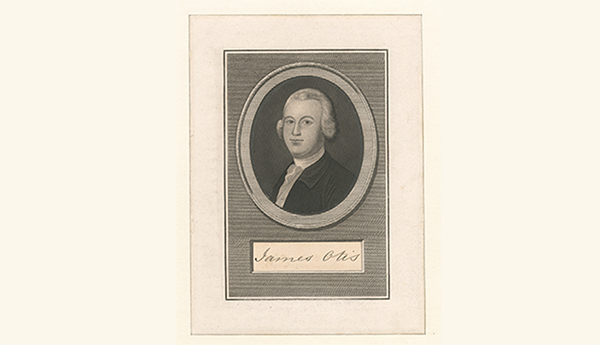
James Otis Jr. was not among the men who signed the Declaration of Independence, and he had largely vanished from public life by the time the Revolution arrived. But for more than a decade before the first shots were fired at Lexington and Concord, he was perhaps the most prominent voice for colonial rights in British North America.
 Otis spent the decade before the war making the case in courtrooms and newspapers that Parliament had no right to tax the colonies, since colonists could not elect their own representatives to it.
The Otis family had lived in the Province of Massachusetts Bay for five generations when James Otis Jr. was born in West Barnstable on Feb. 5, 1725. He was the second of 13 children born to his father, James Otis, and his mother, Mary Allyne, and the first to survive infancy. His sister Mercy, the poet and playwright, and his brothers Joseph and Samuel would play an important part in the coming revolution.
The Otis family regarded itself as quiet but important characters in the great drama of early American history. According to an 1848 family history, they may have lacked “a line of illustrious names,” but they “partook in the perils of founding and defending this country, in times when courage, constancy, and patience were indeed common virtues.” By the time his namesake was born, James Otis Sr. was serving in the Massachusetts House of Representatives for Barnstable and managing a successful law practice. He took care that Otis Jr. met the Latin, Greek and mathematics requirements for admission to Harvard College, though a 19th-century historian, Alice Brown, later described the boy as “brilliant, erratic, no less a genius in capacity than in temperament. A creature of mental impulse, he nevertheless carried the ballast of reverence for exact study.”
Otis Jr. graduated from Harvard in 1743 and studied law in Boston under fellow Harvard alumnus Jeremiah Gridley. A local lawyer remarked that he “had never known a student in law so punctual, so steady, so constant and persevering” as Otis Jr., praise which John Adams, another of Gridley’s students, would later echo. He was admitted to the bar in 1748 and moved his law practice from Plymouth to Boston in 1750.
Otis Jr. established his reputation in the wider community when, in February 1761, he delivered a four-hour speech at Boston’s Old State House condemning British trade policy. The scene was exceptionally dramatic: his rivalry with the presiding judge Thomas Hutchinson was well known, and he was pitted against his mentor, Gridley, who defended Britain’s arbitrary use of general search warrants (known as “writs of assistance”) against the colonists.
Otis Jr. was still a young man at the time; a witness described him as a “plump, round-faced, smooth-skinned, short-necked, eagle-eyed politician” when he rose to the lectern that day. But his arguments against arbitrary power would reverberate through the colonies, showing that Americans might protest not only higher taxes but also the entire structure of British imperial power. He declared that writs of assistance arising from “the privilege of the House” were null and void even if Parliament had authorized them because they violated the natural right that all citizens possess. “It appears to me the worst instrument of arbitrary power, the most destructive of English liberty and the fundamental principles of law, that ever was found in an English law-book,” he told the crowd.
According to Adams, Otis was “a flame of fire” that day. “American Independence was then and there born,” he wrote. “Every man of an immense crowded audience appeared to me to go away, as I did, ready to take up arms against Writs of Assistance.”
Otis Jr. was elected to the provincial legislature of Massachusetts in May 1761. The following spring, he published "A Vindication of the Conduct of the House of Representatives of the Province of Massachusetts Bay," a pamphlet that defended legislators against the governor’s accusations that they had improperly refused to fund a British military expedition. Echoing his speech in Boston, Otis Jr. argued that the power to tax belonged exclusively to the elected representatives of the people, a right that was no less available to colonists than to Englishmen born in Britain. “It would be of little consequence to the people whether they were subject to George or Louis, the king of Great Britain or the French king,” Otis Jr. wrote, “if both were as arbitrary as both would be if both could levy taxes without parliament.”
Once a “brilliant, erratic” boy seeking admission to Harvard, Otis Jr. was by this time one of the most prominent voices for colonial rights in North America. When the Stamp Act Congress convened in New York City in October 1765, uniting delegates from nine colonies to respond to newly imposed taxes by Parliament, Adams described Otis Jr. as the “soul” of the body. In its crowning document, the Declaration of Rights and Grievances, the Congress proclaimed that colonists possessed all the rights of Englishmen and that “no taxes ever have been, or can be constitutionally imposed on them, but by their respective legislatures.” Though the phrase “no taxation without representation” had been circulating in the colonies for some time, Otis had done as much as any single figure to bolster its intellectual and legal foundations.
“His influence at home in controlling and directing the movement of events which led to the War of Independence was universally felt and acknowledged,” according to the Encyclopaedia Britannica, “and abroad no American was so frequently quoted, denounced, or applauded in parliament and the English press before 1769 as the recognized head and chief of the rebellious spirit of the New England colonists.”
The year 1769 marked the end of Otis Jr.’s celebrated presence in public life. After a violent altercation with a tax collector left a gash on his head, peers observed that Otis Jr., who had perhaps already been suffering from mental illness, now “ramble[d] and wander[ed] like a ship without a helm.” His decline left him largely unfit to continue his law practice.
In 1771, he left Boston to live in the Massachusetts countryside with friends and family. He had already burned most of his private papers when he died on May 23, 1783, struck by lightning while he watched a thunderstorm from a friend’s doorway in Andover. His body lies today near Paul Revere, Samuel Adams, and John Hancock in the Granary Burying Ground in Boston.
Anna Salvatore is a Content Fellow at the National Constitution Center and a graduate of Princeton University.
Resources
John Adams to Hezekiah Niles, 14 January 1818, in Niles’ Weekly Register, vol. 13, H. Niles, ed. (Baltimore: Franklin Press, 1817), 361-363.
"John Adams’s Reconstruction of Otis’s Speech in the Writs of Assistance Case," in The Collected Political Writings of James Otis, ed. Richard A. Samuelson (Indianapolis: Liberty Fund, 2015), 11–4. http://oll.libertyfund.org/titles/2703
Alice Brown, Mercy Otis Warren (New York: Charles Scribner’s Sons, 1896), 25.
Horatio N. Otis, “Genealogical and Historical Memoir of the Otis Family,” New England Historical and Genealogical Register, vol. 2 (1848), 281.
Clifford K. Shipton, “James Otis,” in Sibley’s Harvard Graduates, vol. XI, 1741-1745 (Boston: Massachusetts Historical Society, 1960), 247-48